IEA, IMF, World Bank Form Joint Crisis Group as Middle East Conflict Triggers Global Energy Shock
Group to confront the cascading economic and energy disruptions

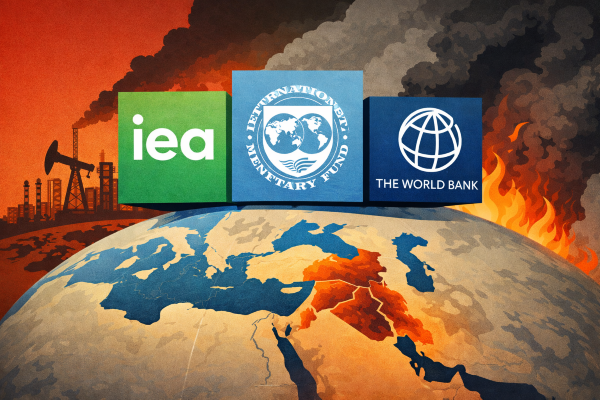 In a rare display of coordinated global intervention, the International Energy Agency, International Monetary Fund, and World Bank Group have formed a joint crisis coordination group to confront the cascading economic and energy disruptions triggered by the escalating Middle East conflict.
The move signals growing concern within the world’s most influential economic institutions that the crisis is fast evolving from a regional conflict into a systemic global shock—with implications for inflation, energy security, and macroeconomic stability.

A Crisis That Is Global—and Unequal
According to a joint statement by the three institutions, the unfolding conflict has already produced one of the most severe supply disruptions in modern energy market history.
But its impact is far from evenly distributed.
Energy-importing economies—particularly low-income and emerging markets—are bearing the heaviest burden. Rising prices of oil, gas, and fertilisers are feeding directly into food inflation, compounding existing vulnerabilities across fragile economies.
The shock is not limited to energy alone. Key industrial inputs—helium, phosphate, aluminium—have also been caught in the disruption cycle, while aviation and tourism have suffered from airspace instability around major Gulf transit corridors.
The result is a familiar but dangerous macroeconomic cocktail:
- Rising inflation
- Currency pressures in emerging markets
- Supply chain bottlenecks
- Slowing global growth
From Fragmented Response to Coordinated Action
Historically, global crises have often been met with fragmented institutional responses. This time, however, the strategy is different.
The newly formed coordination group will act as a central intelligence and response hub, aligning analysis, data, and policy recommendations across energy and financial systems.
Its mandate includes:
- Real-time monitoring of energy prices and supply dynamics
- Tracking trade flows and commodity disruptions
- Assessing fiscal and balance-of-payments pressures
- Evaluating inflation trajectories and policy risks
Beyond diagnostics, the group is expected to deploy a multi-layered response framework, including:
- Targeted policy guidance for affected governments
- Financial support mechanisms, including concessional funding
- Risk mitigation tools to stabilise vulnerable economies
Crucially, the initiative also aims to mobilise a wider coalition of multilateral and bilateral partners—suggesting a broader, coordinated global intervention architecture.
Energy Shock Meets Financial Fragility
The timing of this intervention is significant.
The global economy is already navigating a fragile recovery, marked by tightening monetary conditions, elevated debt levels, and geopolitical uncertainty. The Middle East crisis threatens to amplify these pressures.
For central banks, the dilemma is acute:
Should they tighten policy further to contain inflation—or ease to support growth?
For governments, particularly in developing economies, the challenge is even sharper:
How to absorb rising import costs without triggering fiscal instability or social unrest.
The coordination group’s role, therefore, extends beyond crisis management—it is about preventing systemic contagion.
A New Template for Crisis Governance?
This joint initiative may also represent a broader evolution in global economic governance.
By integrating energy intelligence (IEA) with financial firepower (IMF) and development financing (World Bank), the group creates a multi-dimensional response mechanism—one capable of addressing both immediate shocks and longer-term structural impacts.
In an era where crises are increasingly interconnected—energy, finance, geopolitics, climate—such coordination may become not the exception, but the norm.
BRANDECONOMY Insight
The formation of this joint group is not merely reactive—it is strategically anticipatory.
Three critical implications emerge:
1. Energy Is Once Again the Central Economic Variable
The crisis reinforces a long-standing truth: energy markets remain the primary transmission channel for global economic shocks. Any sustained disruption will reverberate through inflation, trade balances, and industrial output.
2. Emerging Markets Face a Double Squeeze
Rising import costs and currency pressures are colliding with already constrained fiscal space. Without coordinated intervention, many economies risk sliding into a cycle of debt stress and stagflation.
3. Multilateralism Is Being Recalibrated
This initiative signals a shift from siloed institutional responses to integrated crisis management frameworks. The future of global economic stability may depend on how effectively such alliances can act—quickly, coherently, and at scale.
For Nigeria and similar economies, the implications are immediate:
- Increased import costs for energy and fertilisers
- Rising food prices and inflationary pressures
- Greater urgency for energy self-sufficiency and policy discipline
The strategic lesson is clear:
In a world of recurring shocks, resilience—not growth alone—will define economic strength.