Nigeria’s electricity crisis is no longer only about megawatts, transformers, or tariffs. It is increasingly about rights, accountability, and the rule of law—and the recent enforcement action against Ikeja Electric Distribution Company (IKEDC) marks a defining moment in that shift.
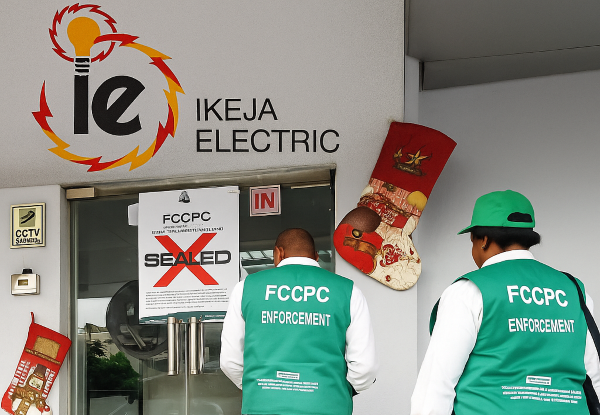
When the Federal Competition and Consumer Protection Commission (FCCPC) sealed Ikeja Electric’s headquarters in Alausa, Lagos, it was not an impulsive regulatory ambush. It was the culmination of months of failed compliance, ignored directives, and a consumer left without electricity for over two and a half years, despite meeting every financial obligation imposed by the utility.




This case has become a test of Nigeria’s evolving consumer-protection regime in a sector long criticised for weak enforcement and asymmetrical power between service providers and customers.
From Power Supply Failure to Rights Violation
At the heart of the dispute is a binding regulatory directive issued by the Nigerian Electricity Regulatory Commission (NERC). Ikeja Electric was instructed to unbundle a single Maximum Demand (MD) account into 20 separate non-MD accounts, covering nineteen residential units and one service point owned by a complainant.
The directive also required the proper metering and reconnection of each unit.
That order was never implemented.
The result was stark:
- Nineteen completed residential units sat idle
- No electricity supply for over 30 months
- Economic loss for the customer
- A clear breach of service obligations under Nigeria’s power-sector rules
For FCCPC, this crossed the line from operational inefficiency into consumer rights abuse.
Why FCCPC Took the Extraordinary Step of Sealing the Premises
Regulatory sealing is not a routine sanction. Under the Federal Competition and Consumer Protection Act (FCCPA) 2018, it is a last-resort enforcement tool, activated only after sustained non-compliance.
In this case, the FCCPC:
- Engaged Ikeja Electric over several months
- Issued a detailed compliance directive in April 2025
- Followed up with a formal Compliance Notice in October 2025
- Granted a seven-day ultimatum for action
None was honoured.
Backed by Sections 17, 18, 124, 150 and 155 of the FCCPA, the Commission moved to seal the company’s premises—signalling that consumer protection laws are no longer symbolic.
This was enforcement, not negotiation.
Ikeja Electric’s Response: Cooperation Under Pressure
Following the sealing, Ikeja Electric publicly stated that it is engaging regulators and affected stakeholders to resolve the dispute over abuse of Consumer Rights. The company has appealed for the premises to be unsealed while it implements the outstanding directives.
While such engagement is welcome, the episode underscores a broader reality: regulatory compliance cannot be optional, especially in essential-service sectors where consumers have limited alternatives.
What This Case Means for Nigeria’s Power Sector
This enforcement action carries implications far beyond one distribution company:
- Consumer Rights Are Now Enforceable
Electricity consumers are no longer passive victims of estimated billing, delayed metering, or ignored complaints. - Regulatory Coordination Is Strengthening
FCCPC’s action reinforces NERC’s authority, creating a united regulatory front. - Utilities Face a New Accountability Threshold
Prolonged non-compliance now carries reputational, operational, and legal risks. - The Energy Transition Is Also a Governance Transition
Power-sector reform is no longer only about infrastructure; it is about fairness, transparency, and lawful conduct.
BRANDECONOMY Insight
For decades, Nigeria’s electricity market operated on an unspoken imbalance: distribution companies held power—consumers bore the cost. This case signals a recalibration.
The sealing of Ikeja Electric is not anti-business. It is pro-market discipline. No energy reform can succeed if service providers ignore rules with impunity while consumers absorb losses silently.
If sustained, this enforcement posture could:
- Restore trust in the electricity market
- Encourage faster metering and service compliance
- Reduce systemic abuse masked as “operational challenges”
In a sector central to productivity, investment, and national competitiveness, rights enforcement may prove as important as new power generation.