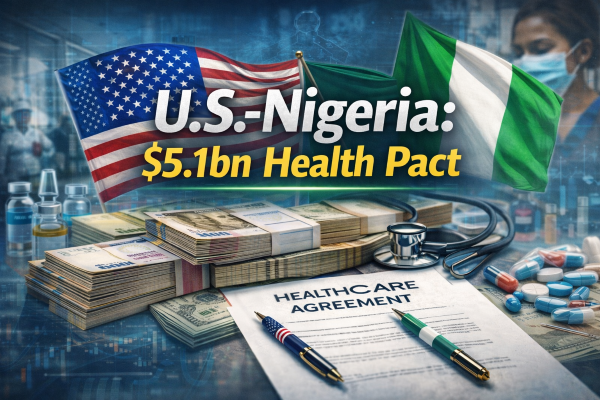
The United States and Nigeria have entered a major new phase of strategic cooperation, signing a $5.1 billion, five-year bilateral healthcare agreement that ranks as the largest co-investment ever recorded under Washington’s evolving global health framework.
The agreement, formalised through a Memorandum of Understanding (MoU) between the United States and the Nigeria, signals a recalibration of development diplomacy—one that blends public health priorities with hard geopolitical and economic interests.




Healthcare as Strategic Diplomacy
The pact is structured to advance the U.S. “America First Global Health Strategy,” a doctrine that reframes foreign health assistance as a tool for mutual security, shared prosperity, and global stability, rather than open-ended aid.
Under the agreement:
- The United States intends to commit $2.1 billion in targeted health-sector support.
- Nigeria will invest $3 billion in new domestic health spending over five years—making it the largest national co-investment under the strategy to date.
From an international relations standpoint, the deal underscores a shift from donor-recipient dynamics toward co-investment partnerships, where accountability and domestic ownership are central.
Faith-Based Healthcare at the Core
One of the most notable components of the MoU is a $200 million U.S. commitment to support more than 900 Christian faith-based healthcare facilities across Nigeria.
These facilities, often embedded in hard-to-reach and underserved communities, play an outsized role in Nigeria’s healthcare delivery system:
- They represent roughly 10% of healthcare providers nationwide.
- Yet they serve over 30% of Nigeria’s estimated 230 million population, particularly in rural and peri-urban areas.
The funding will expand access to integrated HIV, tuberculosis, malaria, and maternal and child health services, reinforcing healthcare delivery where state capacity is often stretched.
Why Nigeria Matters
Nigeria sits at the epicentre of several global health challenges:
- It records one of the highest maternal and child mortality rates worldwide.
- It accounts for approximately 30% of the global malaria burden.
From Washington’s perspective, these are not distant humanitarian statistics—they are global risk indicators. Unchecked public health crises in populous countries like Nigeria carry implications for migration, economic disruption, pandemic risk, and regional instability.
As the agreement itself frames it, strengthening Nigeria’s healthcare system is positioned as a measure that “protects Nigerian and American lives” alike.
Beyond Aid: A Co-Investment Model
Unlike traditional assistance programmes, the MoU places heavy emphasis on domestic financial commitment, policy alignment, and system strengthening.
Nigeria’s $3 billion pledge represents a strategic signal:
- Acknowledgement that health security is foundational to economic growth.
- Alignment with global best practices on shared responsibility.
- A move away from dependency toward sustainable health financing.
For global development watchers, this marks a critical evolution: healthcare as economic infrastructure, not charity.
A New Context for U.S. Global Health Policy
The agreement comes against the backdrop of a significant shift in U.S. foreign assistance architecture, following the recent termination of the USAID global aid programme by the administration of Donald Trump.
In this context, the Nigeria deal illustrates how U.S. engagement is being streamlined into fewer, larger, and more strategic partnerships, anchored in national interest, measurable outcomes, and co-financing.
However, the MoU includes a clear caveat:
As with all U.S. foreign assistance, the President and Secretary of State retain the authority to pause or terminate programmes that no longer align with U.S. national interests.
BRANDECONOMY Insight
This $5.1bn pact is more than a health agreement—it is geopolitics by prescription.
For Nigeria, it represents validation of its strategic importance and a rare opportunity to convert external partnership into lasting system reform. For the United States, it is a calculated investment in stability, influence, and global health security anchored in Africa’s most consequential economy.
The true test will lie in execution: translating funding commitments into measurable reductions in mortality, stronger institutions, and durable healthcare delivery models.
If successfully implemented, this agreement could become a template for future U.S.–Africa partnerships—where health, economics, and diplomacy converge.