Trump Brokers Historic DR Congo–Rwanda Peace Accord: What This Means for Africa, Global Supply Chains & U.S. Power


WASHINGTON REASSERTS ITS GLOBAL POWER
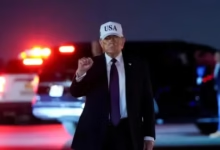
In a dramatic display of diplomatic muscle, President Donald J. Trump has brokered a peace agreement between the Democratic Republic of Congo (DRC) and Rwanda — one of Africa’s most protracted, mineral-driven conflicts.
Signed in Washington at the newly renamed Donald J. Trump Institute of Peace, the deal signals not just a reconciliation attempt between Kinshasa and Kigali, but a bold U.S. realignment of strategic interests in Africa’s mineral heartland.
For a region fractured by nearly 30 years of war, the peace pact — and Washington’s unmistakable fingerprints on it — represents a seismic geopolitical shift.
THE DEAL: TRUMP STEPS IN WHERE THE WORLD FAILED
The new accord builds on a preliminary framework negotiated earlier but stalled amid renewed violence by the Rwanda-backed M23 rebel movement, which captured Goma and Bukavu earlier this year.
Despite the long-standing paralysis of regional peace efforts by the African Union and East African Community, Trump succeeded in forcing a breakthrough.
He was characteristically blunt:
“We are succeeding where so many others failed. It’s a great day for Africa, a great day for the world.” — President Donald J. Trump
As part of the package, Trump announced new U.S. bilateral agreements on rare-earth mineral development, opening the door for major American corporations to enter territories traditionally dominated by China.
“Everybody’s going to make a lot of money,” Trump declared.
WHAT THE PEACE DEAL MEANS FOR AFRICA — AND THE WORLD
1. A Critical Minerals Power Play
Eastern Congo contains:
- 60% of global cobalt reserves
- massive lithium, coltan and nickel deposits
- the world’s largest untapped rare-earth basin
For Washington, securing access is a strategic victory.
For China — which currently controls 90% of global rare-earth processing — it is a challenge to its dominance.
Trump’s move places the U.S. at the center of the global electric-vehicle, battery, semiconductor and defence-technology supply chain.
2. Kagame & Tshisekedi: Peace, but Without Trust
Both leaders praised Trump publicly, though they barely made eye contact and never shook hands.
- Kagame: “No one asked President Trump to do this… but he took it up.”
- Tshisekedi: “This is the beginning of a difficult path toward real peace.”
Yet eastern Congo remains volatile.
Even during the signing, clashes continued around Goma, Rutshuru and South Kivu, with M23 expanding territory.
Local residents remained skeptical:
“We are still at war… peace cannot come if front lines remain active.” — Amani Edith, Goma resident
THE TRUMP DOCTRINE IN AFRICA: POWER, DEALS & MINERALS
Trump’s approach is unapologetically transactional: peace in exchange for access.
Unlike previous administrations that emphasized multilateralism, Trump’s Africa strategy is:
- America first, minerals first
- direct bilateral leverage
- zero ambiguity on economic extraction rights
- military deterrence paired with investment carrots
And the pressure was real.
Trump warned:
“If these killings continue, the USA may go in guns-a-blazing to wipe out the terrorists.”
Such rhetoric marks one of the boldest direct interventions in African peace diplomacy by any U.S. President in decades.
REGIONAL PEACE STILL UNCERTAIN
Despite the pomp in Washington, analysts caution:
The real determinant of peace is the Doha talks, where the U.S. is pushing for:
- a ceasefire between Congo’s army and M23
- withdrawal of foreign fighters
- re-integration or dispersal of rebel units
- a roadmap for political governance in seized territories
Without this, the Washington pact is symbolic — powerful, but incomplete.
WHY THE CONFLICT PERSISTS: A QUICK HISTORY
The roots lie in the 1994 Rwandan genocide, which pushed nearly 2 million Hutu refugees — including génocidaires — into Congo.
Subsequent Rwandan interventions, Congolese militia formation, and a scramble for minerals turned eastern Congo into one of the world’s deadliest conflict zones.
Today:
- 100+ armed groups operate in the region
- 6+ million people displaced
- M23 controls strategic cities
- Rwanda and Congo accuse each other of aggression
- U.N. experts say 3,000–4,000 Rwandan troops support M23 (Kigali denies this)
WHAT COMES NEXT: THREE POSSIBLE FUTURES
1. Peace Holds — U.S. Companies Move In
If ceasefire lines stabilize, the U.S. becomes a dominant player in Africa’s mineral supply chain.
2. Fighting Continues — Trump Deploys Force
Trump has hinted at possible direct U.S. intervention if Christian communities or American investments are threatened.
3. China Responds — Great-Power Showdown
With Beijing entrenched in Congolese mining, the Trump deal may trigger a global resource-power contest.
BRANDECONOMY VERDICT
The Trump-brokered pact is historic but fragile — bold in ambition, uncertain in execution.
Yet one thing is undeniable:
Africa’s minerals are now at the center of a new global political economy — and Washington is no longer watching from the sidelines.