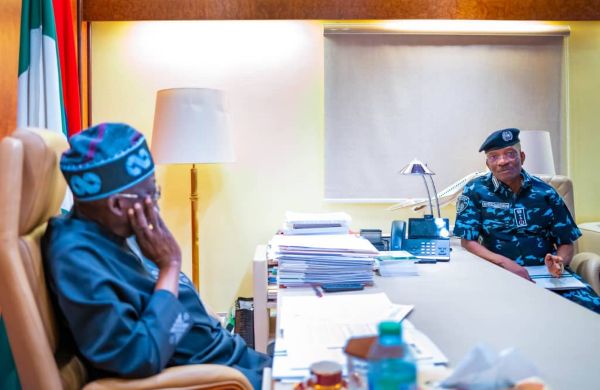
Nigeria is facing one of its darkest security moments in recent years — and President Bola Ahmed Tinubu has now taken one of the boldest policing decisions in decades.
In a sweeping directive that jolted the nation’s power circles, Tinubu has ordered the immediate withdrawal of police escorts from VIPs nationwide, rerouting thousands of armed officers back to frontline policing, community protection and rapid-response operations.




The order, issued after an emergency meeting with service chiefs, the Inspector-General of Police and the DSS Director-General, marks a dramatic recalibration of national security strategy at a time when terrorists, bandits and violent extremists are executing bolder, deadlier and more coordinated attacks than ever.
A Nation Under Fire: Terror Scale Now Beyond “Crisis”
In the last few weeks alone, Nigeria has been brutally reminded of the scale of its insecurity problem:
- Zamfara and Katsina villages burned, dozens abducted, families wiped out.
- Kaduna hit by back-to-back terror raids, leaving scores dead and entire communities displaced.
- Benue, Kebbi, Plateau and Niger have become hunting grounds for night-time abductions, mass killings and indiscriminate violence.
- Major highways — including Abuja–Kaduna, Birnin Gwari, and Sokoto–Illela — have recorded renewed ambushes, robberies and coordinated terror strikes.
Security insiders say the root of the vulnerability is clear:
Nearly 40% of Nigeria’s police workforce has been serving private VIPs rather than protecting citizens.
The president, according to senior officials, concluded that this imbalance has become “dangerous, irresponsible and unsustainable.”
UN Slams School Abductions as Nigeria’s Security Unravels
The United Nations has also stepped in with a rare rebuke.
After 303 pupils and 12 teachers were abducted from St. Mary’s Catholic Schools in Niger State — just days after another mass school kidnapping in Kebbi — UN spokesperson Stéphane Dujarric described the situation as “heartbreaking and unacceptable.”
Schools are no longer safe zones; entire communities are now trauma zones.
The UN called for:
- Immediate rescue operations
- Reinforced safety measures
- Full enforcement of the Safe Schools Declaration
- Stronger collaboration with humanitarian agencies
For the global community, Nigeria’s security flame-out is becoming too loud to ignore.
The New Policing Order: What Happens Now
According to Presidential spokesperson Bayo Onanuga, Tinubu’s directive includes:
1. Total withdrawal of police escorts from VIPs
Officers must return to core duties — surveillance, patrols, investigations and rapid response.
2. VIPs must now rely on NSCDC for protection
The Civil Defence Corps will provide armed escorts for those who qualify.
3. Recruitment of 30,000 new police officers approved
One of the largest expansions in Nigeria’s policing history.
4. States will co-fund police training modernization
New tactical units, better logistics, and stronger training modules.
This redeployment targets areas that have been practically abandoned:
- Remote farming settlements
- Terrorism-prone corridors
- Strategic border communities
- Critical economic zones
- Vulnerable transit routes
BRANDECONOMY Insight: A Disruption Nigeria Desperately Needed
For decades, Nigeria’s policing structure has been upside-down — police escorts protecting the rich instead of protecting the republic.
Tinubu’s directive forces a hard reset.
If executed with discipline and transparency, this pivot could:
✔ Restore police visibility in forgotten towns
✔ Boost intelligence from terror-prone communities
✔ Disrupt roaming bandit and terror networks
✔ Strengthen immediate response to attacks
✔ Rebuild public confidence in security agencies
But to succeed, Nigeria must go beyond symbolism:
- Officers must be properly equipped.
- Rural stations must be modernised.
- Community policing must be revived.
- Morale and welfare must improve.
- State governments must stop playing politics with security.
Nigeria is at war with non-state actors capable of mass casualty violence.
This directive signals a tougher, more realistic security doctrine — but its impact will depend entirely on execution.
The stakes have never been higher.