Unlocking Nigeria’s Growth Engine: Tinubu Urges States to Leverage Their Comparative Advantage

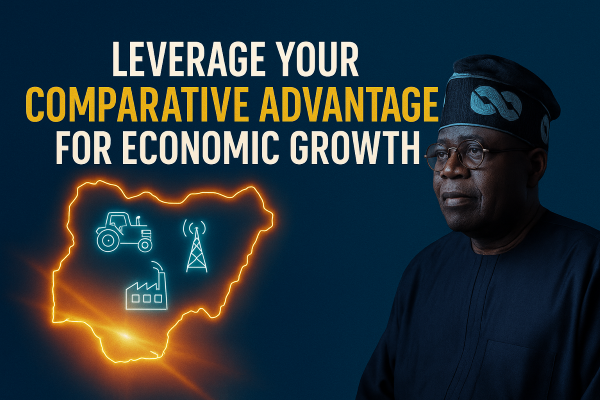
President Bola Tinubu pushes state-driven economic strategy as Imo positions for a $1bn transformation
Nigeria’s economic future—long constrained by structural bottlenecks, policy inconsistency, and overcentralised development—may be entering a new phase of decentralised dynamism.
At the Imo Economic Summit 2025, President Bola Ahmed Tinubu, represented by Vice President Kashim Shettima, delivered a message that could reshape the country’s economic architecture:



“There is no greater accelerator of national growth than steering each state towards its comparative advantage.”
This is more than rhetoric. It is a strategic shift toward a state-by-state economic model, mirroring successful federal systems such as the U.S., India, and Brazil—where subnational competitiveness powers national prosperity.
Nigeria’s 36 states are not economically identical, and Tinubu’s message was clear:
Prosperity will come from differentiation, not uniformity.
A New State-Led Economic Playbook
The Federal Government’s sweeping economic reforms—from FX harmonisation to subsidy removal—are designed to unlock private investment and give states the tools to build sustainable, high-growth economies.
Tinubu identified four catalytic growth arenas where Imo and other states can leap ahead:
1. Digital Infrastructure
Digital capacity is the backbone of the 21st-century economy. States that embrace broadband investment, tech talent pipelines, AI adoption, and digital public services will capture the industries of the future.
2. Special Agro-Processing Zones (SAPZs)
Agriculture remains Nigeria’s greatest untapped export frontier. With SAPZs, states can convert raw produce into high-value exports, boost foreign exchange, and create industrial clusters across food and agro-tech.
3. Free Trade Zones & Logistics Corridors
Positioning states as manufacturing and distribution hubs—especially those with strategic access to ports, gas pipelines, or cross-border routes—can unlock multi-billion-dollar investments.
4. Expanded Gas Utilisation
Gas is Nigeria’s best immediate tool for powering homes, industries, and innovation. As Tinubu noted, affordable and reliable gas-to-power is the bridge to industrial stability.
“IMO” as Investment Meets Opportunity
Governor Hope Uzodimma framed Imo State’s emerging economic identity succinctly:
“IMO means Investment Meets Opportunities.”
Backed by Tinubu’s reform momentum, Uzodimma highlighted policy steps that have improved the state’s investment climate:
- Security and strategic infrastructure
- Reliable power and the imminent Light-Up Imo electricity project
- Digital talent development
- Transparent land administration
- Road networks enabling free movement of goods and services
Uzodimma’s target—a $1bn state economy—aligns with the Federal Government’s national revival agenda.
With West Africa’s largest natural gas reserve, Imo stands on a unique competitive pedestal within the energy, manufacturing, and technology value chains.
Global Voices Align with Nigeria’s Industrial Ambition
The summit featured heavyweight global economic thinkers whose presence signalled Nigeria’s rising strategic relevance.
Boris Johnson, Former UK Prime Minister
Johnson described Nigeria as:
“An investment hub of the future,”
citing demographic strength, shared historical ties with the UK, and growing investor appetite for frontier markets.
Ban Ki-moon, Former UN Secretary-General
Ban Ki-moon emphasised global climate financing and the need for technological support to help African states mitigate climate-induced risks.
He challenged Nigeria—and Africa—to:
- Strengthen implementation of the Sustainable Development Goals
- Expand opportunities for women
- Build durable global partnerships for prosperity
His remarks tied Nigeria’s development to broader global climate action and economic inclusion agendas.
Why Comparative Advantage is Nigeria’s Missing Link
Economists have long argued that Nigeria’s centralised development model underutilises its diversity. Each region possesses unique natural endowments, labour patterns, and cultural strengths.
Tinubu’s strategy implicitly responds to this divide:
Northern States: cereals, livestock, cotton, renewable energy
South-South: hydrocarbons, petrochemicals, logistics
South-East: manufacturing, gas, technology, commerce
South-West: finance, services, tech ecosystems, deep ports
North-Central: minerals, agro-processing, energy corridors
A state-driven development model—properly coordinated—could unlock trillions of naira in dormant value.
A New Era of Competitive Federalism?
Tinubu’s message signals the beginning of a future where states:
- Compete for investment
- Build export-driven industries
- Leverage local strengths
- Develop distinct economic identities
If sustained, this shift could lift Nigeria out of boom-and-bust cycles and build an economy driven not by oil but by productivity.
And with global leaders calling Nigeria a future investment superpower, states must now rise to match the moment.