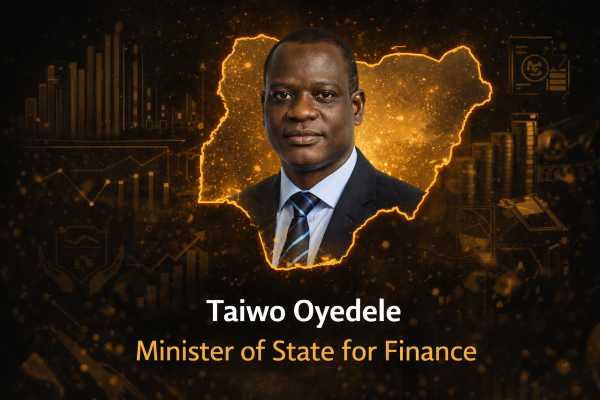
 President Bola Ahmed Tinubu has nominated Taiwo Oyedele as Minister of State for Finance, marking a significant recalibration of Nigeria’s fiscal leadership architecture at a time when revenue mobilisation, tax reform, and macroeconomic consolidation remain central to the administration’s economic agenda.
Dr. Doris Uzoka-Anite, who previously held the role, will transition to the Ministry of Budget and National Planning as Minister of State—her third portfolio in the current administration—underscoring the President’s continued reshuffling of technocratic talent to align with reform priorities.



The nomination has been formally transmitted to the Senate for confirmation.
Why This Appointment Matters Now
Nigeria stands at a pivotal fiscal crossroads. With public debt servicing costs still high, non-oil revenue mobilisation under pressure, and ongoing tax harmonisation reforms reshaping the national revenue architecture, the Ministry of Finance is no longer merely an administrative outpost—it is the strategic nerve centre of economic stabilisation.
Oyedele’s elevation signals the consolidation of tax reform thinking directly within the core fiscal machinery of government.
Until his nomination, Oyedele chaired the Presidential Committee on Fiscal Policy and Tax Reforms—a body tasked with overhauling Nigeria’s tax framework, rationalising multiplicity of levies, and modernising fiscal governance.
His move from reform architect to ministerial implementer suggests that the Tinubu administration intends to transition from policy design to aggressive execution.
From Tax Reform Committee to Treasury Authority
Taiwo Oyedele, 50, brings a rare blend of private-sector tax leadership and public-sector policy design experience.
He spent 22 years at PwC, rising to become Fiscal Policy Partner and Africa Tax Leader. In that role, he engaged extensively with governments and corporates on tax advisory, fiscal strategy, and regulatory reform.
His academic and professional credentials reflect global exposure:
- Higher National Diploma in Accountancy & Finance – Yaba College of Technology
- BSc in Applied Accounting – Oxford Brookes University
- Executive education – London School of Economics, Yale University, Harvard Kennedy School, and the Gordon Institute of Business Science
He is also an Associate Professor at Babcock University and a visiting scholar at Lagos Business School, positioning him as both practitioner and intellectual contributor to Nigeria’s fiscal discourse.
Beyond academia, Taiwo Oyedele has served in strategic economic advisory capacities, including leadership roles within the Nigerian Economic Summit Group (NESG), ICAN’s Taxation & Fiscal Policy Faculty Board, and Nigeria’s National Tax Policy design framework.
The Strategic Implications
1. Tax Reform Implementation Enters Execution Phase
The Presidential Tax Reform Committee proposed measures aimed at:
- Expanding the tax base without overburdening compliant businesses
- Simplifying Nigeria’s fragmented tax ecosystem
- Improving transparency and reducing arbitrage
- Aligning fiscal policy with growth objectives
Moving Oyedele into the Ministry of Finance provides continuity and increases the probability of structured implementation rather than policy stagnation.
2. Revenue Diversification Gains Fresh Momentum
With oil revenues volatile and subsidy-era fiscal distortions still unwinding, Nigeria’s fiscal sustainability depends on deepening non-oil revenue streams.
Oyedele’s background in fiscal governance suggests a technocratic push toward:
- Digitised tax administration
- Improved compliance architecture
- Rationalisation of exemptions
- Debt management integration with revenue reforms
3. Investor Confidence Signal
Markets tend to reward policy coherence. Appointing a reform-focused technocrat with international credibility may improve investor perception, particularly around:
- Fiscal transparency
- Predictability of tax rules
- Institutional continuity
In an environment where FX stability and debt sustainability remain fragile, credibility is currency.
Power Dynamics Within the Economic Team
The Ministry of Finance operates in close coordination with:
- The Central Bank of Nigeria
- The Ministry of Budget and National Planning
- The Federal Inland Revenue Service
- The Debt Management Office
With Uzoka-Anite moving to Budget and Planning, the reshuffle suggests an attempt to align fiscal policy design, budgeting discipline, and tax execution under a more synchronised framework.
If managed effectively, this could reduce policy fragmentation that has historically weakened Nigeria’s macroeconomic coherence.
What to Watch
- Speed of Tax Bill Implementation:
Will proposed reforms be translated into legislative and administrative changes within 12–18 months? - Revenue-to-GDP Ratio:
Nigeria’s revenue-to-GDP remains among the lowest globally. A measurable uptick would validate reform momentum. - Subnational Alignment:
How states respond to harmonisation efforts will determine reform durability. - Private Sector Response:
Business confidence will hinge on whether reforms simplify compliance or create transitional friction.
BRANDECONOMY Insight
Taiwo Oyedele’s nomination is less about political balancing and more about economic execution.
For the first time in decades, a fiscal reform architect is moving directly into ministerial authority without the usual bureaucratic dilution.
If the reform agenda survives political resistance and entrenched interests, Nigeria could witness:
- Improved non-oil revenue efficiency
- Reduced fiscal leakages
- Greater predictability in tax administration
- Enhanced macroeconomic credibility
However, reform success will depend not on policy intelligence—but on institutional courage.
The real test begins after Senate confirmation.