Washington’s Iran Pressure Escalates Into Global Trade Warning
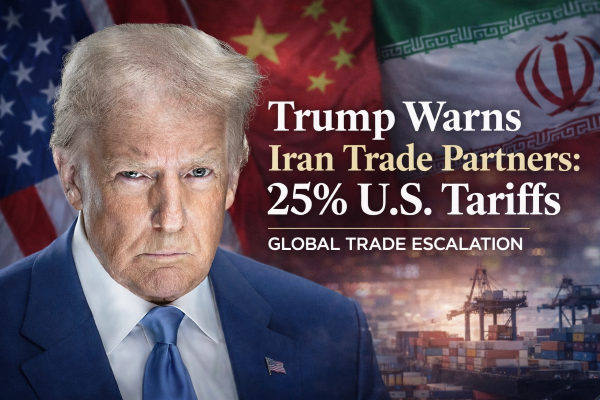
The United States has signalled a sharp escalation in its Iran policy, with Donald Trump warning that any country maintaining commercial ties with Iran will face a sweeping 25 per cent tariff on all trade with the United States.
The declaration, delivered via a post on the Truth Social platform, marks a significant expansion of Washington’s use of tariffs as geopolitical leverage—this time extending the threat beyond Tehran to its global trading partners.



“Effective immediately, any country doing business with the Islamic Republic of Iran will pay a tariff of 25 per cent on any and all business being done with the United States of America,”
— Donald Trump, President of the United States
The statement, described by Trump as “final and conclusive,” offers no accompanying executive order, legal framework, or clarification on enforcement scope—raising questions across diplomatic, legal, and trade policy circles.
A Sanctions Strategy Goes Global
Iran has remained under extensive U.S. sanctions for decades, particularly over its nuclear programme, regional military activities, and human rights record. As a member of OPEC, Iran continues to export crude oil—primarily to China, with Turkey, Iraq, United Arab Emirates, and India also featuring among its key trading partners.
What makes this move different is its extraterritorial ambition: the tariff threat is not limited to Iranian goods, but extends to any commerce conducted by Iran-linked countries with the U.S. economy. In effect, Washington is signalling a willingness to weaponise access to the world’s largest consumer market to enforce compliance.
It is important to note that tariffs are ultimately paid by U.S. importers, a reality that could ripple through American supply chains, pricing structures, and inflation dynamics if enforced broadly.
China Pushes Back, Allies Watch Closely
China reacted swiftly and sharply. The Chinese Embassy in Washington criticised the move as an overreach of unilateral power.
“China’s position against the indiscriminate imposition of tariffs is consistent and clear.
Tariff wars and trade wars have no winners. Coercion and pressure cannot solve problems,”
— Spokesperson, Chinese Embassy in Washington
Beijing signalled it would take “all necessary measures” to protect its interests, underlining the risk that the Iran tariff threat could reopen fault lines in U.S.–China economic relations already strained by technology restrictions and prior trade disputes.
Meanwhile, close U.S. allies Japan and South Korea adopted a more cautious tone. Seoul’s trade ministry said it was monitoring developments and would respond once Washington’s actions became clearer, while Tokyo pledged to examine potential impacts and act “appropriately” as details emerge.
Iran Crisis Adds Volatility to Global Markets
The tariff threat comes against the backdrop of Iran’s most serious domestic unrest in years, following widespread protests that evolved from economic grievances into direct challenges to the country’s clerical leadership.
Iran’s political system has faced sustained pressure since the Islamic Revolution of 1979, but the current demonstrations—triggered by inflation, unemployment, and living costs—have exposed deep structural vulnerabilities. A U.S.-based human rights group, HRANA, estimates that hundreds of protesters and security personnel have been killed since unrest began late last year.
Washington has kept diplomatic channels nominally open. White House officials insist diplomacy remains an option even as pressure mounts.
“Diplomacy is always the first option for the president,”
— Karoline Leavitt, White House Press Secretary
Nonetheless, Trump has also openly referenced contacts with Iranian opposition groups while leaving military action “on the table,” reinforcing uncertainty around U.S. intentions.
Trade Policy as a Weapon—and a Legal Risk
This latest threat reinforces a pattern in Trump’s second term: the aggressive use of tariffs not only as economic tools, but as instruments of foreign policy coercion. Similar tactics have previously targeted nations accused of aligning too closely with U.S. adversaries or pursuing trade policies deemed unfavourable to Washington.
However, Trump’s tariff-heavy approach faces mounting legal scrutiny at home. The U.S. Supreme Court is currently weighing challenges that could strike down broad categories of existing tariffs, potentially limiting executive authority in trade matters.
For global businesses, investors, and policymakers, the Iran tariff warning introduces a new layer of geopolitical risk—where commercial decisions may suddenly carry punitive consequences far beyond their original markets.
What This Means for Global Trade
If enforced, the proposed tariffs could:
- Reshape energy and commodity flows,
- Pressure emerging economies to choose between U.S. and Iranian trade,
- Escalate tensions with China and other major importers of Iranian oil,
- Add volatility to global supply chains already strained by geopolitics.
At its core, the message is clear: access to the U.S. market is being explicitly tied to geopolitical alignment. Whether this hardline stance deters Iran’s partners—or accelerates a reconfiguration of global trade blocs—will define the next phase of international economic diplomacy.