Stabilising Food Prices Without Killing Farm Investment: Why Nigeria Needs a Rules-Based Agricultural Market Framework

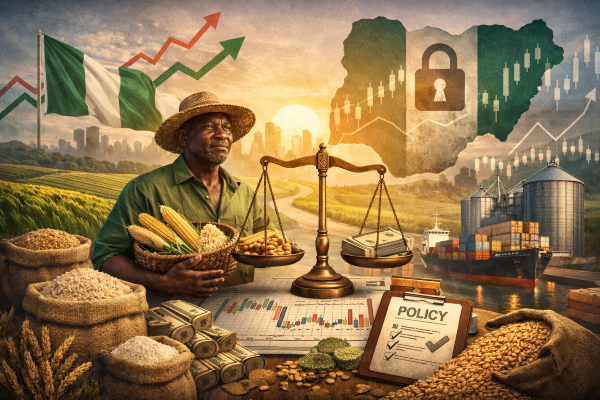
Nigeria’s food economy has reached a critical inflection point. Falling food prices are delivering immediate relief to households under severe cost-of-living pressure, yet the same price corrections are quietly eroding the economic foundations of agriculture—one of the country’s most strategic, employment-intensive sectors. This tension between consumer welfare and producer survival now sits at the heart of Nigeria’s food security challenge.
The call by the Centre for the Promotion of Private Enterprise (CPPE) for a rules-based, market-friendly farm price stabilisation and farmer income protection framework is therefore not a policy footnote; it is a strategic economic imperative.




Why This Matters Now
Agriculture is no longer just a food issue—it is a macroeconomic stabiliser. It influences inflation, rural employment, foreign exchange demand, and investor confidence. When farm prices collapse abruptly, the damage ripples far beyond the farm gate, distorting investment incentives, shrinking production capacity, and ultimately sowing the seeds of future food scarcity and inflation.
Nigeria’s recent food security interventions have achieved short-term consumer gains, but at the cost of destabilising the agricultural value chain, especially Farm Investment. The absence of predictable price-management rules has transformed policy into a blunt instrument—delivering relief today while undermining resilience tomorrow.
The Structural Backdrop: A Fragile Agricultural Market
Nigeria’s agricultural markets remain structurally exposed. Seasonal harvest gluts, inadequate storage infrastructure, weak logistics, and limited agro-processing capacity combine to create sharp price volatility. In such an environment, emergency policy interventions—particularly large-scale import surges—can trigger severe price dislocations.
Staples such as rice, maize, and soybeans have borne the brunt of this imbalance. While import-led price moderation may temporarily ease food inflation, it simultaneously erodes farm incomes, weakens investment confidence, and discourages future production. Over time, this cycle risks locking Nigeria into a pattern of dependency, scarcity, and repeated crisis management.
The Core Tension: Consumers vs Producers Is a False Choice
As Muda Yusuf, Founder of CPPE, has argued, the welfare gains from lower food prices are real and should be acknowledged. However, allowing those gains to be financed by collapsing farmer incomes is economically unsustainable.
Cheap food achieved through market disruption is not a victory—it is a deferred cost. When farmers and investors exit the sector due to persistent losses, production falls, supply tightens, and prices rebound sharply. The eventual outcome is higher inflation, deeper food insecurity, and greater fiscal pressure on government.
The real policy challenge, therefore, is not choosing between consumers and producers, but designing mechanisms that protect both.
What a Rules-Based Price Stabilisation Framework Should Do
A credible farm price stabilisation system must be transparent, predictable, and fiscally sustainable. Crucially, it must support—rather than crowd out—private enterprise participation. Key pillars should include:
- Import Discipline: Clear rules to prevent sudden, large-scale import surges that crash domestic prices and strand local investments.
- Buffer Stock Reform: Modernised, professionally managed reserves that stabilise prices without distorting markets.
- Post-Harvest Infrastructure: Scaled investment in storage, cold chains, logistics, and aggregation to reduce distress sales at harvest time.
- Processing Capacity Expansion: Incentives for agro-processing to absorb surplus output and smooth seasonal price swings.
- Market-Based Risk Tools: Wider access to commodity exchanges, price hedging, insurance products, and tailored agricultural finance.
These tools are not theoretical—they are standard features of resilient agricultural economies globally.
Implications for Business, Policy, and Society
For investors, the absence of price stabilisation mechanisms raises the cost of capital and shortens investment horizons. For policymakers, it increases reliance on ad-hoc interventions that strain public finances. For rural communities, it threatens incomes, employment, and social stability.
Conversely, a rules-based framework would anchor confidence across the value chain—encouraging long-term investment, supporting rural livelihoods, moderating inflation sustainably, and strengthening national food security.
The Way Forward: Collaboration, Not Command-and-Control
Building such a framework cannot be a unilateral government exercise. It requires coordinated action by federal and state authorities, commodity exchanges, development finance institutions, agribusiness investors, and logistics providers. The goal should be to institutionalise predictability—so markets adjust through rules, not shocks.
Nigeria’s agricultural future depends not on emergency fixes, but on systems that balance affordability with viability. Price stability is not about fixing prices; it is about fixing the rules that govern the market.
If Nigeria gets this right, agriculture can once again become a pillar of inclusive growth, macroeconomic stability, and long-term resilience.