Otti Delivers Again as Abia Ends 9-Year Blackout, Returns Power to 33 Ukwa West Communities

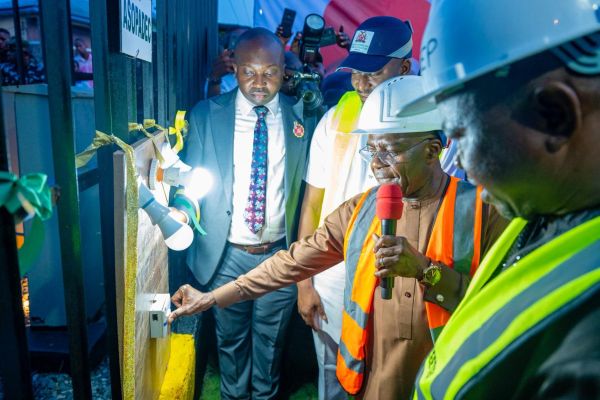
After nearly a decade of darkness, Abia State has flipped the switch on a long-delayed promise—restoring electricity to 33 communities in Ukwa West Local Government Area and unlocking a new chapter of economic possibility for one of the state’s most strategic zones.
At a ceremonial power switch-on in Obehie, Governor Alex Otti framed the moment as both a fulfilment of a March commitment and a defining proof-point of his administration’s results-driven approach to governance.



“From today, you will enjoy 24-hour power supply,” Otti told residents—an assurance anchored not in optimism, but in infrastructure depth and private-sector partnership.
From Darkness to Development
Ukwa West’s blackout had stretched for nine years, stalling livelihoods, shrinking local enterprise, and amplifying poverty in Abia’s only oil-producing LGA—home to thousands of smallholder farmers and micro-businesses. Power restoration here is not merely social relief; it is development economics in action.
Electricity lowers production costs, expands agro-processing, improves household welfare, and restores investor confidence. In short, power is productivity—and Ukwa West is back online.
The Power Behind the Promise
Central to the credibility of the restoration is Bart Nnaji, Chairman of Geometric Power Limited, whose long-term bet on decentralised energy anchors the Aba Integrated Power Project.
Governor Otti disclosed that Nnaji has invested about $800 million to build a resilient, off-grid power ecosystem—describing it as a “necessary sacrifice” to fix Nigeria’s most stubborn growth constraint.
Ukwa West is served by Aba Power Limited, Geometric Power’s distribution arm, which operates outside the national grid—shielding communities from the frequent system collapses that have plagued Nigeria’s power supply.
Substance Over Ceremony
This is not a ceremonial reconnection. According to the Commissioner for Power and Public Utilities, Ikechukwu Monday, the project’s scope includes:
- Rehabilitation of 30 transformer distribution substations
- Installation of 12 new transformers
- Restoration of 34km of high-tension lines
- Rehabilitation of 3.5km of low-tension lines
- Ongoing metering for transparent, efficient billing
To power growth—not just lighting—a 42km dedicated industrial line costing about ₦2 billion is under construction to serve local enterprises.
Protecting the Grid, Protecting the Future
Nnaji cautioned that sustainability depends on community ownership, revealing that the new line has already been vandalised seven times. He urged residents to report suspicious activity and reject energy theft—an appeal that underscores a hard truth: infrastructure without vigilance is fragile.
Affordability With Accountability
Acknowledging tariff sensitivity in a largely agrarian LGA, Governor Otti directed local leaders to design targeted support for households genuinely unable to pay—balancing cost recovery with social protection.
“I am not asking you to do what I have not done. I have already done this in my own community,” he said.
Lawmakers, including Chief Godwin Adiele, echoed calls for tariff relief while urging swift progress on promised commercial road links—power’s natural complement.
A Signal Beyond Ukwa West
For the General Manager of the Abia State Oil Producing Areas Development Commission, Joshua Onyeike, the reconnection is a milestone that restores hope and signals equitable delivery of democracy’s dividends.
For investors and policy watchers, the takeaway is bigger: Abia is executing infrastructure-led growth, pairing political will with private capital and decentralised energy—an increasingly compelling template for sub-national development in Nigeria.
BRANDECONOMY Insight
This is a celebratory headline backed by substance. Ending a nine-year blackout resets Ukwa West’s economic trajectory and reinforces a governing philosophy: promise, partner, deliver.
If protected, paid for, and productively used, this power will do more than light homes—it will power jobs, incomes, and confidence. For Abia, the lights coming on are also a signal to capital: the state is serious about growth.