Why Nigeria’s Banking Recapitalisation Is Entering a More Ambitious Phase
Nigeria’s banking sector is approaching a decisive inflection point — one that could redefine its capacity to finance growth, support a $1 trillion economy ambition, and finally break with an era of undercapitalised financial institutions.
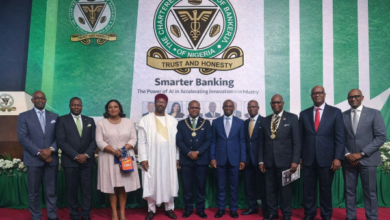
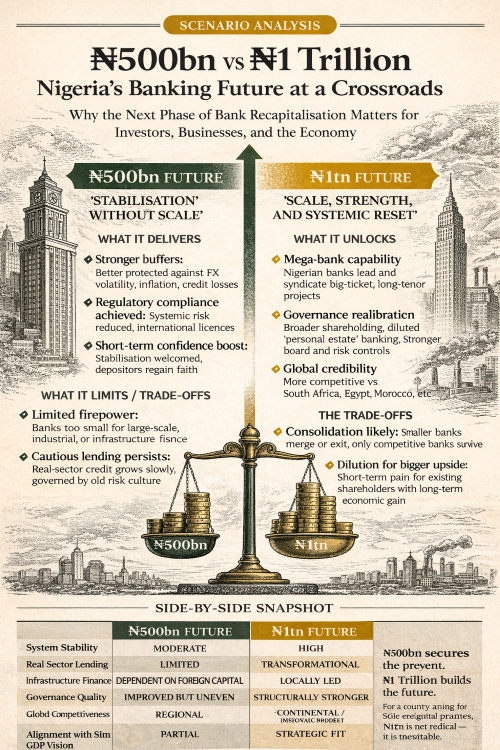
Billionaire investor and Chairman of First HoldCo Plc, Femi Otedola, has thrown his weight behind a far more ambitious banking reform agenda, calling for the minimum capital requirement for international banks to be raised from ₦500 billion to at least ₦1 trillion, even as FirstBank of Nigeria successfully meets the Central Bank of Nigeria’s current recapitalisation threshold.


The intervention is more than a corporate endorsement. It is a strategic signal from one of Nigeria’s most seasoned capital allocators that the country’s financial system must now be built for scale, resilience, and global competitiveness — not survival.
FirstBank Hits ₦500bn: A Marker, Not the Destination
FirstBank’s attainment of the ₦500 billion minimum capital base required for an international banking licence places it among the early leaders of the ongoing recapitalisation exercise unveiled by the CBN in 2024 — the most sweeping overhaul of bank balance sheets in nearly two decades.
But in Otedola’s assessment, this milestone should be viewed as a floor, not a ceiling.
In an economy seeking to industrialise, deepen infrastructure finance, and expand credit to the real sector, he argues that banks must be able to underwrite large-ticket transactions without excessive concentration risk or governance fragility.
Stronger capital buffers, in his view, will:
- Improve corporate governance,
- Broaden ownership structures,
- Reduce insider dominance,
- And end the long-standing culture of banks being run as “personal estates”.
Why ₦1 Trillion Matters in a $1 Trillion Economy Vision
Nigeria’s ambition to build a $1 trillion economy cannot be reconciled with banks whose balance sheets remain thin relative to the scale of national economic needs.
Otedola’s ₦1 trillion benchmark speaks directly to:
- Infrastructure finance gaps,
- Long-tenor industrial lending,
- Energy transition funding,
- And regional competitiveness against peer economies.
Well-capitalised banks are better positioned to:
- Absorb macroeconomic shocks,
- Maintain confidence during currency volatility,
- Support credit expansion without compromising stability.
In essence, recapitalisation is not about optics — it is about economic firepower.
Cardoso’s Monetary Reset: From Orthodoxy to Credibility
Otedola’s intervention also comes with strong endorsement of the Central Bank’s current leadership under Yemi Cardoso, whose policy stance marks a decisive break from years of distortion-heavy monetary experimentation.
Key outcomes cited include:
- A return to orthodox monetary policy,
- Improved foreign exchange transparency,
- Market-driven naira strength,
- And Nigeria’s external reserves climbing above $46 billion, a seven-year high.
For investors and businesses, these shifts have restored a critical asset Nigeria had lost: policy credibility.
The ongoing disinflation trend, gradual easing of pressure on households, and renewed confidence in FX pricing are not abstract theories — they are signals markets respond to.
From Profits to Prudence: Why 2025 Is a Year of Consolidation
After posting strong profits in 2024, Nigerian banks have entered what Otedola describes as a necessary phase of prudence and consolidation.
Rather than aggressive balance-sheet expansion, the focus has shifted to:
- Capital strengthening,
- Risk discipline,
- And long-term sustainability.
This transition is essential if banks are to finance:
- Manufacturing expansion,
- Energy infrastructure,
- Agriculture value chains,
- And SMEs — without repeating past cycles of fragility.
Beyond FirstBank: What This Means for the Banking System
FirstBank’s capital raise sends a broader signal to the market: recapitalisation is achievable, but ambition must follow execution.
Shareholders across the industry are now confronted with a choice:
- Build globally relevant institutions,
- Or remain structurally limited in an increasingly competitive financial landscape.
As Nigeria stabilises macroeconomic fundamentals, the banking sector’s ability to scale responsibly will determine whether growth becomes inclusive — or remains constrained.
BRANDECONOMY Insight
Recapitalisation is not a regulatory burden — it is a growth enabler.
Nigeria’s next phase of economic expansion will be led by institutions that can lend boldly, govern transparently, and withstand shocks without public rescue.
Conclusion: Banking Reform as Economic Infrastructure
Otedola’s call for a ₦1 trillion capital base reframes banking reform as economic infrastructure, not compliance.
With FirstBank crossing the ₦500 billion threshold and the CBN staying the course on disciplined monetary reform, Nigeria’s financial system is beginning to look less fragile — and more fit for purpose.
The real test now is whether ambition will match opportunity.