Nigeria on the Rise: Dangote Group Moves to Top the Global Fertiliser Market by 2028


Africa’s industrial titan, Aliko Dangote, unveils bold expansion plan that could reshape global agriculture
BRANDECONOMY PREMIUM ANALYSIS
Nigeria’s industrial renaissance gained new momentum as Aliko Dangote, Africa’s richest man and chairman of the Dangote Group, announced an audacious target:
to make Nigeria the world’s No. 1 fertiliser producer by 2028.

Delivered at the Imo Economic Summit in Owerri, the declaration signalled not just a corporate expansion—but a new continental ambition. Dangote revealed plans to quadruple urea production from 3 million tonnes to a staggering 12 million tonnes, a capacity that would place Nigeria above every fertiliser-producing nation on earth.
This is more than an industrial milestone; it is a strategic transformation with global economic implications.
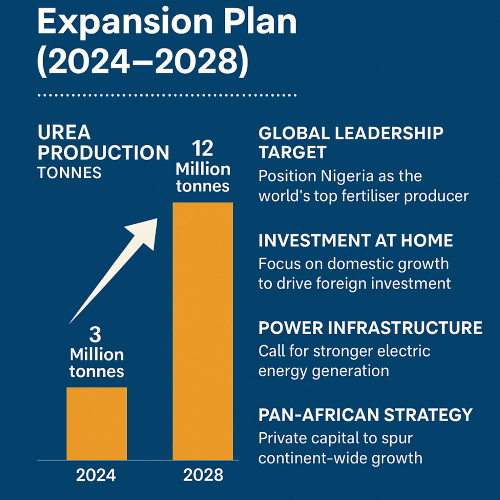
A Fertiliser Superpower in the Making
The world is facing severe disruptions in agricultural supply chains—from geopolitical conflicts to soaring input prices. As nations scramble to secure fertiliser access, Nigeria now has a rare opportunity to position itself as a stabilising force in global food production.
If Dangote’s vision materialises, Nigeria could:
- Redefine Africa’s place in global agribusiness
- Boost food security across the continent
- Expand non-oil exports and diversify foreign exchange earnings
- Create thousands of skilled jobs across logistics, energy, manufacturing and agro-value chains
- Become a critical supplier to markets increasingly seeking alternatives to Russia, China and the Middle East
The scale of the planned capacity—12 million tonnes—would place Nigeria in the league of global agricultural powerhouses.
“Africans Must Invest at Home” — Dangote’s Economic Philosophy
Dangote’s remarks went beyond production numbers—they were a call to Africa’s economic consciousness.
“There is no place like home. Africans must invest at home because only a local investor can convince a foreign investor to invest in Africa.”
He also disclosed plans to double the Dangote Group’s investments in Nigeria, signalling confidence in the policy direction of the Tinubu administration and in Africa’s long-term industrial prospects.
This philosophy—rooting continental industrialisation in African capital—is increasingly shaping the continent’s future economic narrative.
Africa’s Opportunity: Talent, Minerals & Youth
Former Mauritius President Ameenah Gurib-Fakim delivered a strategic perspective that underscored the moment:
- Africa has the world’s youngest population
- The continent holds 30% of global mineral reserves
- Demand for food and fertiliser will surge as global populations expand
Her message to African leaders and entrepreneurs:
“It is time for Africa to take her destiny in her hands.”
The presence of former UN Secretary-General Ban Ki-moon and Vice President Kashim Shettima (representing President Tinubu) added diplomatic weight to the call for an African-led industrial transformation.
Powering the Vision: Nigeria Must Fix Electricity
Despite the optimism, Dangote highlighted one critical enabler—energy.
Without a stable power infrastructure, the continent’s most ambitious manufacturing expansion could face bottlenecks.
“We need more investment in electric power generation,” he said, urging the government to prioritise energy as the backbone of Nigeria’s industrial competitiveness.
Electricity reliability will determine whether Nigeria merely dreams of global industrial leadership—or achieves it.
Can Nigeria Truly Lead the Global Fertiliser Market by 2028?
The ambition is colossal, but not impossible. Success hinges on strategic enablers:
1. Infrastructure Readiness
Ports, pipelines, and transport corridors must operate efficiently.
2. Policy Stability
Long-term industrial policies must remain consistent across administrations.
3. Energy Security
Reliable, affordable power remains the single most important gamechanger.
4. Currency Stability
Export competitiveness depends heavily on a stable macroeconomic environment.
5. AfCFTA Integration
A unified African market could exponentially increase fertiliser exports across the continent.
If these conditions align, Nigeria could make history—not just as Africa’s largest fertiliser producer, but the world’s leading one.