Nigeria Ranks 3rd in Africa as NGX Hits ₦100trn — Tinubu Urges Nigerians to Invest Locally

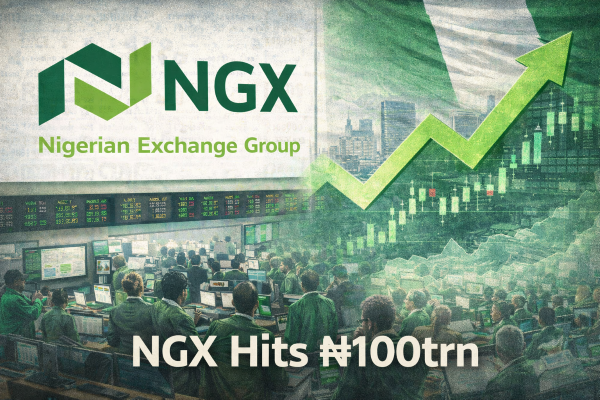
Nigeria’s capital market has crossed a historic psychological and financial threshold, reinforcing its status as one of Africa’s most consequential investment destinations. With total market capitalisation on the Nigerian Exchange (NGX) surpassing ₦100 trillion, Nigeria now ranks third in Africa by number of listed companies, marking a defining moment for domestic capital formation, investor confidence, and long-term economic rebalancing.
President Bola Ahmed Tinubu has hailed the milestone as evidence that Nigeria’s reform-driven economic reset is beginning to translate into measurable market outcomes, while urging citizens, institutions, and long-term savers to deepen their participation in the local investment ecosystem.


Africa’s Top Three — And Still Expanding
According to continental market data, Nigeria now sits behind only Egypt and South Africa in terms of listed companies, with 156 companies quoted on the Nigerian Exchange. Alongside Morocco, Egypt, and South Africa, Nigeria forms part of a small group of markets that together account for a significant share of Africa’s total market capitalisation and trading activity.
More importantly, the NGX’s surge past ₦100 trillion underscores not just scale, but momentum. The All-Share Index closed 2025 with returns exceeding 50 per cent, placing Nigeria among the world’s best-performing equity markets in a year when many global bourses struggled with tightening financial conditions and geopolitical uncertainty.
For investors, this NGX performance signals a market that is no longer merely speculative or cyclical, but one increasingly anchored by earnings growth, recapitalisation-driven balance sheet strength, and expanding sectoral depth.
Tinubu’s Investment Message: Capital Must Come Home
President Tinubu framed the NGX ₦100 trillion milestone as more than a market statistic. In his view, it represents a shift in national economic psychology — from consumption and rent-seeking toward ownership, savings, and productive capital deployment.
His message was direct: Nigeria’s next phase of growth will be driven not only by foreign capital, but by domestic investors backing domestic enterprises. From pension funds and insurance pools to retail investors and diaspora capital, the President urged Nigerians to see the stock market as a long-term wealth engine rather than a short-term trading arena.
This call aligns with a broader policy thrust aimed at deepening local participation, stabilising capital flows, and reducing Nigeria’s historical vulnerability to sudden foreign portfolio reversals.
What Is Powering the Market Rally
The NGX’s ascent has been underpinned by a convergence of structural and cyclical forces:
- Bank recapitalisation and balance sheet repair, which unlocked fresh equity issuances and boosted investor confidence.
- Strong corporate earnings, particularly in banking, consumer goods, telecoms, and industrials.
- Improving macro signals, including declining inflation, a stabilising exchange rate environment, and rising external reserves.
- Infrastructure-led growth narratives, with transport, ports, energy, and logistics projects reshaping long-term productivity expectations.
Together, these factors have repositioned Nigerian equities as a credible store of value and growth hedge within both domestic and frontier-market portfolios.
Beyond Equities: A Broader Capital Market Story
While equities dominate the headline figures, the ₦100 trillion milestone also reflects broader capital market maturation. Debt instruments, infrastructure-linked securities, and alternative investment vehicles are gradually expanding Nigeria’s financial architecture, offering investors multiple entry points aligned with different risk appetites.
Crucially, regulators and market operators are increasingly focused on market integrity, transparency, and digital access, key ingredients for sustaining confidence and attracting long-duration capital.
BRANDECONOMY Insight
Nigeria’s climb to Africa’s top three stock markets — and the NGX’s ₦100 trillion breakthrough — marks a strategic inflection point. The real story is not the headline number, but the shift from fragile, externally driven liquidity to a more balanced market anchored by local capital, reforms, and institutional participation.
If policy consistency is maintained, inflation continues its downward trajectory, and new NGX listings from energy, telecoms, technology, and infrastructure materialise, Nigeria’s capital market could evolve from a regional heavyweight into a continental benchmark for inclusive, reform-led growth.
The challenge now is execution: converting market momentum into sustained wealth creation, deeper financial inclusion, and a capital market that truly mirrors the scale and ambition of Africa’s largest economy and how it distills down to the benefit of the average investor and Nigerian Citizen.