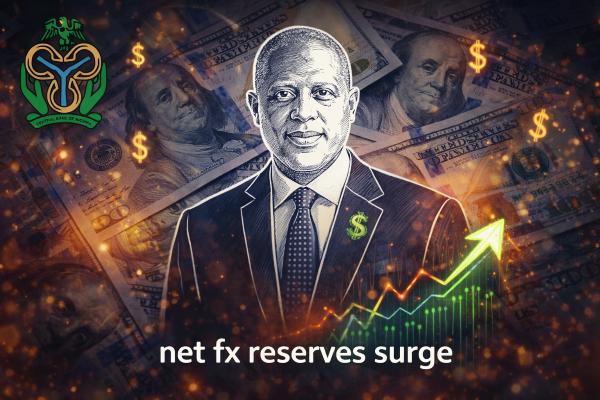
 Nigeria’s external balance sheet has undergone one of its most dramatic recalibrations in recent history. The Central Bank of Nigeria (CBN) has disclosed that the country’s net foreign exchange reserves rose from $3.99 billion at the end of 2023 to $34.80 billion by December 2025 — a 772% increase in just two years.
For an economy that entered 2024 battling FX volatility, capital flight concerns, and credibility deficits in the foreign exchange market, the scale of this reserve recovery is strategically significant.




Gross vs Net: Understanding the Shift
CBN Governor Olayemi Cardoso explained that Nigeria’s gross external reserves stood at $50.45 billion as of February 16, 2026, while end-2025 gross reserves were $45.71 billion — up from $40.19 billion at end-2024.
However, the more revealing metric is net reserves — which strip out forward obligations and encumbrances to reflect usable liquidity.
Key data points:
- Net reserves (end-2023): $3.99bn
- Net reserves (end-2024): $23.11bn
- Net reserves (end-2025): $34.80bn
Notably, the 2025 net figure exceeded Nigeria’s total gross reserves at end-2023 ($33.22bn), underscoring what Cardoso described as a “fundamental improvement in reserve quality.”
The Drivers: Policy Credibility and FX Reforms
According to the CBN governor, the surge reflects:
- Increased transparency in FX management
- Enhanced credibility in market operations
- Improved reserve management practices
- Stronger investor confidence
- Liquidity inflows into the official FX window
The Bank has pursued structural reforms aimed at restoring confidence in Nigeria’s exchange rate framework, streamlining FX windows, and reducing opacity in forward positions.
The improved reserve quality suggests that inflows have not merely replenished gross buffers but strengthened underlying liquidity.
Macro Implications
The strengthening of net reserves carries important macroeconomic implications:
1️⃣ Exchange Rate Stability
Higher usable reserves provide greater capacity to intervene in FX markets and reduce speculative volatility.
2️⃣ External Debt Servicing
Stronger buffers enhance Nigeria’s ability to meet sovereign and quasi-sovereign obligations.
3️⃣ Investor Signalling
Reserve rebuilding serves as a credibility anchor for foreign portfolio and direct investors.
4️⃣ Policy Flexibility
A healthier reserve position offers room for calibrated monetary easing should inflation dynamics permit.
What the Numbers Don’t Say
While the reserve surge signals improvement, several structural variables remain relevant:
- Sustainability of FX inflows
- Oil production stability
- Global capital market conditions
- Domestic inflation trajectory
- Fiscal consolidation discipline
Reserve accumulation is a necessary stabilisation tool — but it must be supported by structural export growth and diversified inflow sources.
BRANDECONOMY Insight
The most important takeaway from Nigeria’s reserve jump is not the headline percentage — it is the quality shift.
Three structural signals emerge:
- Liquidity Strengthening, Not Just Optics.
The leap in net reserves suggests genuine buffer reconstruction rather than cosmetic gross figure expansion. - Credibility Dividend.
FX market reforms appear to be restoring confidence, a prerequisite for sustainable inflows. - External Shock Insurance.
In a volatile global environment marked by geopolitical risk and energy price swings, stronger reserves provide critical macroeconomic insulation.
However, reserve durability will ultimately depend on Nigeria’s capacity to:
- Deepen non-oil exports
- Stabilise oil production
- Maintain reform momentum
- Attract long-term capital rather than short-term flows
The 772% surge is a stabilisation milestone. The next phase is consolidation.