MSME Squeeze: Small Businesses Demand Cost Relief, Credit and Policy Stability to ease Hardship

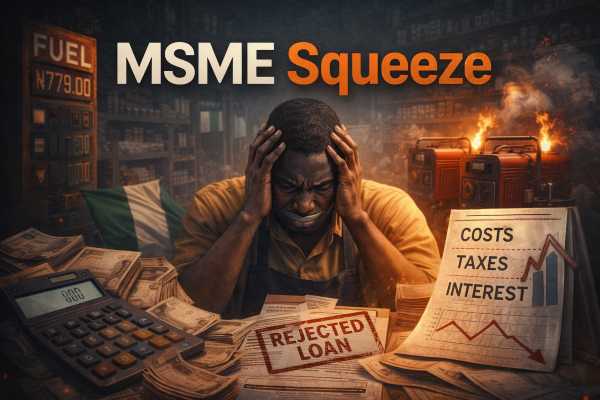
Nigeria’s small and medium-sized businesses—the economy’s most prolific job creators—are operating under intensifying strain. Across Abuja and beyond, entrepreneurs are calling for clearer policies, cheaper finance and practical cost relief as inflation, energy prices and regulatory frictions compress margins and stall growth.
Interviews with operators and business leaders reveal a common diagnosis: the cost base has surged faster than revenues, while uncertainty has made planning nearly impossible. The result is a fragile MSME ecosystem where resilience is being tested daily.



The Cost Shock: Energy, Logistics and FX
For Godwin Achakpa, a business owner in the Federal Capital Territory, the operating environment has turned punitive. Rising electricity tariffs and fuel costs have pushed firms toward generators and solar—both capital intensive—while logistics bottlenecks slow throughput and add hidden expenses.
Currency depreciation and elevated inflation, he says, are eroding profits and forcing difficult choices.
“Soaring inflation and currency depreciation are squeezing margins and pushing many small businesses toward shutdown,” said Godwin Achakpa, Business Owner, FCT.
Insecurity and Multiple Taxes: The Local Drag
In the Karu/Nyanya corridor, Agnes Okoro highlights a different pressure point: insecurity and fragmented levies that sap confidence and cash flow.
“The business community is calling for effective implementation of announced relief programmes. Intervention funds should be accessible and transparently disbursed,” said Agnes Okoro, Business Owner, Karu/Nyanya.
“We also need better power, transport and digital connectivity to compete.”
Her plea underscores a recurring theme—policy predictability matters as much as policy intent.
Finance Gap: When Credit Is the Constraint
From an institutional standpoint, the numbers tell a worrying story. Alfred Moses, a member of the Nigerian Association of Small and Medium Enterprises, says MSMEs are being priced out of credit.
“Commercial banks still classify SMEs as high-risk, with high interest rates and stringent collateral,” said Alfred Moses, NASME.
“High inflation, FX volatility and fuel price hikes have raised input costs, while weak purchasing power is cutting sales.”
Poor electricity supply compounds the problem for small businesses, he adds, inflating daily operating expenses and disrupting production schedules.
Chamber View: Policy Consistency Is the Multiplier
At the policy interface, Abuja Chamber of Commerce and Industry President Emeka Obegolu frames the challenge bluntly: inconsistent reforms can kill confidence faster than any tax.
“MSMEs are the backbone of the economy. Policy consistency and private-sector-friendly reforms are critical to reducing the cost of doing business,” said Emeka Obegolu, President, ACCI.
He warns that poorly managed reforms risk closures, job losses and capital flight—particularly in Abuja, now a major investment hub that needs stronger infrastructure and regulatory support.
Government Response: What’s on the Table
The Federal Ministry of Industry, Trade and Investment says it is scaling support. Jumoke Oduwole, Minister of Industry, Trade and Investment, reaffirmed commitments to grants, low-interest loans, job-creation incentives and improved access to business resources.
“We are strengthening technical cooperation and knowledge exchange to support MSMEs, improve standards and build industrial capacity,” said Jumoke Oduwole, Minister of Industry, Trade and Investment.
The ambition is resilience—but execution, timing and access will determine impact.
BRANDECONOMY Insight
Nigeria’s MSME crunch is not a mystery; it is a coordination failure. Energy costs, credit pricing, tax overlap and policy swings are interacting to choke growth. The fix is equally clear: predictable rules, cheaper power pathways, risk-sharing credit and transparent interventions. If policymakers align these levers, MSMEs can pivot from survival to scale—unlocking jobs, productivity and inclusive growth in 2026 and beyond.