Nigeria Courts Global Capital with New Mining Incentives at London Expo

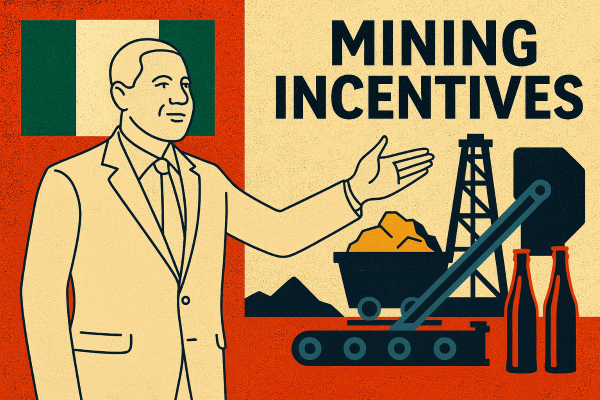
Nigeria’s pitch to global mining investors reached a decisive new height in London as the Federal Government unveiled a suite of high-impact incentives—from seamless profit repatriation to duty-free importation of mining equipment—positioning Africa’s largest economy as one of the most attractive destinations for mineral investment in the Global South.
Speaking at the Resourcing Tomorrow Annual Exhibition and Conference, Minister of Solid Minerals Development Dr. Dele Alake told an audience of multinational mining companies, financiers and commodity strategists that Nigeria’s mining renaissance is underway, marked by unprecedented inflows into lithium, rare earth elements and iron ore value-addition projects.


Alake, represented in a statement by his Special Adviser Kehinde Bamigbetan, said Nigeria is no longer offering rhetoric but demonstrable proof: factories under construction, heavy machinery already installed, and billions of dollars committed to midstream and downstream mineral processing.
A Mining Sector Moving from Potential to Performance
The Tinubu administration’s ban on “pit-to-port” raw mineral export is forcing value addition inside Nigeria—an industrial shift that has attracted over $2 billion in mineral-processing investments within two years.
Lithium Surge: Nigeria Becomes a West African Powerhouse
Alake noted that four global investors—Canmax Technologies, Jiuling Lithium, Avatar New Energy Nigeria Limited, and Asba Group—have collectively committed over $1.3 billion to lithium-processing facilities.
These are not speculative promises—they are steel, concrete and industrial equipment already transforming multiple states across the Federation.
A flagship project—the $50 million lithium-processing cluster outside Abuja—is now under construction. It will anchor a chain of processing hubs spreading across Nasarawa, Kogi, Kwara and Ebonyi, creating thousands of jobs and setting the foundation for Nigeria’s battery-grade mineral industry.
Rare Earth and Iron Ore—Nigeria Steps into Strategic Minerals
In November, Nigeria broke ground on a $400 million rare earth ore processing facility by Hasetins Group. The plant, expected to go live in 15 months, places Nigeria into a critical global supply chain dominated by Asia.
A multi-billion-dollar iron-ore-to-steel project, leveraging advanced processing technology, is also being finalised—signalling the government’s ambition to revive the nation’s dormant metallurgy ecosystem.
Investment Security: Mining Marshals & Satellite Surveillance
Alake emphasised that Nigeria is upgrading security around mining assets through:
- Specialised Mining Marshals operating nationwide
- Satellite-based monitoring of mining sites
- Stronger enforcement of mining regulations
These measures are designed to reduce illegal mining, enhance investor confidence and protect host communities.
NSMC: Nigeria’s Sovereign Mining Partner
The newly established Nigeria Solid Minerals Company (NSMC) is central to the country’s investment strategy. Built on legacy assets from the former Nigerian Mining Corporation, NSMC now serves as:
- A sovereign co-investor,
- A risk-sharing partner, and
- A driver of downstream value creation.
Its mandate is to partner private investors through equity, shared risk, and guaranteed governance frameworks that align with global standards.
Global-Standard Geological Mapping & Export Reforms
To support investor decision-making, the government has:
- Mapped over 80% of Nigeria’s geological formations,
- Finalised new Solid Minerals Export Guidelines ensuring transparency, ESG compliance, and traceability,
- Strengthened regulatory architecture to curb mineral smuggling and revenue leakages.
Alake also highlighted the signing of 427 Community Development Agreements, ensuring mining delivers economic, environmental and social benefits at community level.
The Northern Governors’ Call for a Mining Ban: The Security Underlay
The London New Mining Incentives pitch arrived against the backdrop of conversations at home where some Northern governors have called for a temporary suspension of mining activities in certain states due to rising insecurity.
BRANDECONOMY analysis indicates that:
- The real threat stems from illegal mining syndicates,
- Not from licensed operators under regulatory oversight.
Industry experts agree that banning legitimate mining would push the sector underground, empower criminal networks, and deter global capital—directly contradicting the value-addition momentum showcased in London.
BRANDECONOMY Insight
Nigeria’s mining sector is entering a defining decade. For the first time in 50 years, the nation is shifting from exporting raw minerals to becoming a processing and manufacturing hub.
Three forces are driving this transformation:
1. Global Mineral Competition
Countries are scrambling for lithium, cobalt, nickel and rare earths—minerals essential for electric vehicles, AI systems and renewable energy. Nigeria’s strategic deposits place it in the centre of a trillion-dollar global scramble.
2. Nigeria’s Demographic Dividend
With a growing young workforce, mining and mineral processing offer a pathway to high-quality jobs across engineering, geology, logistics, automation and metallurgy.
3. Credible Policy Posture
For the first time in decades, Nigeria is signaling New Mining Incentives policy clarity—export guidelines, geological mapping, ESG enforcement, and sovereign co-investment.
If managed effectively, mining could become Nigeria’s second-highest foreign-exchange earner by 2030.