Safety Concerns Rise as Lagos Tanker Crash Kills 2, Calabar Gas Explosion Injures Dozens

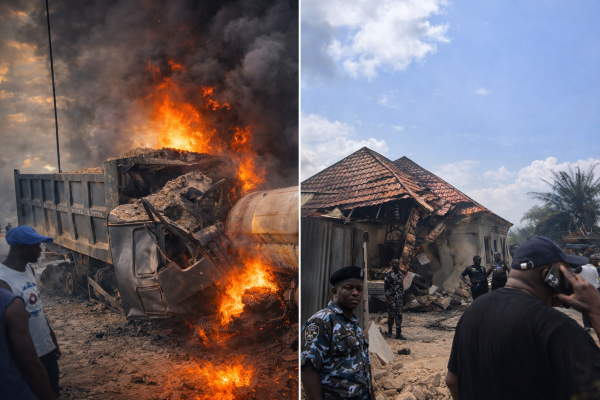 A pair of devastating incidents involving a crash and explosion across Nigeria’s urban corridors—one on Lagos’ fast-expanding Lekki–Epe axis and another in the densely packed neighbourhoods of Calabar—have once again laid bare the systemic vulnerabilities embedded in the country’s transport, energy handling and urban planning ecosystems.
Within hours, a high-impact collision involving a heavy-duty tipper truck and a gas tanker in Lagos claimed two lives, while a separate gas explosion in Cross River left dozens injured and entire structures reduced to rubble. Together, the events tell a deeper story: Nigeria’s infrastructure is expanding faster than its safety architecture.




Lagos: High-Speed Collision, High-Stakes Consequences
The Lagos State Fire and Rescue Service confirmed that the early morning crash in Sangotedo occurred when a speeding 20-tonne tipper truck rammed into a stationary 30-tonne gas tanker that had failed to fully exit the carriageway.
The consequences were immediate and severe.
The impact triggered a fast-spreading inferno that engulfed adjacent commercial structures—including warehouses, roadside shops, and utility installations—creating a cascading risk environment in one of Lagos’ most economically active corridors.
Firefighters from multiple stations responded swiftly, containing the blaze before it could reach a nearby filling station and a fully loaded petrol tanker—an escalation that could have transformed the incident into a large-scale urban disaster.
Two fatalities were recorded—the truck driver and his assistant—while the tanker driver escaped unhurt. Emergency agencies subsequently cleared the wreckage, restoring traffic flow and stabilising the corridor.
Yet, beneath the operational efficiency lies a more troubling question: why was a fully loaded gas tanker stationary on a major expressway at that hour, and without adequate hazard control?
Calabar: A Preventable Explosion in a Vulnerable Zone
In Calabar, the narrative shifts from collision to containment failure.
A routine gas transfer operation spiralled into a major explosion when a hose detached during the transfer process, releasing volatile gas fumes into a densely populated residential area.
Within moments, the environment ignited.
At least 36–38 individuals sustained varying degrees of burns, with victims rushed to the University of Calabar Teaching Hospital. No fatalities were recorded, but property losses remain extensive and largely unquantified.
More concerning, however, was the systemic failure of emergency response capacity.
Local fire services were unable to respond due to non-functional equipment—a stark revelation that underscores deeper institutional weaknesses in disaster preparedness.
Governor Bassey Otu’s subsequent promise of medical support and compensation reflects immediate relief measures—but does little to address the structural issues that enabled the disaster.
The Structural Problem: Growth Without Guardrails
Nigeria’s urban and economic expansion is accelerating—particularly along corridors like Lekki–Epe and emerging cities such as Calabar. But regulatory enforcement, safety compliance, and emergency readiness have not kept pace.
Three systemic risks are increasingly evident:
1. Transport Safety Deficits
Heavy-duty vehicles operate with minimal enforcement of speed, parking protocols, and hazard positioning—turning highways into latent risk zones.
2. Energy Handling Vulnerabilities
Gas and petroleum products are routinely managed in environments lacking industrial-grade safeguards, particularly in mixed-use residential areas.
3. Emergency Response Gaps
From vandalised equipment to aging fire trucks, Nigeria’s first-response infrastructure remains critically underfunded and operationally inconsistent.
Implications for Business, Investment and Urban Planning
For investors and policymakers, these incidents extend beyond human tragedy—they signal operational risk.
- Logistics & Supply Chains: Increased insurance costs and risk premiums for transport and energy distribution.
- Real Estate: Rising concerns over zoning integrity and proximity to hazardous installations.
- Industrial Operations: Greater scrutiny on safety compliance and environmental risk exposure.
- Public Finance: Growing fiscal burden from disaster response, compensation, and infrastructure rebuilding.
In an economy seeking to attract global capital, recurring safety failures erode investor confidence and complicate Nigeria’s competitiveness narrative.
Forward Outlook: Reform or Recurrence
Nigeria stands at a crossroads between expansion and enforcement.
Without urgent reforms, these incidents risk becoming cyclical rather than exceptional.
Critical Next Moves:
- Strict enforcement of urban zoning laws (especially for gas facilities)
- Mandatory highway safety compliance systems for heavy-duty vehicles
- Modernisation of fire and emergency services nationwide
- Real-time monitoring and early warning systems for hazardous operations
- Public-private partnerships in urban safety infrastructure
The real test is not in response—but in prevention.
BRANDECONOMY Insight
Nigeria’s infrastructure story is increasingly defined by a paradox: rapid economic expansion coexisting with fragile safety systems.
While capital flows into roads, real estate and energy distribution networks, risk governance remains underdeveloped, creating a silent drag on long-term growth.
For Nigeria to transition into a $1 trillion economy, urban safety must evolve from reactive firefighting to proactive system design.
In the language of global capital, safety is not social—it is financial.