Rising Fuel Costs Reveal a Deeper Energy Crisis as Dangote Refinery Laments Costs to 47 Government Agencies
A Fuel Price Shock That Signals Something Bigger

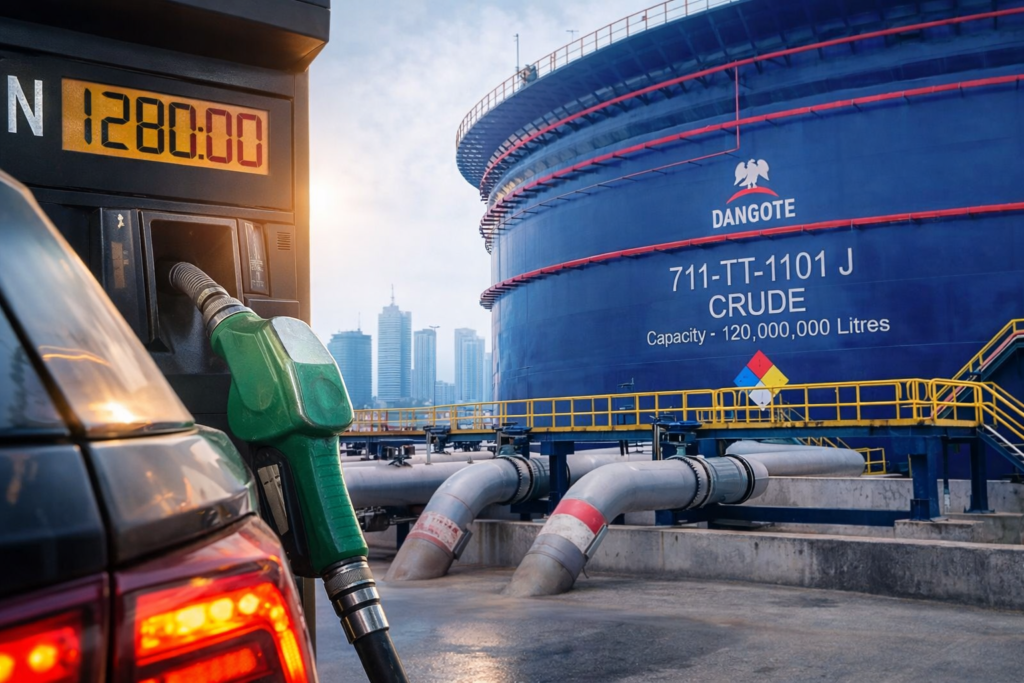 Nigeria’s rapidly rising petrol prices—now approaching ₦1,300 per litre in several markets—are more than a temporary market fluctuation. They expose a deeper structural weakness in the country’s energy architecture.
At the centre of the debate is the Dangote Petroleum Refinery, Africa’s largest refining complex, whose management has warned that a combination of global geopolitical shocks, domestic regulatory burdens and crude supply dynamics is driving up the cost of refined fuel.




According to David Bird, Managing Director of Dangote Petroleum Refinery, the refinery interacts with 47 different government agencies, each imposing fees or compliance costs across the refining and logistics chain.
“We deal with about 47 government agencies across the value chain, and each adds some form of cost to the final price of fuel,” said David Bird, Managing Director, Dangote Petroleum Refinery.
“Every agency must examine how it can reduce costs within the supply chain.”
The result is a complex pricing structure in which local pump prices increasingly mirror global energy turbulence.
Global Conflict Meets Nigeria’s Energy Market
The immediate trigger for the latest fuel price spike lies in the intensifying geopolitical tensions in the Middle East.
The disruption of oil flows through the Strait of Hormuz—a narrow maritime corridor that carries roughly 20 percent of global oil shipments—has rattled global energy markets.
Within days of the escalation:
- crude prices surged toward $120 per barrel
- shipping costs spiked dramatically
- insurance premiums for tankers increased sharply
Although prices later retreated toward $98 per barrel, the episode exposed the fragility of global oil supply chains.
For Nigeria, which still prices refined fuel based on global benchmarks, the shock transmitted almost instantly to the domestic market.
The Paradox of Domestic Refining
Nigeria’s energy system is confronting a paradox: even with the commissioning of a 650,000-barrel-per-day refinery, domestic petrol prices remain deeply tied to global oil market volatility.
Bird explained that the Dangote refinery purchases crude oil at international benchmark prices, even when sourced locally under Nigeria’s crude-for-naira framework.
This means the refinery remains exposed to global cost drivers such as:
- crude oil price volatility
- maritime freight rates
- tanker insurance premiums
- international financing costs
Freight costs alone have surged dramatically during the crisis, rising from roughly $800,000 per shipment to nearly $3.5 million in some cases.
Nigeria’s Crude Supply Puzzle
One of the most contentious issues raised by Dangote Refinery management is the allocation of Nigerian crude oil.
Despite operating within a major oil-producing country, the refinery says it often struggles to obtain preferred Nigerian crude grades such as Bonny Light and Escravos.
Instead, refinery officials claim that cargoes frequently go first to international buyers before re-entering the market through trading intermediaries.
“Sometimes the crude grades we request appear later on the international market through traders,” Bird said.
“The domestic refining industry should ideally be treated as a priority customer.”
This dynamic introduces additional trading margins into the supply chain—effectively raising the refinery’s feedstock costs.
The Regulatory Cost Layer
Beyond crude procurement challenges, the refinery has pointed to the fragmented regulatory structure of Nigeria’s energy and maritime ecosystem.
Industry participants note that the refining and distribution chain interacts with numerous authorities responsible for:
- ports and shipping
- maritime regulation
- environmental compliance
- inspection and certification
- security oversight
Each layer introduces administrative fees, inspections or operational charges that ultimately accumulate in the final pump price.
For a facility processing hundreds of thousands of barrels daily, these incremental costs can become substantial.
Inflation Risks Across the Economy
The private sector is already bracing for the broader economic consequences.
Energy prices sit at the centre of Nigeria’s inflation structure because fuel affects transportation, logistics and agricultural supply chains.
Business leaders warn that rising petrol prices will inevitably feed into:
- transport fares
- food distribution costs
- manufacturing expenses
- retail prices
In effect, petrol price increases quickly cascade through the entire economy.
Economists note that Nigeria’s inflation trajectory remains closely tied to energy costs, making the current price surge a significant macroeconomic concern.
Why Domestic Refining Still Matters
Despite the turbulence, analysts believe Nigeria’s emerging refining capacity could still become a powerful stabilising force.
The Dangote Refinery alone has the capacity to process 650,000 barrels of crude per day, with potential expansion to around 700,000 barrels per day.
If supported by coherent policy reforms, domestic refining could help Nigeria achieve three strategic goals:
Energy Security
Ensuring consistent fuel supply regardless of global disruptions.
Foreign Exchange Stability
Reducing dependence on imported refined products.
Industrial Growth
Creating a downstream petrochemical ecosystem capable of supporting manufacturing.
However, these benefits depend on aligning several policy levers—including crude supply allocation, regulatory efficiency and pricing transparency.
A Strategic Inflection Point
Nigeria now faces a defining policy choice.
Rising oil prices globally could increase government revenues from crude exports. Yet the same price increases also threaten domestic economic stability through higher fuel costs.
Without internal shock absorbers—such as integrated domestic refining and efficient regulatory frameworks—the country remains vulnerable to geopolitical events thousands of kilometres away.
In other words, the current fuel price surge is not merely a temporary crisis. It is a stress test for Nigeria’s long-term energy strategy.
BRANDECONOMY Insight
The Structural Lesson From Nigeria’s Fuel Price Crisis
The petrol price spike highlights a fundamental contradiction in Nigeria’s energy system: a major oil producer still behaves like a fuel-importing economy.
Three structural issues stand out:
- Crude Allocation Strategy
Domestic refineries require guaranteed access to local crude to stabilise refining costs. - Regulatory Fragmentation
Multiple agencies operating across the value chain increase transaction costs and complexity. - Global Price Exposure
Without integrated domestic supply chains, international oil market shocks will continue to dictate local fuel prices.
If Nigeria successfully reforms these structural bottlenecks, domestic refining could become a cornerstone of economic resilience.
If not, fuel price volatility will remain a recurring feature of the Nigerian economy.