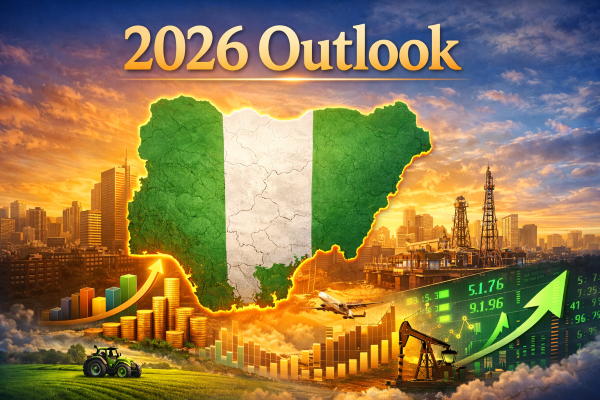
Nigeria’s macroeconomic narrative is beginning to tilt from crisis management toward cautious recovery. At a high-level economic outlook forum in Lagos, policymakers, bankers and economists converged around a shared projection: 2026 could mark Nigeria’s first full stabilisation year after a prolonged cycle of shocks, reforms and painful adjustments.
The consensus view—anchored by projections from the Central Bank of Nigeria and leading development economists—is that stronger growth, moderating inflation and improving external buffers are now within reach, provided reform momentum is sustained and execution risks are tightly managed.




Growth Rebound: The 4.5% Question
Speaking at the 12th National Economic Outlook forum organised by the Chartered Institute of Bankers of Nigeria Centre for Financial Studies in collaboration with B. Adedipe Associates, the Central Bank projected real GDP growth of 4.49 per cent in 2026.
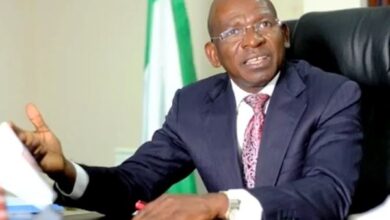
According to Muhammad Abdullahi, Deputy Governor of the Central Bank of Nigeria in charge of the Economic Policy Directorate, the outlook is underpinned by a broad-based expansion of the non-oil economy, improved crude oil output, rising private-sector investment and a gradually stabilising macroeconomic environment.
From a development economics perspective, the significance lies not just in the headline number, but in its composition. Growth driven by manufacturing, services, agribusiness and private capital formation is structurally more resilient than oil-led rebounds of the past.
Inflation: From Runaway to Retreat
Equally critical is the inflation trajectory. The apex bank expects headline inflation to moderate to 12.94 per cent in 2026, a sharp deceleration from the elevated levels experienced during the peak of currency realignment and energy price shocks.
Abdullahi attributed the easing trend to lower food and energy pressures, alongside the delayed but cumulative impact of tight monetary policy.
“Inflation is expected to continue easing, supported by reforms, reduced supply-side pressures and the lagged effects of monetary tightening,” said Muhammad Abdullahi, Deputy Governor (Economic Policy), Central Bank of Nigeria.
He was represented at the forum by Victor Oboh, Director of Monetary Policy at the Central Bank.
For households and businesses alike, sustained disinflation would mark a turning point—restoring purchasing power, improving planning horizons and lowering the real cost of capital.
External Sector Turnaround: Reserves and FX Stability
Perhaps the most striking signal of macroeconomic repair is Nigeria’s external position. The country recorded a balance of payments surplus of approximately $3.81 billion in 2025, reversing deficits from the previous two years.
Foreign exchange conditions are projected to remain broadly stable in 2026, supported by FX market reforms, higher oil receipts, growing diaspora remittances and improving investor confidence.
External reserves, according to the Central Bank, are projected to exceed $50 billion in 2026, providing a stronger buffer against external shocks and speculative currency pressures.
This combination—reserve accumulation, FX reforms and restored confidence—represents a marked departure from the episodic FX crises that have defined Nigeria’s recent past.
Banking and Credit: The Next Transmission Channel
The Central Bank used the forum to deliver a clear message to financial institutions: macroeconomic stabilisation must translate into real-sector credit expansion.
Abdullahi urged banks to deepen lending to productive sectors, particularly manufacturing, agribusiness and small and medium enterprises. From a banking industry lens, this is a critical test of whether reforms will catalyse inclusive growth or remain trapped within financial markets.
Economists’ Verdict: 2026 as a Stabilisation Year
Delivering the keynote address, Biodun Adedipe, Chief Consultant at B. Adedipe Associates Ltd, described 2026 as a stabilisation year—a period characterised by exchange-rate calm, declining inflation, rising reserves and robust capital market performance.
He noted that Nigerians are already beginning to feel the early benefits of reforms, particularly in the easing prices of some staple food items, but cautioned that sustained production—especially in agriculture—remains essential to locking in disinflation.
Execution Risk: The Deciding Factor
Offering a note of disciplined realism, Baba Musa, President of the Nigerian Economic Society, stressed that improving fundamentals alone do not guarantee outcomes.
“Effective monetary, fiscal and tax reforms will ultimately determine the economic outcomes in 2026,” said Baba Musa, President, Nigerian Economic Society.
He urged businesses to respond proactively by investing in capacity expansion, technology upgrades and new markets—positioning themselves ahead of demand recovery rather than reacting after the fact.
Fiscal Reset and Tax Reform Signals
Earlier remarks by Pius Olanrewaju, Chairman of the Council of the Chartered Institute of Bankers of Nigeria, framed the outlook within Nigeria’s evolving fiscal architecture.
He noted that new tax reforms effective from January 1 are designed to broaden the tax base, strengthen public finances and reduce dependence on oil revenues, while shielding small businesses and low-income earners—an essential balance for social and political sustainability.
BRANDECONOMY Insight
Taken together, the projections point to a fragile but credible recovery path. Nigeria’s challenge in 2026 will not be the absence of policy ideas, but the discipline of execution—ensuring that macro stability feeds through to jobs, incomes, credit access and industrial productivity. If reforms hold, 2026 may be remembered as the year Nigeria finally turned stabilisation into strategy.