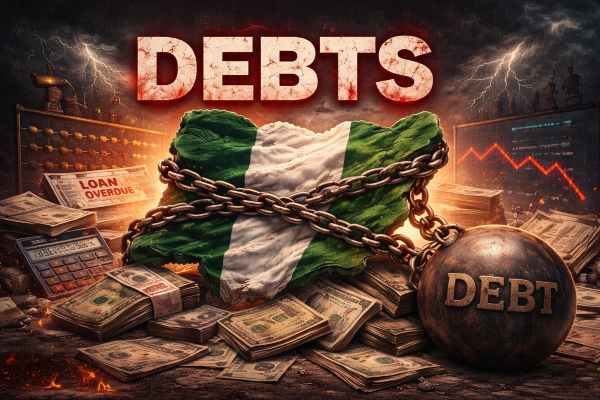
Nigeria’s rising public debt is triggering deep unease across policy, business and civil society circles—not simply because the numbers are growing, but because too much borrowing is being channelled into non-productive expenditure. Stakeholders warn that unless debt is urgently redirected toward growth-enhancing investments, the country risks locking itself into a vicious cycle of weak revenues, rising debt service and shrinking development space.
At ₦152.4 trillion as of mid-2025, Nigeria’s public debt has become a defining macroeconomic variable. Yet the sharper debate is no longer about whether Nigeria can borrow—but what Nigeria is borrowing for.




The Core Anxiety: Debt Without Development
Data from the Debt Management Office show steady increases in both domestic and external debt. However, analysts argue that the structure and use of these funds raise red flags. A growing share of new borrowing is financing recurrent expenditure and consumption, not infrastructure, industrial capacity or export-earning assets.
This pattern weakens the economy’s ability to generate future revenues needed to service the same debts—effectively borrowing from tomorrow to pay for today.
Debt Service Is Crowding Out Growth
One of the strongest expressions of stakeholder concern centres on the debt service burden. Muda Yusuf, Chief Executive Officer of the Centre for the Promotion of Private Enterprise, warns that Nigeria is approaching a fiscal danger zone.
“Debt service is already far more than the appropriation for capital spending, and the trend is worrying,” said Muda Yusuf, CEO, Centre for the Promotion of Private Enterprise.
“We are borrowing primarily to fund consumption and recurrent expenditure rather than productive capital projects.”
With more than 80 per cent of government revenue reportedly devoted to debt servicing, stakeholders fear that essential functions—education, health, infrastructure and security—are being structurally underfunded.
FX Exposure: When Consumption Debt Becomes Costlier
Currency depreciation has amplified the risks. External borrowing used for non-productive purposes becomes especially dangerous when the naira weakens, as debt service costs balloon without a corresponding increase in foreign exchange inflows.
This dynamic, analysts say, amounts to a hidden fiscal tax, silently transferring resources away from development spending into debt repayment.
Transparency and Accountability Gaps
From a governance standpoint, civic and policy groups insist that new loans must be justified by measurable outcomes. The concern is not borrowing per se, but borrowing without clear productivity benchmarks.
Stakeholders argue that before additional loans are contracted, government must clearly demonstrate:
- What previous borrowings were used for
- Which projects are generating returns
- How new debt will expand the tax and export base
Without this clarity, borrowing risks becoming fiscally addictive rather than transformational.
The Official Reassurance—and Its Limits
The Federal Government, through the Debt Management Office, maintains that Nigeria’s debt remains sustainable, citing a debt-to-GDP ratio of about 40 per cent, well below the 70 per cent benchmark for emerging economies. Patience Oniha, Director-General of the DMO, has reiterated that Nigeria’s borrowing levels are not excessive by global standards.
However, stakeholders counter that debt sustainability is not just a ratio. It is a function of:
- Revenue strength
- Interest and exchange-rate risk
- Productivity of borrowed funds
A low ratio offers little comfort if debt finances consumption rather than growth.
What Stakeholders Want to See Change
Across the private sector, civil society and development community, a clear consensus is emerging:
- Borrow for productivity, not payrolls
- Prioritise infrastructure, manufacturing, agriculture and export-oriented sectors
- Tie borrowing to revenue-generating projects with clear timelines
- Strengthen non-oil revenue and tax efficiency to reduce borrowing dependence
In essence, Nigeria must earn its way out of debt, not borrow its way deeper into it.
BRANDECONOMY Insight
Nigeria’s debt challenge is not a crisis of access to credit—it is a crisis of capital allocation. Borrowing that fuels consumption deepens fragility; borrowing that builds productive capacity creates resilience. The country’s real debt test is whether policymakers can pivot decisively from short-term fiscal comfort to long-term economic value. Until that shift occurs, stakeholder apprehension will only intensify.