How Customs 2,500 seizures worth N59bn in 2025 and Reforms Are Redefining National Security and Trade

Inside Nigeria’s Quiet Battle at the Borders
Nigeria’s most consequential security and economic battles are no longer fought only in forests or financial markets—they are being waged, quietly and relentlessly, at the nation’s ports, airports, and land borders.
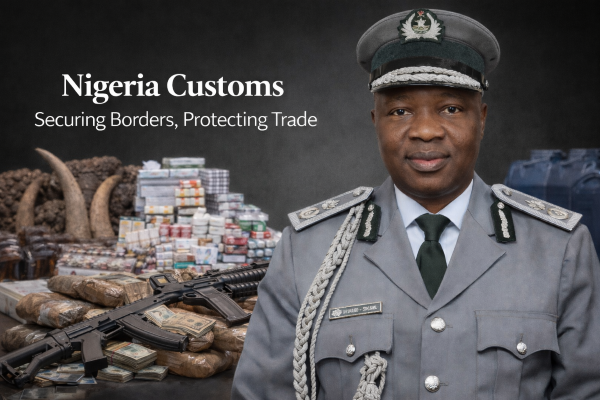
In 2025, the Nigeria Customs Service (NCS) intercepted over 2,500 consignments of prohibited and harmful goods, with an estimated value exceeding ₦59 billion. Beyond the headline figures lies a deeper national story: one of border vigilance as economic defence, and trade reform as a competitiveness imperative.


This dual mandate—protecting society while accelerating legitimate trade—now defines the modern Nigerian Customs strategy.
Seizures as Security Architecture, Not Just Enforcement
The scale and composition of the seizures reveal the nature of the threats Nigeria faces.
According to Bashir Adeniyi, Comptroller-General of the Nigeria Customs Service, the interdictions spanned narcotics, counterfeit pharmaceuticals, wildlife products, arms and ammunition, petroleum products, vehicles, and substandard consumer goods.
“These operations do not always make headlines for long, but their impact is enduring—fewer young people exposed to harmful drugs, fewer weapons reaching criminal networks, fewer counterfeit medicines reaching patients, and fewer endangered species removed from the ecosystem,”
—Bashir Adeniyi, Comptroller-General, Nigeria Customs Service
At Apapa Port alone, Customs uncovered 16 containers of prohibited goods valued at over ₦10 billion, combining narcotics, expired pharmaceuticals, and concealed firearms in a single operation.
At international airports, officers intercepted more than 1,600 exotic birds trafficked without CITES permits, disrupting an international wildlife crime network and shielding Nigeria from treaty violations.
These are not isolated wins. They represent the dismantling of criminal supply chains before they reach Nigerian communities—preventing addiction, violent crime, environmental damage, and avoidable loss of life.
In effect, Customs seizures have become a first line of national defence.
The Trade Paradox: Speed Exists, Inefficiency Persists
Yet enforcement and seizures is only half the story.
In 2025, the NCS also confronted a hard truth: Nigeria does not suffer from an inability to clear goods quickly—it suffers from systems that prevent goods from moving quickly.
This insight emerged from the Trade Release Study (TRS) conducted at Tincan Island Port—Nigeria’s most comprehensive, data-driven assessment of cargo clearance performance to date.
“Our challenge is not that we cannot move goods fast; it is that goods are not allowed to move fast,”
—Bashir Adeniyi, Comptroller-General, Nigeria Customs Service
The study revealed that while physical examination times are relatively efficient, excessive idle periods—caused by fragmented scheduling, manual documentation, and poor inter-agency coordination—significantly extend clearance timelines and erode competitiveness.
This distinction is critical. It reframes Nigeria’s trade problem from one of capacity to one of process design.
From Opinion-Driven Reform to Evidence-Based Customs
The unveiling of the Trade Release Study (TRS) signals a structural shift within Nigerian Customs:
from complaints-driven policy to data-driven reform.
The TRS is not merely a diagnostic instrument; it is a strategic governance tool—one that allows government to measure performance, identify bottlenecks, reduce transaction costs, and restore predictability across the trade ecosystem.
According to Dr Doris Uzoka-Anite, Minister of State for Finance, the initiative aligns directly with the Federal Government’s macroeconomic reset.
“The TRS is not just a diagnostic tool; it is a strategic policy instrument that strengthens transparency, reduces transaction costs, and enables smarter regulation across the trade ecosystem,”
—Dr Doris Uzoka-Anite, Minister of State for Finance, Nigeria
Trade facilitation, border efficiency, and revenue assurance now sit at the centre of Nigeria’s fiscal and investor-confidence strategy.
Revenue Without Compromise
Contrary to the long-held belief that tighter enforcement stifles trade, 2025 proved the opposite.
The Nigeria Customs Service recorded ₦7.28 trillion in revenue, exceeding its target by ₦697 billion—a growth of more than 10% year-on-year.
This performance underscores a critical lesson:
effective enforcement and efficient trade are not competing objectives—they are mutually reinforcing.
By shutting down illicit flows while streamlining legitimate ones, Customs is repositioning itself as both revenue engine and trade enabler.
Why This Matters for Business and Investors
For manufacturers, importers, exporters, and logistics providers, the implications are profound:
- Lower hidden trade costs through reduced delays
- Improved predictability at ports and borders
- Reduced exposure to illicit competition
- Stronger investor confidence in Nigeria’s trade governance
For the wider economy, smarter border management directly supports job creation, industrial competitiveness, and export growth.
The Road Ahead: Vigilance Meets Reform
As Nigeria deepens its integration into regional and global trade systems, the role of Customs is evolving—from gatekeeper to strategic economic institution.
The future lies in sustaining this balance:
- Relentless vigilance against harmful imports
- Data-led reforms that unlock speed, transparency, and trust
If executed consistently, Nigeria’s border strategy could become one of its most powerful—yet least visible—tools for national transformation.
BRANDECONOMY INSIGHT
Nigeria’s Customs reform is quietly rewriting the country’s economic security doctrine. What the 2025 seizure figures and the Trade Release Study jointly reveal is a strategic pivot: border enforcement is no longer treated as a narrow security function, but as a core instrument of economic competitiveness.
Three insights stand out.
First, seizures are now a form of preventive economic policy. By intercepting narcotics, counterfeit medicines, weapons, and illicit petroleum products before they enter circulation, Customs is reducing downstream costs that would otherwise be borne by healthcare systems, security agencies, environmental regulators, and households. The real value of the ₦59bn seizures lies not in the goods confiscated, but in the losses avoided.
Second, Nigeria’s trade problem is systemic, not infrastructural. The Trade Release Study confirms that clearance delays are driven less by physical bottlenecks and more by fragmented processes, manual documentation, and weak inter-agency coordination. This reframes reform priorities away from expensive infrastructure spending towards smarter regulation, automation, and institutional alignment.
Third, enforcement and efficiency are proving complementary, not contradictory. The record ₦7.28 trillion revenue performance demonstrates that stronger controls, when paired with data-driven reforms, can expand legitimate trade rather than suppress it. This challenges the long-standing assumption that stricter border management must slow commerce.
The strategic takeaway: Nigeria’s competitiveness will increasingly depend on how well it secures its borders while accelerating lawful trade. Customs is emerging as a frontline economic institution—one whose success will shape investor confidence, industrial growth, and the credibility of Nigeria’s ease-of-doing-business agenda.