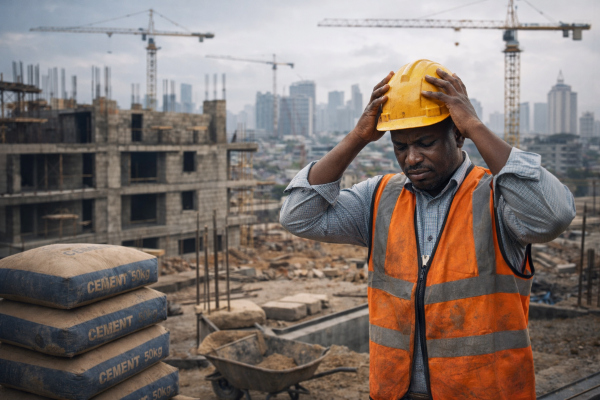
 Nigeria’s fragile housing ecosystem is coming under renewed strain as a sharp rise in cement and building material costs ripples across the construction value chain—pushing homeownership further out of reach and accelerating rental inflation in major cities.
Across the Federal Capital Territory and other urban corridors, industry stakeholders warn that the surge in cement prices—now exceeding ₦14,000 per 50kg bag in some regions—signals a deeper structural imbalance in Nigeria’s real estate and infrastructure economy.




At the heart of the concern is a widening affordability gap: a country with one of Africa’s fastest-growing populations is simultaneously witnessing a slowdown in housing supply due to escalating construction costs.
Cost Pressures Cascade Across the Construction Value Chain
Developers, builders, and housing advocates point to a convergence of macroeconomic pressures driving the spike in cement prices and allied materials such as steel, sand, and roofing components.
Energy costs remain the dominant factor. Cement production in Nigeria is heavily dependent on gas and diesel—inputs that have become significantly more expensive amid currency volatility and global energy disruptions. Industry estimates suggest that energy alone accounts for between 30% and 40% of total production costs.
Compounding this is logistics inefficiency. Poor road infrastructure, rising diesel prices, and security concerns along transport corridors have inflated distribution costs, which can contribute as much as 25% of the final retail price of cement.
Currency depreciation has further intensified the squeeze, raising the cost of imported machinery, spare parts, and industrial additives—critical inputs for cement manufacturing.
The result is a cost structure that leaves manufacturers little room to absorb shocks, ultimately passing the burden onto developers and, by extension, consumers.
Housing Affordability Slips Further Out of Reach
The implications for Nigeria’s housing market are stark.
As construction costs climb, developers are scaling back projects, delaying delivery timelines, or passing on costs to buyers and tenants. In key urban centres such as Lagos and Abuja, rental prices have surged dramatically, with two-bedroom apartments now commanding between ₦1.5 million and ₦2 million annually in many locations—more than double previous benchmarks.
This trend is not isolated. Secondary cities including Kano and Port Harcourt are experiencing similar upward pressure, signalling a nationwide affordability crisis.
For many households, the dream of homeownership is receding, replaced by a precarious rental existence shaped by volatile pricing and limited supply.
Even more concerning is the risk of quality compromise. As margins tighten, some developers may resort to substandard materials—raising systemic concerns about building safety and long-term structural integrity.
Structural Imbalance: Demand Growth vs Supply Constraints
Nigeria’s housing deficit—already estimated in the tens of millions—continues to widen under the weight of demographic expansion and urban migration.
Demand for housing is rising rapidly, driven by population growth and infrastructure expansion. Yet supply remains constrained by high input costs, limited access to affordable financing, and weak industrial linkages within the construction ecosystem.
Regional disparities further complicate the picture. The South-East, for instance, remains heavily dependent on cement transported from other parts of the country, exposing it to higher logistics costs and price volatility.
Stakeholders argue that decentralising production—such as reviving dormant facilities like the Nigercem plant in Nkalagu—could ease supply bottlenecks and stabilise regional pricing dynamics.
Calls for Policy Intervention Intensify
Against this backdrop, industry players are calling for decisive government action to stabilise the sector.
Key recommendations include:
- Energy Reform: Ensuring stable electricity supply and affordable gas for manufacturers to reduce production costs
- Logistics Optimisation: Investing in transport infrastructure to lower distribution expenses
- Market Competition: Considering controlled importation to moderate domestic prices while supporting local production
- Industrial Policy Support: Providing incentives for local manufacturing and alternative building materials
- Affordable Housing Strategy: Expanding public housing schemes to bridge the supply gap
There are also calls for stronger regulatory oversight to prevent price manipulation across distribution channels and ensure transparency within the cement value chain.
A Sector at a Crossroads
The construction sector remains one of Nigeria’s most critical economic engines—driving employment, infrastructure development, and urban growth. Yet, without coordinated policy action, it risks becoming a casualty of macroeconomic instability.
What is unfolding is more than a price surge; it is a systemic stress test of Nigeria’s housing model—one that exposes the interdependence between energy, currency, infrastructure, and industrial policy.
BRANDECONOMY INSIGHT
Nigeria’s cement crisis is not merely a supply-side issue—it is a macro-structural signal.
Three strategic realities emerge:
- Energy is the Hidden Price Driver:
Without resolving Nigeria’s energy inefficiencies, industrial costs—especially in cement—will remain structurally elevated. - Housing is Becoming a Monetary Policy Transmission Channel:
Rising rents and construction costs are feeding directly into inflation, reinforcing broader cost-of-living pressures. - Industrial Decentralisation is Now Imperative:
Regional production hubs can reduce logistics costs, improve resilience, and unlock local economic ecosystems.
Ultimately, Nigeria faces a clear choice:
Reform the industrial backbone of its housing economy—or risk institutionalising unaffordable living.