Nigeria’s Cashew Goldmine: How a $10bn Export Industry Is Waiting to Be Unlocked

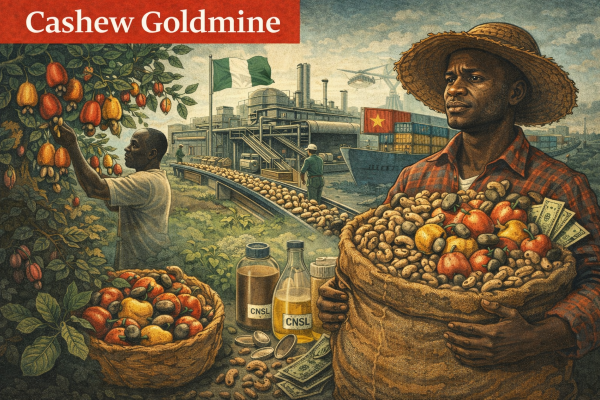
Nigeria is sitting on one of its most undervalued export assets — cashew. With the right mix of policy discipline, processing investment and export governance, the cashew industry could conservatively deliver over $10 billion in annual revenues, repositioning agriculture as a serious foreign-exchange engine for the Nigerian economy.
That is the strategic message emerging from the National Cashew Association of Nigeria (NCAN) as stakeholders prepare for the 4th National Cashew Day in Abuja, themed “Unlocking the Full Potential of Nigeria’s Cashew Industry.”




From Raw Exports to a Global Value Chain
According to NCAN President Dr. Ojo Ajanaku, Nigeria already exports significant volumes of raw cashew, but captures only a fraction of the value created globally.
In the most recent export season alone, Nigeria shipped over 400,000 tonnes of cashew, valued at roughly $700 million. Yet most of this trade occurred with weak documentation, poor export proceeds tracking and limited repatriation, depriving the economy of much-needed FX inflows.
This leakage, Ajanaku argues, is not a production problem — it is a value-chain governance failure.
“A substantial volume of cashew exported from Nigeria leaves the country without proper export proceeds forms. Earnings are not fully repatriated, and the economy loses twice — revenue and control.”
The $3bn Cashew Math — And Why It’s Conservative
Nigeria’s cashew potential becomes clearer with simple arithmetic:
- 2 million tonnes annual production (achievable within five years)
- Average price of $1,500 per tonne
- Annual export value: $3 billion from raw cashew alone
But this is only the starting point.
The Real Wealth Is in Processing
Globally, the most lucrative cashew markets are not in raw nuts, but in processed derivatives — an area Nigeria has largely ignored.
Key by-products include:
- Cashew Nut Shell Fluid (CNSF) — used in industrial resins, brake linings and coatings
- Cashew cake — a high-value industrial and feed input
In Vietnam, a global processing leader, cashew cake sells for about $0.95 per kilogram. In Nigeria, processors often pay to dispose of it as waste.
This single inefficiency captures the structural problem of Nigeria’s agro-export economy: exporting raw value while importing processed wealth.
Why $10bn Is Realistic, Not Aspirational
NCAN estimates that full domestic processing of cashew and its by-products could unlock no less than $10 billion annually, driven by:
- Export-ready processed kernels
- Industrial derivatives (CNSF, oils, resins)
- Employment across farming, logistics, processing and export services
- Stronger FX inflows with traceable proceeds
Crucially, Nigeria already has the production capacity. What it lacks is industrial processing scale — a gap countries like Vietnam have mastered.
Vietnam Partnership Signals a Strategic Shift
To close this gap, Nigeria has signed a landmark Memorandum of Understanding with Vietnam, aimed at:
- Technology transfer in cashew processing
- Skills development and industrial best practices
- Deepened bilateral trade cooperation
This signals a pivot from commodity export dependency to agro-industrial competitiveness.
Production States Hold the Key
Ajanaku highlights a striking paradox: Kogi State, Nigeria’s largest cashew producer, has no major processing factory.
This underscores the need for:
- Processing hubs in producing states
- Incentives for private agro-industrial investment
- Infrastructure alignment — power, logistics, export corridors
“Producing states must be prioritised. The value Nigeria is losing today is value that should be created at home.”
Beyond Cashew: A Template for Agro-Industrial Reform
NCAN officials say the cashew strategy could become a blueprint for Nigeria’s broader agricultural export reform — combining:
- Export proceeds discipline
- Local processing mandates
- Technology partnerships
- Stronger institutional coordination
The association is already engaging the Ministry of Finance, Ministry of Agriculture and Food Security, NEXIM Bank and other agencies to reposition cashew as a structured export industry rather than an informal commodity trade.
The Bigger Picture
Nigeria’s cashew story is not just about nuts — it is about industrial ambition.
If Nigeria can move cashew from farms to factories, from raw exports to finished goods, and from leakage to accountability, the sector could:
- Rival oil as a non-oil FX earner
- Create thousands of jobs
- Strengthen rural economies
- Anchor Nigeria’s agro-industrial future
The cashew goldmine is already in the ground. What remains is the discipline to mine it properly.