Nigeria’s Capital Market Re-Rated as NGX Hits ₦130 Trillion Market Cap Milestone says NGX Boss Popoola
Nigeria’s financial markets showing signs of recalibration.

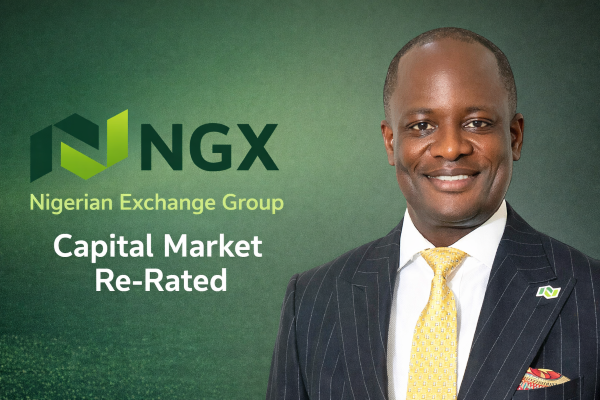
Nigeria’s capital market is undergoing a structural shift—one that could redefine its position within global investment flows. The surge in market capitalisation to over ₦130 trillion, alongside renewed foreign investor interest, signals more than a cyclical rally; it points to a re-rating of Nigeria’s risk profile.
For investors, policymakers, and corporates, this moment represents a critical inflection point: Nigeria is no longer being priced solely on historical fragility, but increasingly on forward-looking reform momentum and earnings resilience.




Context: From Market Recovery to Strategic Repricing
After years of FX instability, capital flight, and weakened investor confidence, Nigeria’s financial markets are showing signs of recalibration.
According to Nigerian Exchange Group CEO Temi Popoola, global investors are reassessing Nigeria through a more data-driven lens:
“What we are seeing is a gradual re-rating of Nigeria. Investors are beginning to assess data, returns, reforms, and improving macroeconomic direction—and that is changing sentiment.”
This shift is occurring alongside broader macro reforms tied to the administration of Bola Ahmed Tinubu, including:
- FX market liberalisation
- Energy sector restructuring
- Fiscal realignment
Together, these are reshaping Nigeria’s investment narrative—from volatility to viability.
Market Momentum: The Numbers Behind the Narrative
The re-rating thesis is being reinforced by strong market performance:
- Market Capitalisation: ₦130.026 trillion (record high)
- Daily Gain: ₦696 billion
- All-Share Index: 202,559.41 points (+0.54%)
- Trading Volume: 1.752 billion shares (+41.22%)
- Transaction Value: ₦88.095 billion
The rally has been driven by large and mid-cap leaders, including:
- BUA Cement Plc
- Dangote Cement Plc
- Zenith Bank Plc
- Guaranty Trust Holding Company Plc
- Nigerian Aviation Handling Company Plc
This breadth of gains suggests system-wide investor confidence, rather than isolated stock rallies.
Core Analysis: What is Driving the Re-Rating?
1. Policy Clarity as a Capital Magnet
Global capital is highly sensitive to predictability. Nigeria’s recent reforms—though initially disruptive—are now creating clearer economic signals.
Popoola emphasised:
“Global capital responds to clarity and consistency. As those elements become evident, Nigeria becomes more investable.”
2. Domestic Capital Formation Rising
Local investor participation is increasing, cushioning volatility from foreign outflows and deepening market liquidity.
3. Energy Sector Transformation
With rising domestic refining capacity (notably Dangote Refinery), Nigeria is:
- Reducing FX pressure
- Improving trade balance outlook
- Enhancing macro stability
4. Valuation Reset vs Emerging Markets
Nigeria’s equities, previously discounted due to macro risks, are now being repriced as:
- Earnings improve
- FX transparency increases
- Reform credibility strengthens
Institutional Confidence: Signals from the Top
Umaru Kwairanga, Chairman of NGX Group, reinforced the macro narrative:
“Nigeria’s economy has stabilised and has started to grow steadily again.”
He highlighted:
- AS Index growth: from ~55,000 to over 201,000 points (+261%)
- Market cap growth: from ₦30 trillion to ₦129 trillion (+325%)
- Trading activity: up nearly fourfold
More critically, he pointed to future catalysts, including:
- Planned mega listings (e.g., Dangote Refinery)
- Ambition to triple market indices within two years
- Alignment with Nigeria’s $1 trillion GDP target by 2030
Implications: What This Means for Investors and the Economy
For Global Investors
- Nigeria is transitioning from a high-risk outlier to a high-return frontier play
- Early movers may benefit from valuation upside before full repricing
For Domestic Investors
- Sustained bull run strengthens wealth creation
- Deepens pension fund and institutional participation
For Policymakers
- Reinforces the need for policy consistency
- Any reversal could quickly erode gains
For Corporates
- Stronger capital markets improve:
- Access to funding
- IPO viability
- Corporate expansion strategies
Risks: Why the Rally is Not Guaranteed
Despite optimism, key vulnerabilities remain:
- Global risk-off sentiment (especially from US rate cycles)
- Profit-taking pressures as valuations stretch
- FX volatility relapse risks
- Execution risk on reforms
As United Capital Plc noted:
“The structural bull run remains intact, but investors should remain alert to global shocks and valuation pressures.”
Forward Outlook: From Re-Rating to Capital Inflows
Nigeria’s next challenge is clear:
Convert sentiment into sustained capital inflows.
This will depend on:
- Consistent macroeconomic execution
- Deepening of market infrastructure
- Strategic engagement with global financial hubs like London
Popoola captured the moment succinctly:
“The focus now is ensuring this recognition translates into sustained capital flows.”
BRANDECONOMY Insight
Nigeria is not just recovering—it is being repriced.
The significance of this moment lies in perception shift:
- From risk-heavy frontier market
- To reform-driven growth opportunity
But re-rating is only the first phase.
The real test is durability.
Nigeria must now:
- Institutionalise reforms
- Strengthen investor protections
- Deepen liquidity and listings
If sustained, this could mark the beginning of Nigeria’s emergence as:
Africa’s most compelling capital market story of the decade.
If reversed, it risks becoming yet another false dawn in frontier market cycles.