Customers Protest Rising Bank Charges, Say Deductions Discourage Savings

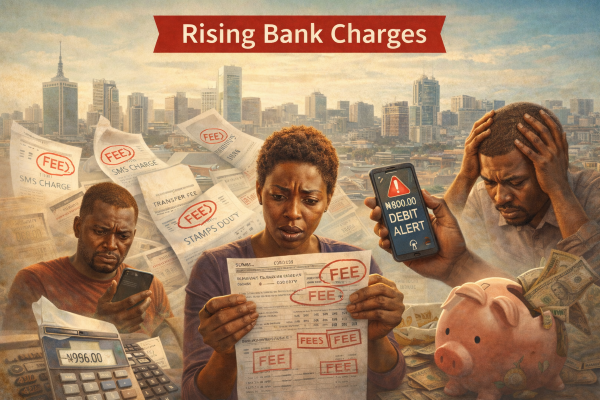 Bank customers across Nigeria are increasingly expressing frustration over the growing number of transaction-related charges imposed by commercial banks, warning that the deductions are discouraging them from keeping money in their accounts.
Several customers who spoke in Abuja said the cumulative effect of charges such as SMS alerts, transfer commissions, Value Added Tax (VAT), and stamp duties has made routine banking transactions more expensive and, in some cases, financially discouraging.



They urged the Central Bank of Nigeria (CBN) to intervene and review the fee structure within the banking sector, arguing that excessive charges undermine the country’s financial inclusion agenda.
Customers Raise Concerns Over Daily Deductions
Mrs. Helen Agodo, a customer of First HoldCo Plc, said she had noticed frequent debits from her account that have become increasingly difficult to keep track of.
She called on the Bank Customers Association of Nigeria (BCAN) to engage regulators and ensure greater transparency in bank deductions.
According to Agodo, she once calculated the debit alerts received in a single day and found that charges had accumulated to nearly ₦800.
She argued that when multiplied across thousands of customers, such deductions could represent significant earnings for banks at the expense of depositors.
Electronic Banking Users Feel the Impact
Miss Cheta Ugochukwu, a customer of Guaranty Trust Holding Company Plc, said customers who rely heavily on electronic banking are particularly affected by the charges.
She cited fees such as SMS alert charges, VAT, stamp duties, and commissions on instant transfers as examples of deductions that accumulate over time.
According to her, the charges appear inconsistent with Nigeria’s push toward a cashless economy.
Ugochukwu said she was recently billed nearly ₦1,000 in a single month for SMS alert services and had considered disabling the service entirely in order to reduce costs.
Charges Discouraging Deposits
Mr. Usman Idris, who banks with Fidelity Bank Plc, said his experience with cumulative deductions had discouraged him from depositing business funds into his account.
He explained that after depositing money, he discovered that the balance had reduced due to multiple bank charges, leaving him unable to withdraw the full amount when needed.
Similarly, Mr. Andrew Adejoh, a customer of Zenith Bank Plc, said many Nigerians are beginning to reconsider keeping money in bank accounts.
He suggested that the rising charges could be pushing some individuals toward keeping physical cash at home instead of depositing it in financial institutions.
Mr. Tunde Bello, who banks with Access Bank Plc, also urged the CBN to examine the fee structure imposed by banks and ensure that customers are not overburdened.
CBN Moves to Reduce Selected Charges
Industry observers note that the CBN has recently taken steps aimed at reducing the financial burden on customers.
Earlier this year, the apex bank announced the elimination of several banking charges, including the ₦50 electronic money transfer levy, stamp duties on salary and investment accounts, and internal transfer fees.
The policy move was designed to encourage greater participation in the formal financial system and support Nigeria’s financial inclusion objectives.
BRANDECONOMY Insight
The growing complaints about bank charges reflect a broader tension within Nigeria’s financial ecosystem: balancing digital banking growth with customer trust and affordability.
Three important structural issues are emerging.
1. The Cost of Nigeria’s Cashless Transition
Nigeria’s banking sector has rapidly embraced digital transactions, with millions of customers now using mobile apps, instant transfers, and online payment platforms.
However, many digital transactions still attract layered fees—transfer charges, SMS notifications, VAT, and service commissions.
For low-income earners and small businesses, these costs can make routine banking feel expensive.
2. Financial Inclusion vs. Transaction Economics
Nigeria’s financial inclusion strategy aims to bring millions of unbanked citizens into the formal banking system.
But excessive transaction costs risk undermining this goal.
If customers perceive banking as expensive, they may revert to cash-based informal financial behaviour, which weakens financial system transparency and limits the growth of digital payments.
3. Banks’ Revenue Model Under Pressure
For Nigerian banks, transaction fees have become an important revenue stream as competition compresses traditional lending margins.
However, over-reliance on small retail charges could damage customer loyalty and public perception of the banking industry.
The long-term solution may lie in transparent pricing structures, reduced micro-charges, and greater reliance on value-added financial services rather than transactional deductions.
Ultimately, restoring confidence in the banking system will require regulators and banks to strike a careful balance between profitability and consumer fairness.