New Tax Shock Looms: Onyema Warns Airfares Could Hit ₦1m as Nigeria’s Aviation Faces Existential Threat

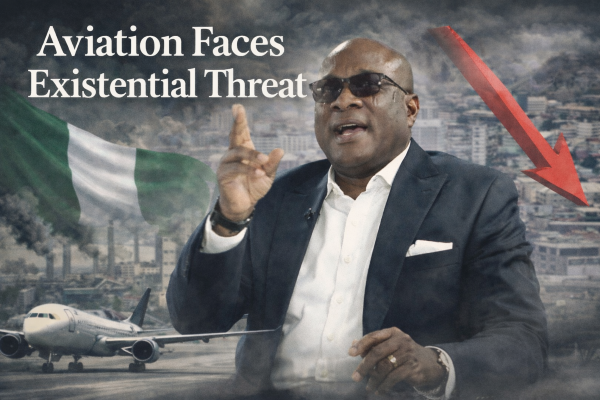
Nigeria’s domestic aviation industry is staring at a potential tipping point, as fresh tax provisions threaten to unravel years of fragile progress in airline sustainability, affordability, and sectoral growth. At the centre of the alarm is Allen Onyema, Chairman and Chief Executive Officer of Air Peace, who has issued one of the starkest warnings yet: if the new tax regime is see-throughly implemented, economy-class airfares could spiral towards ₦1 million, while several Nigerian airlines risk collapse within months.
This is not a tale of airline profiteering. It is, rather, a sobering case study of how policy misalignment, excessive taxation, and macroeconomic stress can cripple a strategic sector that underpins national integration, trade, tourism, and productivity.


An Industry Strangled by Charges, Not Greed
Onyema’s central argument is disarmingly simple: Nigerian airlines do not retain most of what passengers pay. From every domestic ticket sold, a labyrinth of statutory deductions, regulatory charges, and levies strips operators of the bulk of revenue before they can even address fuel, maintenance, staff costs, insurance, or debt servicing.
By Onyema’s account, a ticket priced at roughly ₦350,000 leaves the airline with barely ₦81,000 after mandatory deductions. Among the most controversial is a compulsory five per cent charge on ticket sales payable to aviation regulators, alongside multiple other fees that compound operational stress.
In effect, airlines are being taxed not on profits, but on gross revenue—an approach that contradicts global aviation norms and erodes commercial viability.
ICAO Standards vs Nigeria’s Revenue Mentality
Globally, aviation regulation follows a cost-recovery principle, as outlined by the International Civil Aviation Organisation (ICAO). Regulators are expected to recover the cost of services rendered—not convert airlines into revenue-generation tools for government treasuries.
Nigeria’s current approach, Onyema argues, flips this logic on its head. Instead of enabling airlines to grow, fleet-expand, and lower fares through scale, the system incentivises contraction, higher prices, and eventual exits from the market.
The result is a vicious cycle: higher charges lead to higher fares, higher fares depress demand, weaker demand shrinks airline cashflow, and shrinking cashflow accelerates financial distress.
Why the 2020 Aviation Tax Relief Mattered
The aviation industry had previously enjoyed a lifeline. The 2020 tax framework removed customs duties and VAT on imported aircraft, engines, spare parts, and even ticket fares. That policy alignment recognised aviation as a capital-intensive, low-margin industry critical to economic development.
The new tax regime reverses much of that relief. Aircraft purchases and spare parts are once again subject to 7.5 per cent VAT—an enormous burden in an industry where aircraft are typically acquired through heavy borrowing.
To put the numbers in perspective:
- A single aircraft priced at $80 million now attracts VAT running into billions of naira.
- Nigerian airlines borrow at interest rates of 30–35 per cent, among the highest globally.
- Layering VAT on top of such financing costs, Onyema warns, is economically suffocating.
The Passenger Will Pay the Final Price
No airline absorbs systemic cost shocks indefinitely. Onyema is unequivocal that the new tax burden will inevitably be passed on to passengers. With VAT returning to ticket fares and deductions rising, domestic air travel risks becoming an elite luxury rather than a mass mobility service.
The projected outcome is stark: sharply reduced passenger volumes, fewer routes, grounded aircraft, and a shrinking aviation network that undermines business travel, regional commerce, tourism, and emergency connectivity.
Aviation Is Not Just Another Business
From a development economics standpoint, aviation is not a discretionary industry. It is a strategic enabler of GDP growth, labour mobility, regional integration, and investment flows. Countries that understand this treat airlines as national economic infrastructure—even when privately owned.
Onyema is careful to stress that Nigerian airlines are not asking for subsidies. The request is simpler and more pragmatic: policy coherence, tax rationalisation, and a return to the 2020 aviation-friendly framework that recognised the sector’s peculiar economics.
Banking Sector Exposure: The Silent Risk
Beyond airlines and passengers, Nigerian banks are deeply exposed. Aircraft acquisitions are heavily financed through local banks. If airlines fail under the weight of taxation and high interest rates, the ripple effects will extend into the financial system, worsening non-performing loans and amplifying systemic risk.
In this sense, aviation tax policy is not just an industry issue—it is a financial stability concern.
Listening Government, Urgent Decision
To Onyema’s credit, he acknowledges that the current administration has shown openness to industry feedback in the past. However, time is not a luxury. Aviation operates on thin margins and tight cash cycles. Policy delays measured in months could translate into irreversible losses.
The choice before policymakers is clear:
- Treat aviation as a cash cow and risk sectoral collapse, or
- Treat it as an economic catalyst and design taxes that sustain growth, affordability, and safety.
BRANDECONOMY Verdict
Nigeria cannot tax its way into aviation growth. Excessive levies, overlapping charges, and punitive borrowing costs will not expand the tax base—they will shrink it. Sustainable aviation policy must prioritise cost recovery, capital efficiency, and passenger affordability, not short-term fiscal extraction.
If airfares approach ₦1 million, the real casualty will not be airlines alone—it will be national productivity, economic inclusion, and Nigeria’s ambition to function as an integrated modern economy.