NDCCITMA Calls for New Economic Agenda as Niger Delta Seeks to Close ₦25 Trillion GDP Gap with South-West
Rebuilding the Economic Operating System

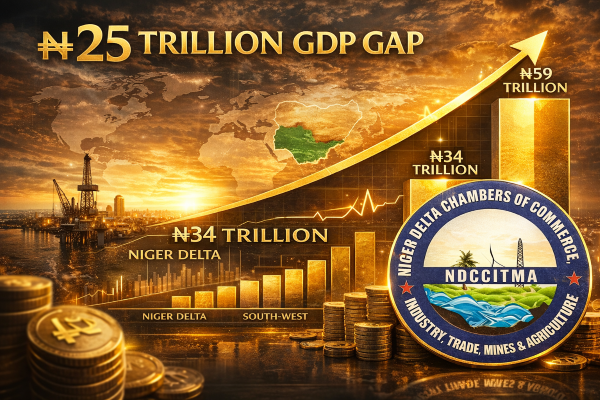 The Niger Delta Chamber of Commerce Industry Trade Mines and Agriculture has issued a strategic call for a fundamental reset of the Niger Delta’s economic trajectory, urging stakeholders across the region to adopt a new development framework capable of unlocking growth and closing a widening Gross Domestic Product (GDP) gap with Nigeria’s South-West.
At a high-level business roundtable convened in Port Harcourt, the chamber’s leadership laid bare a stark economic reality: the Niger Delta, with an estimated GDP of ₦34 trillion, trails the South-West’s ₦59 trillion output by approximately ₦25 trillion.




For a region that accounts for a significant share of Nigeria’s oil wealth, gas reserves, and maritime access, the disparity underscores what industry observers increasingly describe as a conversion crisis—where abundant resources fail to translate into measurable economic productivity.
From Resource Wealth to Economic Underperformance
Speaking at the forum themed “Creating a New Development Agenda for the Niger Delta Region,” NDCCITMA’s Board Secretary, Solomon Edebiri, emphasised the urgency of rethinking the region’s growth model.
Beyond headline GDP figures, the deeper concern lies in structural inefficiencies:
- Weak export performance
- Limited value chain integration
- Low enterprise scalability
- Constrained access to finance
A striking illustration of this imbalance is seen in export metrics. While Lagos records approximately $200 million in annual air exports, Port Harcourt accounts for a negligible $20,000, highlighting a profound gap in trade competitiveness.
The Structural Deficit: From Potential to Productivity
The Chairman of NDCCITMA’s Board, Idare Gogo Ogan, delivered what can be described as the most consequential insight of the roundtable:
The Niger Delta’s challenge is not a lack of opportunities—but a failure to convert opportunities into bankable, financeable projects.
For decades, Niger Delta region’s development discourse has been dominated by politically charged themes—derivation, militancy, environmental degradation, and amnesty—without corresponding economic transformation.
Ogan’s intervention reframes the debate:
👉 From political agitation → to economic execution
Rebuilding the Economic Operating System
The NDCCITMA leadership identified four critical pillars that must be prioritised to unlock growth:
- Security (investor confidence)
- Power (industrial productivity)
- Logistics (trade efficiency)
- Project Preparation (bankability)
Without these foundational elements, the region risks remaining rich in resources but poor in outcomes.
Capital Exists—Commitment Is the Missing Variable
In a significant policy signal, the Managing Director of the Niger Delta Development Commission, Samuel Ogbuku, challenged a long-standing narrative around capital scarcity.
According to him, the Niger Delta does not suffer from a shortage of:
- Capital
- Entrepreneurial talent
- Institutional presence
Rather, the region faces a deficit of commitment and coordinated execution.
His call for stakeholders to “invest at home” reflects a broader push towards endogenous development, where local capital drives local transformation.
The Strategic Pivot: Beyond Oil
A key outcome of the roundtable is the recognition that the Niger Delta must diversify beyond hydrocarbons.
Priority sectors include:
- Agriculture and agro-processing
- Maritime and logistics
- Manufacturing
- SME-driven enterprise ecosystems
NDCCITMA’s role, according to Edebiri, will centre on:
- Mentorship and enterprise development
- Policy dialogue and advocacy
- Improving access to finance
- Enhancing ease of doing business
BRANDECONOMY INSIGHT
🔍 The Real Issue: Nigeria’s Most Strategic Region Is Economically Under-Optimised
This development signals a deeper structural challenge:
👉 The Niger Delta is Nigeria’s most strategically endowed region—but one of its least optimised economically.
🔑 4 Strategic Takeaways
1️⃣ GDP Gap Reflects Structural Imbalance
The ₦25 trillion gap is not just economic—it is institutional and systemic.
2️⃣ Export Weakness Is the Red Flag
The Lagos–Port Harcourt export disparity reveals:
- Poor logistics integration
- Weak global trade positioning
3️⃣ Bankability Is the Missing Link
Investors do not fund ideas—they fund:
- Structured
- De-risked
- Executable projects
4️⃣ Narrative Must Shift
From:
❌ Agitation
To:
✅ Economic engineering
💡 Strategic Outlook
For policymakers:
- Prioritise project preparation frameworks
- Strengthen regional trade infrastructure
For investors:
- Untapped opportunities exist in:
- Agro value chains
- Logistics
- SME ecosystems
For platforms like NITEX:
👉 This gap represents a multi-billion naira opportunity to catalyse deal flow and economic activation
FINAL EDITOR’S NOTE
The Niger Delta does not need more conversations.
It needs:
👉 Structure
👉 Execution
👉 Bankable opportunities
And if properly activated, it could become:
👉 Nigeria’s most powerful economic growth engine in the next decade.