Netflix Exits Warner Bid as Paramount Moves to Reshape Hollywood

 A Strategic Reset in the Streaming Wars
 A Strategic Reset in the Streaming Wars
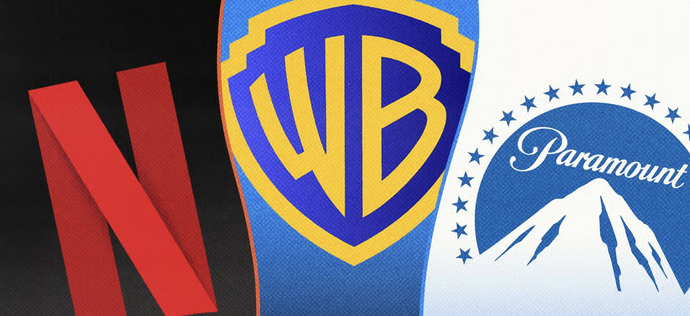
Netflix’s decision to walk away from its bid for Warner Bros. Discovery’s studio and streaming assets marks a pivotal shift in the evolving power map of global media.
What began as a targeted acquisition play has now opened the door for a far larger structural realignment: a potential full-scale takeover of Warner Bros. Discovery by Paramount, backed by Skydance.



The immediate implication is clear — Hollywood consolidation is accelerating.
The deeper implication is more complex — streaming economics, political influence, regulatory oversight and capital structure are colliding at once.
This is not merely a corporate transaction. It is an inflection point in global media governance.
Why Netflix Walked Away
Netflix had initially offered approximately $27.75 per share for Warner’s studio and streaming division — a transaction valued at roughly $83 billion including debt.
But when Paramount’s bid to acquire the entire company at $31 per share (valued near $111 billion including debt) was deemed “superior” by Warner’s board, Netflix was given a narrow window to counter.
It declined within hours.
In a joint statement, Netflix co-CEOs Ted Sarandos and Greg Peters described the deal as a “nice to have at the right price, not a must have at any price.”
That line reveals discipline.
Netflix’s model has always prioritized:
- Content control without excessive legacy baggage
- Capital efficiency
- Streaming-first scalability
A bidding war for a legacy-heavy conglomerate risked undermining those economics.
The decision reinforces Netflix’s strategic identity: growth through pricing power and global subscriber expansion — not empire building at any cost.
Paramount’s Bigger Bet
Unlike Netflix, Paramount’s interest is not selective. It wants the entire Warner Bros. Discovery ecosystem.
That includes:
- HBO Max
- Warner Bros.’ theatrical studio
- CNN
- The DC Universe franchise
- Global distribution assets
Combined with Paramount’s own holdings — CBS, Paramount+, MTV, Nickelodeon and a deep film library — the merger would reshape Hollywood’s competitive geometry.
Two of the five remaining legacy studios would merge.
Two major broadcast news brands could fall under one corporate umbrella.
Two global streaming platforms would consolidate content libraries.
Scale is the thesis.
Executives at Paramount argue that consolidation is necessary to compete against global giants in streaming, where content costs and subscriber acquisition expenses continue to rise.
But scale also introduces complexity — financial and political.
The Political Economy Dimension
The proposed merger does not exist in a vacuum.
Concerns have surfaced regarding:
- Political relationships surrounding ownership
- Editorial direction at major news networks
- Regulatory influence
- Antitrust scrutiny
The merger would require approval from the U.S. Department of Justice and likely regulators in other jurisdictions.
Lawmakers have already signaled alarm over media concentration. Critics argue that further consolidation could:
- Reduce competition
- Increase consumer prices
- Accelerate newsroom restructuring
- Limit diversity in content creation
Supporters counter that without consolidation, legacy media companies may struggle to compete with digital-native streaming platforms and tech giants.
This is the central tension: competition law versus survival economics.
Debt, Capital Structure and Risk
Paramount’s bid is heavily debt-financed.
That introduces risk.
Taking on billions in new leverage to finance a merger in an industry undergoing structural disruption increases vulnerability to:
- Advertising volatility
- Subscriber churn
- Content production inflation
- Regulatory delays
The pledge to pay a regulatory termination fee of $7 billion signals confidence — but also underscores the stakes.
For Warner shareholders, the calculus is immediate value versus long-term integration risk.
For Paramount, it is scale now or marginalisation later.
What This Means for the Streaming Landscape
If approved, a Paramount–Warner combination would:
- Create one of the largest content libraries globally
- Intensify pressure on Disney, Comcast and Amazon
- Increase consolidation momentum in media
- Potentially reshape pricing models in streaming
Netflix, meanwhile, avoids integration risk and preserves its financial flexibility.
Sometimes, the boldest move in corporate strategy is restraint.
Regulatory Outlook
Regulatory approval remains uncertain.
Authorities will assess:
- Market concentration in film distribution
- Impact on broadcast news competition
- Consumer pricing implications
- International competition law compliance
Recent global precedent shows regulators are increasingly wary of mega-mergers, particularly in industries tied to public information and digital access.
This deal will test how governments balance industrial competitiveness with media plurality.
Forward Scenarios
1️⃣ Approval with Conditions
Merger proceeds, but with divestitures or structural remedies.
Industry consolidation accelerates.
2️⃣ Prolonged Regulatory Review
Integration delayed, debt pressure mounts, investor volatility increases.
3️⃣ Blocked Deal
Warner reopens strategic alternatives.
Streaming consolidation slows temporarily.
BRANDECONOMY Insight
The streaming wars have entered their consolidation phase.
First came scale through subscriber growth.
Now comes scale through acquisition.
Netflix’s withdrawal underscores a broader lesson: not all growth is worth buying. Strategic clarity often beats empire ambition.
For Paramount, the wager is existential. For regulators, the decision is structural. For audiences, the outcome could shape what stories get told — and who controls their distribution.
In a fragmented media economy, ownership architecture increasingly determines cultural influence.
Hollywood’s next chapter may be written not in script rooms — but in boardrooms and courtrooms.