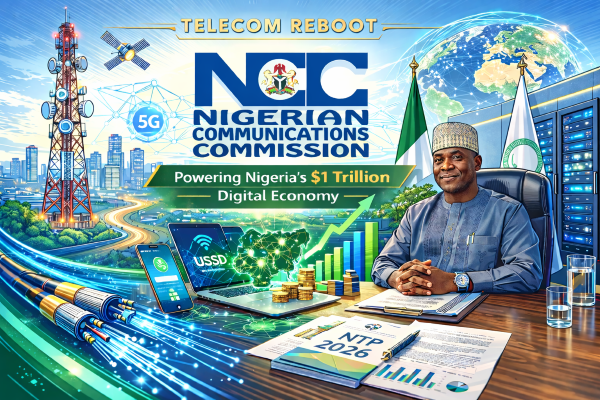
Telecom Reboot: Can NCC’s Regulatory Reforms Power Nigeria’s $1 Trillion Economy?

 Strategic Imperative: Why Telecom Policy Now Matters More Than Ever
 Strategic Imperative: Why Telecom Policy Now Matters More Than Ever
Nigeria’s ambition to build a $1 trillion economy is no longer rhetorical flourish—it is an economic survival strategy. With oil revenues structurally volatile and demographic pressures intensifying, digital infrastructure has become the country’s most scalable growth engine.
At the heart of this transformation sits the Nigerian Communications Commission (NCC). Its recent moves—ranging from initiating a comprehensive overhaul of the National Telecommunications Policy (NTP 2000) to resolving a ₦300 billion USSD debt crisis and confronting fibre infrastructure vandalism—represent more than regulatory housekeeping. They signal a structural reset.



If executed with discipline and coherence, these interventions could define the trajectory of Nigeria’s digital economy over the next decade.
The End of the 2000 Telecom Era
When the NTP 2000 was introduced, Nigeria had fewer than 500,000 connected lines. Today, active mobile connections approach 180 million. The original policy framework successfully liberalised the sector, catalysed private investment, and laid the groundwork for the Nigerian Communications Act of 2003.
But the sector has outgrown its foundational architecture.
The new consultation process—led under the supervision of the Minister of Communications, Innovation and Digital Economy—aims to deliver a draft NTP 2026. According to Dr Aminu Maida, Executive Vice-Chairman, NCC, the revised policy will address spectrum management, broadband expansion, net neutrality, emerging technologies, sustainability, and national security.
This review is not incremental reform. It is institutional recalibration.
The questions now are strategic:
- Can spectrum be allocated more efficiently?
- Can broadband penetration cross the productivity threshold?
- Can regulatory certainty attract long-term foreign capital?
- Can telecom infrastructure be treated as sovereign economic infrastructure rather than optional utilities?
The answers will determine whether digital growth becomes exponential—or stalls.
The USSD Crisis: From Systemic Risk to Structural Reform
One of the most destabilising frictions in the digital ecosystem was the ₦300 billion USSD debt standoff between telecom operators and banks. For nearly five years, the impasse threatened mobile banking continuity.
According to Gbenga Adebayo, Chairman, Association of Licensed Telecommunications Operators of Nigeria (ALTON), the crisis posed systemic risk to both telecom operators and Nigeria’s digital financial architecture.
The shift to End-User Billing (EUB) fundamentally changed the model. Rather than banks accumulating unpaid corporate bills, subscribers are now billed directly (with consent) per USSD session.
The implications are profound:
- Elimination of receivables risk
- Stabilised telecom cash flow
- Protection of financial inclusion channels
- Improved investor confidence
In emerging markets, payment rails are the backbone of digital GDP. By resolving the USSD impasse, the NCC preserved one of Nigeria’s most critical digital arteries.
Forex Reform and Tariff Reset: Restoring Commercial Viability
Telecom operators operate in a dual-currency trap: revenues in naira; obligations in dollars (bandwidth, software, equipment, international traffic).
During peak FX volatility, operators were functionally subsidising national connectivity.
Regulatory support, combined with broader foreign exchange reforms, has reduced exposure and stabilised balance sheets. Meanwhile, tariff adjustments—after 13 years of static pricing—have restored partial cost-reflectivity.
Adebayo notes that inflation, currency volatility, energy costs, and infrastructure aging had pushed tariffs below sustainability levels before review.
The tariff reset achieves three strategic outcomes:
- Prevents service rationing
- Reactivates capital expenditure cycles
- Signals regulatory realism to investors
For a $1 trillion economy, telecom must be investable—not politically suppressed.
Fibre Cuts: The Silent Economic Saboteur
Beyond macro-finance, Nigeria faces a more physical vulnerability: fibre optic destruction.
Over 19,000 fibre cuts were recorded last year. In early 2026 alone, incidents spiked sharply. These disruptions cripple banking systems, e-commerce, logistics, education platforms, and even emergency services.
According to Idris Olorunnimbe, Chairman, NCC Board of Commissioners, telecommunications infrastructure is the “central nervous system” of the economy.
The NCC’s firm stance—“he who cuts must fix”—and its push to enforce Critical National Infrastructure designation may prove transformative.
If enforced rigorously, consequences for contractors who damage fibre could:
- Reduce nationwide outages
- Lower systemic economic losses
- Encourage coordinated infrastructure planning
- Force state governments to integrate fibre mapping into road projects
Without infrastructure protection, broadband expansion is meaningless.
The Power Dynamics: Regulation, Operators, Banks, States
The telecom ecosystem is not merely technical; it is political economy in motion.
Key tensions include:
- Operators vs Banks (USSD pricing and billing models)
- Operators vs States (Right-of-way charges and fibre damage)
- Consumers vs Operators (Tariff sensitivity)
- National Security vs Net Neutrality
- Investment Incentives vs Consumer Protection
The NCC’s balancing act must preserve competition, protect consumers, and sustain operators simultaneously.
Institutional independence will be decisive. As Olorunnimbe emphasised, regulatory decisions must remain guided by national interest and integrity—not pressure cycles.
Telecom as GDP Multiplier
Telecom is no longer a standalone sector. It is a GDP multiplier.
Broadband penetration increases:
- SME productivity
- E-commerce volumes
- Financial inclusion rates
- EdTech and HealthTech scalability
- Government service delivery efficiency
Every 10% increase in broadband penetration correlates with measurable GDP uplift in developing markets.
If Nigeria reaches high-quality broadband saturation—especially in underserved communities—the economic multiplier effect could push digital contribution beyond current thresholds.
But quality of service, reliability, and affordability must converge.
Forward Outlook: Three Scenarios
1️⃣ Reform Acceleration Scenario (High Growth Path)
- NTP 2026 modernises spectrum allocation
- Fibre protection enforcement reduces outages
- Stable tariffs attract new investment
- Rural broadband incentives close inclusion gaps
Result: Telecom becomes primary driver of digital GDP expansion.
2️⃣ Partial Reform Scenario (Moderate Growth Path)
- Policy revised but weak enforcement
- Infrastructure damage persists
- Investment cautious but not withdrawn
Result: Growth continues, but below potential.
3️⃣ Reform Stall Scenario (Risk Path)
- Political interference weakens tariff rationality
- Fibre cuts remain unresolved
- Investor confidence declines
Result: Capital expenditure slows, digital ambitions falter.
What This Means for CEOs and Investors
For telecom operators:
- Prepare for higher compliance scrutiny
- Align capital planning with NTP 2026 objectives
- Invest in resilience infrastructure
For banks and fintechs:
- Build sustainable USSD economics
- Diversify digital access beyond legacy rails
For construction firms:
- Fibre mapping and coordination must become standard protocol
For state governments:
- Telecom integration into infrastructure planning is no longer optional
For global investors:
- Watch regulatory independence and enforcement credibility
BRANDECONOMY Insight
Nigeria’s digital economy will not become a trillion-dollar contributor through startup optimism alone. It will depend on regulatory clarity, infrastructure discipline, capital sustainability, and cross-sector coordination by the NCC and other relevant government agencies and stakeholders.
Overall government policy, attitude, and fidelity to the vision will be the key driver in the Trillion Dollar drive.
The NCC’s recent moves are not isolated events—they are structural signals.
If The NCC policy reform aligns with enforcement strength and investment realism, telecom could shift from being a support sector to becoming Nigeria’s primary economic backbone.
The trillion-dollar ambition runs through fibre cables, spectrum grids, billing systems, and regulatory credibility.
And this time, the margin for error is thin.