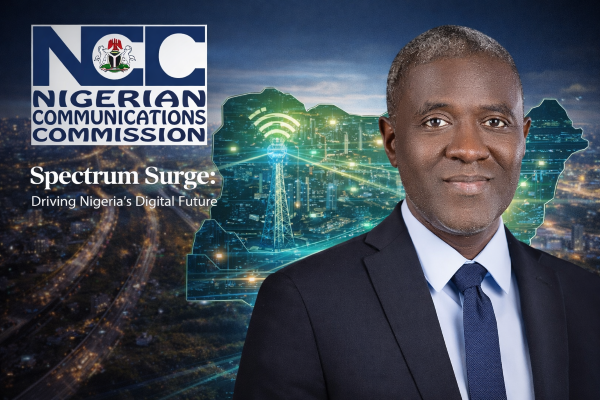
Spectrum Surge: How NCC Is Re-Engineering Nigeria’s Digital Future

Why Nigeria’s Next Growth Frontier Runs Through the Airwaves
Nigeria’s digital economy is entering a decisive phase—and at its centre is spectrum: the invisible infrastructure powering broadband, fintech, education, healthcare, smart industry and the modern services economy.
With the unveiling of the National Spectrum Roadmap 2026–2030 and the planned opening of the lower 6GHz and 60GHz bands, the Nigerian Communications Commission (NCC) is executing one of the most consequential telecom policy shifts since the liberalisation of the sector. The move signals a strategic pivot from incremental network expansion to future-ready digital capacity, designed to support Nigeria’s economic ambitions through 2030 and beyond.



This is not merely a technical reform. It is a national productivity intervention.

Spectrum as Economic Infrastructure, Not Just Telecom Policy
Spectrum is the backbone of everything digital—mobile broadband, cloud services, IoT, digital payments, e-commerce, telemedicine, remote learning and smart public services. Every online transaction, video call, digital classroom and connected factory depends on it.
By opening new high-capacity spectrum bands, the NCC is effectively expanding Nigeria’s digital highways, reducing congestion, improving quality of service and unlocking room for innovation at scale.
According to Dr Aminu Maida, Executive Vice Chairman of the Nigerian Communications Commission, the roadmap is designed to create “a transparent, predictable regulatory environment supporting investment, encouraging innovation, expanding access and improving service quality for all Nigerians.”
That predictability is critical. Investors do not deploy capital into opaque spectrum regimes. Innovation does not thrive in regulatory uncertainty.

Why 6GHz and 60GHz Matter
The lower 6GHz band and 60GHz licence-exempt spectrum represent a new class of digital capacity:
1. High-Speed, Low-Latency Connectivity
These bands support wider channel bandwidths, enabling faster data speeds and lower latency—essential for modern applications such as cloud computing, AI-driven services, and immersive technologies.
2. Enterprise and SME Transformation
The spectrum expansion creates a platform for:
- Smart factories and industrial automation
- SME digitalisation and e-commerce
- Fintech platforms and real-time payments
- Start-ups building data-intensive services
Martha Suarez, President of the Dynamic Spectrum Alliance, noted that the 6GHz band enables transformation across SMEs, agriculture, smart homes, factories, Internet of Things, augmented reality, virtual reality and extended reality—technologies that define modern competitiveness.
3. Bridging the Urban–Rural Digital Divide
Crucially, the NCC’s strategy is not urban-centric. According to Atiku Lawal, Head of Spectrum Services at the NCC, the objective is not only quality of service, but inclusion—ensuring underserved and rural communities are integrated into Nigeria’s digital economy.
This marks a shift from access as a privilege to connectivity as national infrastructure.
From Voice Economy to Digital Productivity Economy
Nigeria’s telecom sector has evolved beyond voice calls. Digital services now underpin:
- Banking and financial inclusion
- Digital trade and logistics
- Health diagnostics and remote care
- Education delivery and workforce upskilling
Lawal emphasised that Nigerians are no longer “just calling relatives,” but running businesses, executing bank transactions and participating in a digital marketplace that demands reliability, speed and scale.
Over the past five years:
- Electronic transaction volumes have surged dramatically
- Data consumption has exploded
- Network congestion has become a binding constraint
Opening new spectrum is therefore not optional—it is structural economic reform.
Transparency, Trust and Long-Term Planning
One of the most strategic elements of the 2026–2030 Spectrum Roadmap is regulatory clarity.
For telecom operators, infrastructure investors and technology partners, the roadmap provides:
- Visibility into future spectrum releases
- Clear guidelines for licence-exempt bands
- A predictable policy horizon for capital deployment
Abraham Oshadami, Executive Commissioner for Technical Services at the NCC, underscored that spectrum resources must serve every community and that expansion must align with national development goals, not just operator balance sheets.
This approach aligns Nigeria with global best practices, where spectrum policy is treated as industrial policy.
GDP, Jobs and National Competitiveness
Telecom infrastructure is a multiplier. Each expansion of broadband capacity:
- Lowers the cost of doing business
- Increases productivity across sectors
- Attracts foreign and domestic investment
- Creates jobs across construction, technology, services and content
Industry stakeholders, including Huawei, have projected that the roadmap will boost broadband penetration, accelerate innovation and contribute meaningfully to GDP growth.
In effect, the NCC is laying the foundation for Nigeria’s next growth cycle, where digital services—not oil—drive marginal economic expansion.
Preparing Nigeria for the Data Decade
By 2030, Nigeria’s data demand will be exponentially higher than today—driven by population growth, urbanisation, digital services and AI-enabled applications.
The Spectrum Roadmap positions Nigeria to:
- Absorb future data traffic without systemic bottlenecks
- Support smart cities, campuses and hospitals
- Enable public-sector digital transformation
- Compete regionally as a West African digital hub
As Maida put it, “Spectrum is invisible, but indispensable.” Managing it well is a test of state capacity in the digital age.
BRANDECONOMY Insight: Why This Matters Beyond Telecom
This is not just an NCC success story. It is a governance benchmark.
The spectrum initiative demonstrates how MDAs can:
- Think long-term
- Anchor policy in economic outcomes
- Balance innovation with inclusion
- Build investor confidence through transparency
In an era of fiscal pressure and limited public resources, smart regulation becomes economic policy.
Nigeria’s digital future will not be built by slogans, but by decisions like this—quiet, technical, and transformational.