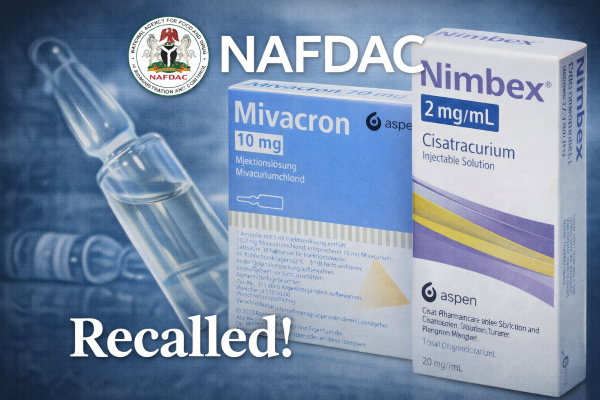
Nigeria’s drug safety regulator has moved swiftly to protect patients and clinicians, announcing the recall of two widely used anaesthetic injections after quality concerns emerged from overseas manufacturing controls.
A Precaution With High-Stakes Implications
The National Agency for Food and Drug Administration and Control (NAFDAC) has issued a public alert on the recall of Mivacron Injection (0.2%) and Nimbex Injection (2mg/mL), both essential medicines in surgical and intensive-care settings. The affected products are manufactured by Aspen Pharmacare Asia Limited, with the recall triggered by safety concerns approved by the Hong Kong Department of Health.




According to NAFDAC, one batch of Mivacron and five batches of Nimbex are impacted. The recall is precautionary but serious, following findings that the manufacturer’s manual visual inspection process may not have detected all glass particles in ampoules—a risk that can have grave clinical consequences.
“The recall was made as a precautionary measure due to potential quality issues identified by the manufacturer,” NAFDAC stated, adding that inspection deficiencies meant “not all glass particles in the ampoules were likely detected.”
Why This Matters: Clinical & Patient Safety
Mivacron (mivacurium) and Nimbex (cisatracurium) are prescription neuromuscular blocking agents used as adjuncts to general anaesthesia. They are critical in surgeries and intensive care units, where dosing accuracy and product integrity are non-negotiable. Any particulate contamination—even rare—poses risks ranging from vascular injury to severe adverse events.
This recall underscores a broader truth in pharmaceutical governance: quality lapses anywhere in a global supply chain can have immediate local consequences. For Nigeria’s healthcare system, the incident reinforces the importance of vigilant pharmacovigilance and rapid regulatory response.
What Healthcare Providers and Patients Should Do
- Immediate vigilance: Hospitals, pharmacies, and anaesthesia teams should quarantine affected batches and switch to verified alternatives.
- Report suspected products: NAFDAC urges healthcare professionals and consumers to report any suspected substandard medicines to the nearest NAFDAC office or through its official e-reporting platforms.
- Strengthen checks: Facilities should review incoming stock verification and supplier documentation, especially for high-risk injectables.
BRANDECONOMY Insight
This episode is not just a recall; it is a stress test of Nigeria’s drug safety architecture. NAFDAC’s decisive action reflects maturing regulatory capacity, but it also highlights the need for continuous oversight of offshore manufacturing, tighter inspection protocols for injectables, and stronger collaboration with global regulators. As Nigeria pushes to deepen local pharmaceutical manufacturing, quality assurance must remain the cornerstone—because in healthcare, trust is built molecule by molecule.