Malami Detained as EFCC Intensifies Probe Into Alleged Loot Diversion, Terror Financing

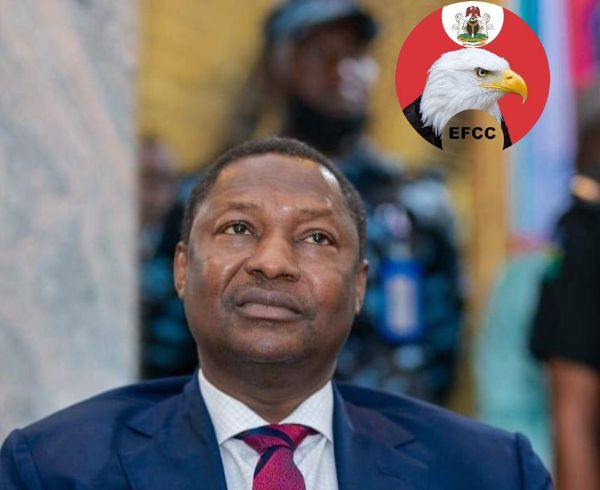
Nigeria’s anti-graft landscape took a dramatic turn on Tuesday as the Economic and Financial Crimes Commission (EFCC) detained former Attorney-General of the Federation and Minister of Justice, Abubakar Malami, SAN, after he failed to meet the bail conditions tied to a widening probe into alleged financial crimes, terrorism financing, and the handling of recovered Abacha funds.
Multiple EFCC sources confirmed that the former AGF—long viewed as one of the most powerful figures in the Buhari administration—remained in custody as investigators continued to question him on 18 separate allegations, ranging from money laundering to abuse of office and suspicious financial transactions.




According to investigators, Malami is expected to face daily interrogation throughout December as the agency expands its inquiry into the whereabouts of recovered Abacha loot, including funds returned by Switzerland and the Island of Jersey. The probe also covers alleged terrorism financing links, a claim the former minister has described as “fabricated.”
Despite being granted administrative bail, Malami was said to have failed to satisfy the terms, prompting the EFCC to hold him pending compliance.
An official familiar with the investigation told News Agency of Nigeria (NAN).
“The offences are extensive. As we probe deeper, more transactions and networks emerge. He will remain with us until all bail conditions are met.”
Malami, in his first formal response, maintained that his record in office directly contradicts any suggestion of complicity.
“During my tenure, I strengthened Nigeria’s frameworks against money laundering and terror financing—not weakened them,” he insisted.
His defence underscores the legal and political complexity surrounding the case, especially as the investigation touches on two decades of national concerns over transparency in the management of recovered stolen assets.
BRANDECONOMY Analysis: A Test Case for Accountability in High Office
Malami’s detention marks a watershed moment in Nigeria’s pursuit of high-level accountability. For years, civil society organisations and international partners have demanded clearer mechanisms for tracking recovered illicit assets—particularly the notorious Abacha funds, which have cycled through repatriation and redistribution with recurrent opacity.
What makes this case even more consequential is the allegation of potential links to terrorism financing—an area where global compliance standards, FATF rules, and domestic security concerns now intersect sharply with political governance.
For the financial markets, diplomatic partners, and governance reform advocates, the outcome of this investigation will serve as a signal for Nigeria’s seriousness in tackling entrenched corruption. For the judiciary, it raises questions about the durability of legal safeguards when political power shifts hands.
Whether this ends in prosecution, exoneration, or political bargaining, the Malami inquiry will likely reshape national debates on elite accountability, prosecutorial independence, and the fate of long-criticised institutional loopholes.