A High-Stakes Test of Asset Recovery, Due Process and Judicial Credibility in Nigeria
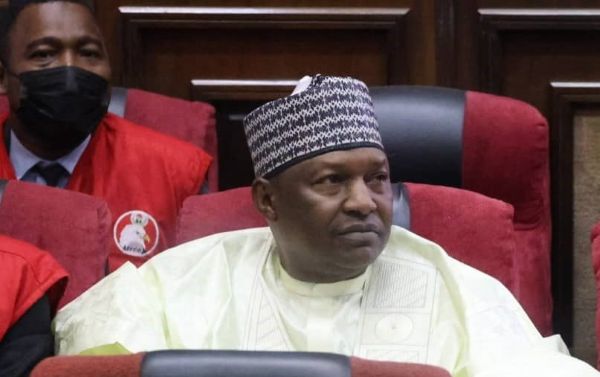
Nigeria’s anti-corruption jurisprudence entered a consequential phase this week as the Federal High Court ordered the interim forfeiture of 57 high-value assets allegedly linked to Abubakar Malami, a former Attorney-General of the Federation and Senior Advocate of Nigeria.
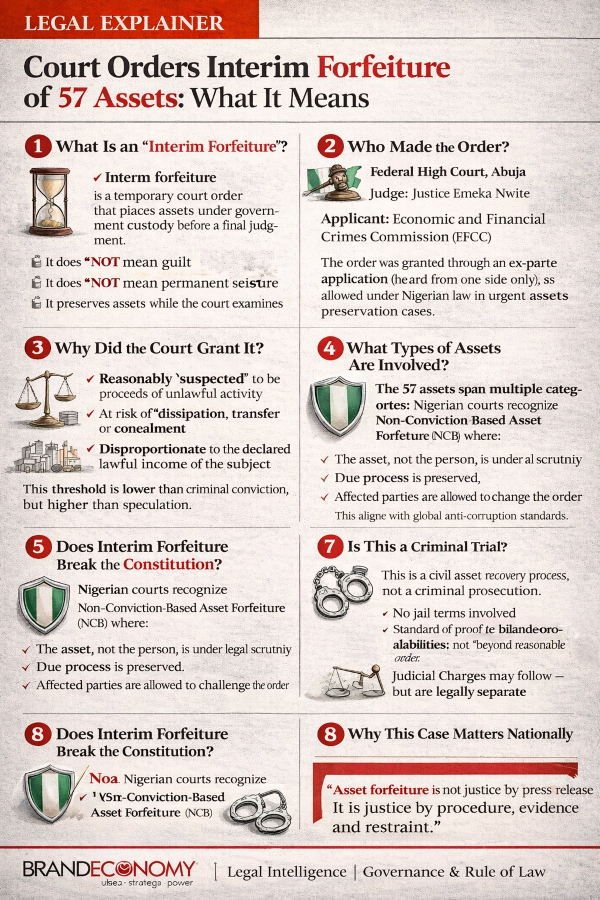
The ruling—delivered by Justice Emeka Nwite following an ex-parte application by the Economic and Financial Crimes Commission—places multi-billion-naira properties across Abuja, Kebbi, Kano and Kaduna under temporary federal custody, pending a full determination on their provenance.




At stake is not only the fate of one of the most extensive asset forfeiture actions involving a former justice minister, but also the integrity of Nigeria’s evolving framework for non-conviction-based asset recovery.
What the Court Actually Ordered—and Why It Matters
The court held that the listed assets are “reasonably suspected to be proceeds of unlawful activities”, a legal threshold that permits interim forfeiture under Nigerian law without a prior criminal conviction.
Crucially, the judge also ordered:
- Nationwide publication of the forfeiture order, and
- A 14-day window for any interested party to show cause why the properties should not be permanently forfeited to the Federal Government.
This procedural safeguard anchors the ruling firmly within constitutional due process, shifting the burden—temporarily but lawfully—onto claimants to demonstrate legitimate ownership.
A Portfolio That Raises Red Flags
The assets placed under interim forfeiture span:
- Luxury residential properties in Maitama, Asokoro, Garki and Wuse II
- High-end hotels and commercial plazas in Abuja and Kano
- Large tracts of land in Kebbi State
- Industrial and agro-processing facilities, including factories and storage complexes
- Educational infrastructure, notably a private university with multiple campuses
- Mixed-use estates, warehouses and malls, some acquired during or shortly after Malami’s tenure
Court filings suggest valuation running into hundreds of billions of naira, sharply contrasting with the officially declared income and assets attributed to the former minister during his eight years in office.
The Legal Core: Income Disparity and Asset Tracing
Investigators allege that:
- Malami earned under ₦90 million in cumulative salary between 2015 and 2023, plus severance and estacodes
- His declared personal assets at one point stood at roughly ₦41 million
- Several properties were allegedly acquired through front companies, associates, or controlled entities
Under Nigerian law, such discrepancies—if proven—trigger the doctrine of unexplained wealth, a cornerstone of modern asset-recovery regimes globally.
Importantly, estacodes and travel allowances, while lawful, do not constitute personal income, a distinction the court is expected to interrogate carefully at the substantive stage.
Non-Conviction Asset Forfeiture: Lawful—but Contentious
Nigeria’s use of interim forfeiture without prior conviction aligns with global anti-corruption practice, particularly where:
- Assets risk dissipation
- Ownership structures are opaque
- Public interest outweighs delay
However, the doctrine is controversial, especially when deployed against politically exposed persons. Its legitimacy depends entirely on judicial restraint, evidentiary rigor, and transparent adjudication.
This case will therefore test whether Nigeria can balance:
- Aggressive asset recovery, and
- Protection of constitutional rights, including presumption of innocence and fair hearing.
Why This Case Is Bigger Than One Man
Beyond personalities, the Malami forfeiture action has wide-ranging implications:
- For governance: It signals that former power brokers are no longer immune from post-office scrutiny.
- For investors: It reinforces the importance of rule-based enforcement over selective justice.
- For the judiciary: It elevates the courts as arbiters not just of guilt, but of economic accountability.
- For anti-corruption credibility: The outcome will either strengthen or weaken public trust in asset recovery as a tool of justice—not vengeance.
What Happens Next
The next legal milestones are decisive:
- Interested parties must file objections within 14 days of publication
- The court will assess evidence of lawful acquisition, not political narratives
- Failure to rebut the presumption could lead to final forfeiture, transferring ownership permanently to the state
Conversely, credible proof of legitimate funding could see some or all assets released.
BRANDECONOMY INSIGHT
This case is not about optics—it is about institutional maturity.
Nigeria’s anti-corruption war will not be won by headlines or asset seizures alone, but by courts that apply the law consistently, transparently, and without fear or favour. If the Malami forfeiture process follows due process to its logical conclusion—whatever that conclusion may be—it could become a benchmark case in restoring confidence in public office, asset disclosure, and judicial independence.
Handled poorly, it risks deepening cynicism.
Handled well, it could redefine accountability at the very top.