Lekki Deep Sea Port Hits 50% Capacity as Nigeria Customs Automation Accelerates Cargo Flow
How Lekki Deep Sea Port Hit 50% Capacity

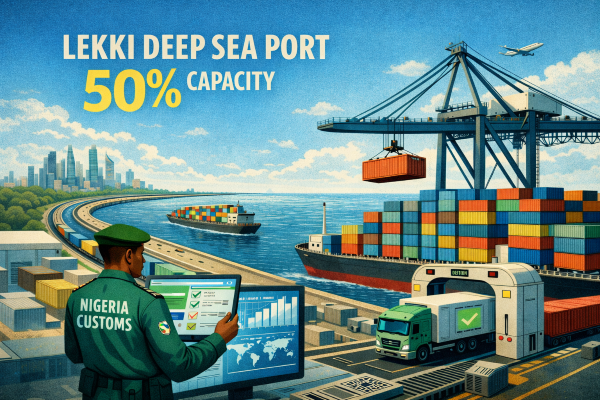
Nigeria’s flagship deep seaport, Lekki Deep Sea Port, has reached nearly 50 per cent of its designed operational capacity, with accelerating cargo throughput driven in large part by scaling automation within Nigeria Customs Service (NCS) processes and the port’s end-to-end digital architecture.
The milestone signals a structural shift in Nigeria’s maritime operations—away from manual, congestion-prone workflows toward technology-enabled trade facilitation that is reshaping cargo clearance, vessel turnaround and hinterland evacuation.




Throughput Growth Meets Digital Trade Facilitation
The Managing Director of Lekki Port LFTZ Enterprise Ltd., Wang Qiang, disclosed the performance benchmark during an end-of-year media engagement in Lagos, noting that container traffic has recorded steady month-on-month growth since September 2025.
Handling volumes measured in twenty-foot equivalent units (TEUs) have risen consistently, reflecting growing confidence among shipping lines and cargo owners in the port’s ability to deliver predictable clearance timelines supported by Customs-led automation.
Reaching the 50 per cent threshold so early in the port’s lifecycle underscores how digital customs processes—rather than physical expansion—are emerging as the primary growth catalyst.
Nigeria Customs Automation: The Efficiency Multiplier
Lekki Deep Sea Port was conceived as a fully automated terminal, but Wang stressed that its true efficiency gains are now being unlocked by progressive automation within Nigeria Customs operations.
Digital integration between the Customs platform, terminal operating systems and customer interfaces is reducing manual intervention, improving risk profiling and enabling faster cargo release—key ingredients in lowering dwell time and logistics costs.
However, Wang noted that residual physical cargo examinations and partial digital adoption across agencies remain bottlenecks. Full end-to-end automation, particularly in inspections and documentation, would significantly compress clearance cycles and unlock the port’s full productivity potential.
“For automation to deliver world-class outcomes, Customs, operators and customers must function as a single digital ecosystem,” he said.
Multimodal Evacuation Reinforces Automation Gains
Beyond clearance speed, multimodal connectivity is amplifying the benefits of Customs automation. Barge operations now account for about 10 per cent of cargo evacuation, providing an efficient alternative to road transport and easing pressure on Lagos corridors.
Strategic infrastructure projects—including the Lagos–Calabar Coastal Road and planned rail links—are expected to further distribute cargo inland, ensuring that automation gains at the port are not lost to post-clearance congestion.
Scaling Capacity Without Physical Expansion
One of Lekki Port’s defining advantages lies in its ability to scale throughput through process optimisation, rather than immediate physical expansion. With seamless Customs integration, data-driven inspections and improved hinterland access, the port can effectively double capacity using existing infrastructure.
This productivity-led model mirrors global best practice, where speed, transparency and system interoperability determine competitiveness more than quay length or crane count.
Implications for Nigeria’s Blue Economy
The convergence of world-class port infrastructure and Customs automation positions Lekki Deep Sea Port as a cornerstone of Nigeria’s Blue Economy strategy. Faster cargo clearance lowers trade costs, enhances supply-chain reliability and strengthens Nigeria’s appeal as a regional logistics hub.
As automation deepens, the port is poised to shift Nigeria’s maritime narrative from congestion management to trade efficiency and value creation.
BRANDECONOMY Insight
Lekki Port’s rise to 50 per cent capacity confirms a hard truth: Customs automation is now the single most powerful lever of port efficiency in Nigeria. The infrastructure is ready, global operators are responding and cargo volumes are rising. What remains is total alignment across all border agencies. If Customs-led automation is fully institutionalised, Lekki Deep Sea Port could become West Africa’s benchmark for digital trade. If not, its full potential will remain throttled by partial reforms.