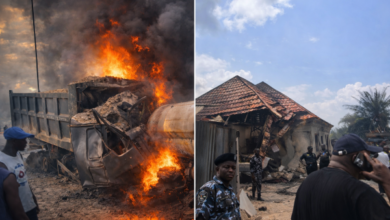
Fire Outbreak Hits Lagos Airport Terminal 1 — FAAN Assures No Casualties

 The Federal Airports Authority of Nigeria (FAAN) has confirmed a fire outbreak at Terminal One of the Murtala Muhammed International Airport (MMIA), Lagos.
In a public update, FAAN stated that its in-house firefighting team responded immediately to contain the situation and that no loss of life had been recorded. Emergency evacuation of passengers and airport personnel was carried out in an orderly manner.




The authority further disclosed that mutual aid arrangements were activated to reinforce response capacity. Support was requested from the Lagos State Government, Julius Berger Nigeria Plc, China Civil Engineering Construction Corporation, the Lagos State Emergency Management Agency (LASEMA), and other emergency services.
FAAN reassured the public that all necessary measures were being taken to safeguard lives and property, adding that verified updates would be communicated as investigations and containment efforts progress.
Context: Terminal One’s Modernisation Debate
The incident comes amid ongoing discussions around the proposed comprehensive remodelling of Terminal One.
Last year, the Federal Government approved a major redevelopment plan for the facility, estimated at ₦712 billion. The Minister of Aviation and Aerospace Development, Festus Keyamo, argued that the terminal — originally commissioned in 1979 — had deteriorated significantly and required structural overhaul to meet modern international standards.
The proposed reconstruction is positioned as part of a broader ambition to transform Lagos into a competitive regional aviation hub. However, the scale of the investment has generated public debate, particularly in the context of fiscal pressures, inflation and competing infrastructure priorities.
The fire incident is likely to intensify scrutiny over the condition of existing infrastructure and the urgency of modernisation efforts.
BRANDECONOMY Insight
The Airport fire outbreak underscores three structural issues within Nigeria’s aviation ecosystem:
- Infrastructure Age and Risk Exposure
Terminal One is over four decades old. Aging infrastructure elevates operational and safety risks, particularly in high-traffic facilities where systems require continuous modernisation. - Hub Ambition vs. Execution Capacity
Nigeria’s aspiration to reposition Lagos as a West African aviation hub depends not just on rebuilding terminals but on integrated systems — safety protocols, inter-terminal connectivity, passenger processing efficiency and airline confidence. - Public Trust and Investment Justification
Large-scale infrastructure approvals demand public transparency and measurable milestones. Incidents like this reinforce the argument for structured capital investment — but also for cost discipline and oversight.
If managed effectively, this incident may accelerate policy momentum toward airport modernisation. However, credibility will depend on transparent investigation findings, clear remediation timelines and visible safety upgrades.
Nigeria’s aviation sector sits at the intersection of tourism, trade, logistics and investor perception. Safety assurance and infrastructure reliability are not optional — they are competitive necessities.