FIRS–France Digital Tax Pact Signals Nigeria’s Revenue Transformation – Zacch Adedeji


A New Era of Technology-Driven Tax Administration
Nigeria’s revenue future is shifting—and fast. As the Federal Inland Revenue Service (FIRS) prepares to evolve into the Nigeria Revenue Service (NRS) in January 2026, the agency has taken a decisive step by entering a landmark cooperation pact with France’s tax authority, Direction Générale des Finances Publiques (DGFiP).
The agreement, signed at the French Embassy in Abuja by FIRS Chairman Zacch Adedeji and France’s Ambassador to Nigeria Marc Fonbaustier, marks one of the most ambitious international tax modernisation moves in Nigeria’s history.
It signals a deep recognition: the world’s tax systems are being re-engineered by digital technology, artificial intelligence, cybersecurity demands, and borderless digital commerce—and Nigeria must not be left behind.
Why This Partnership Matters Now
Nigeria has long battled structural weaknesses in tax administration:
– A low tax-to-GDP ratio averaging 6–10% (vs. Africa’s 15% benchmark)
– Fragmented systems across federal and state actors
– Weak cross-border enforcement
– Limited digital compliance infrastructure
With the country aggressively expanding its digital economy—from fintech to e-commerce to remote work—revenue leakages have grown more complex and harder to track. France, meanwhile, is widely regarded as a global leader in digital tax reforms, having deployed:
– Automated AI-driven compliance engines
– Real-time data analytics
– Advanced e-filing and taxpayer service platforms
– Cybersecure enforcement systems
By partnering with DGFiP, Nigeria positions itself to acquire world-class tax technology, auditing intelligence and workforce development frameworks.

A Two-Way Knowledge Exchange
FIRS Chairman Zacch Adedeji underscored that the partnership is not merely technical assistance—it is a two-way innovation exchange.
Nigeria gains:
- Access to France’s automated compliance systems
- Models for data-driven audit selection
- Exposure to global best practices on cross-border taxation
- Tools for managing digital commerce and platform taxation
France learns from Nigeria:
- How to navigate a rapidly digitising market of 220+ million young, tech-savvy consumers
- Insights into agile digital adoption in emerging markets
- Approaches to scaling public-finance systems within youthful workforces
In Adedeji’s words, “Both countries must adapt to emerging challenges such as AI deployment, cybersecurity, and cross-border taxation. This partnership strengthens that transition.”
Preparing for the Nigeria Revenue Service Era
The pact is strategically timed ahead of Nigeria’s transition into the NRS, designed to unify tax processes, strengthen enforcement and transform the country’s revenue administration culture.
Key areas of collaboration include:
1. Digital Transformation
- Automated compliance systems
- Integrated taxpayer portals
- Algorithm-driven audit engines
- Real-time data exchange
2. Human Capital & Institutional Culture
Nigeria aims to adopt France’s structured professional standards and continuous learning systems while offering DGFiP new insights on managing young, diverse, high-growth workforces.
3. International Taxation & BEPS Enforcement
The MoU covers:
- Exchange of information
- Transfer pricing monitoring
- Base Erosion & Profit Shifting (BEPS) frameworks
- Joint approaches to taxing digital multinationals
In a global economy where trillions move through digital channels, tax cooperation has become a competitive necessity—not a diplomatic luxury.
Implications for Nigeria’s Revenue Future
The partnership strengthens Nigeria’s ability to:
- Widen the tax base without raising rates
- Curb illicit financial flows
- Improve transparency and leak-proofing
- Compete globally for investment
- Build trust in public finance institutions
By embedding AI, automation and global compliance standards into its operations, the NRS will operate with a level of precision that aligns with international expectations for modern tax regimes.
What’s the Real Reason Behind the FIRS-France Digital Tax Reform Partnership?
This move, however, has sparked both curiosity and scrutiny. Nigeria’s Federal Inland Revenue Service (FIRS) has entered into a high-profile partnership with France’s tax authority, the Direction Générale des Finances Publiques (DGFP). The headline question on many minds is: why is this partnership so critical, and what does it mean for Nigeria’s fiscal future?
Digging Deeper: The Why and the Concerns
At its core, the agreement between FIRS and DGFP is about modernizing Nigeria’s tax administration through digital transformation and cross-border enforcement. For a country grappling with a historically low tax-to-GDP ratio—averaging around 6-10%, significantly below the African average—this partnership is positioned as a bold step toward a more transparent and tech-driven revenue service.




Yet, it’s also stirred concerns among critics at home. Some Nigerians are asking if this reliance on a foreign partnership is a vote of no-confidence in Nigeria’s own capacity to reform its tax system independently. Others wonder if the collaboration might lead to policy shifts that could inadvertently disadvantage local businesses or impose unfamiliar European-style tax practices that don’t neatly align with Nigeria’s economic realities.
The Global Context: Who Else Has Benefited?
France is known for its advanced digital tax reforms and has partnered with other developing economies, notably in parts of Francophone Africa, to modernize tax systems. For example, Senegal has engaged in similar partnerships that have helped streamline its tax compliance systems and increase revenue collection efficiency. The idea is that these partnerships can inject fresh technological know-how and create a two-way learning street.
What Nigeria Could Gain—or Lose
On the upside, Nigeria stands to gain cutting-edge expertise in digital compliance and taxpayer services that could significantly reduce tax evasion and broaden the tax base without introducing new levies. However, skeptics caution that becoming too reliant on external models might overlook local nuances. Critics argue that Nigeria must ensure that any digital tax reform is adaptable to its unique economic landscape, balancing the benefits of international collaboration with homegrown realities.
Nigeria moves toward a new tax era—but critics warn of hidden risks
The pact—coming just weeks before FIRS transitions into the Nigeria Revenue Service (NRS)—is being hailed by government officials as a strategic accelerator for digital tax reform. But as the dust settles, a new question has emerged:
Why France—why now—and what does Nigeria stand to gain or lose from this global tax realignment?
A Partnership Born of Necessity—or Urgency?
Nigeria has struggled for decades with chronically low tax-to-GDP ratios, weak enforcement, fragmented systems and a growing digital economy that continues to outpace tax regulation.
The FIRS–France partnership attempts to address three urgent national weaknesses:
1. Digital enforcement gaps
France is one of the world’s most sophisticated tax jurisdictions, having pioneered algorithm-driven compliance systems, AI-enabled audits and real-time data analytics. Nigeria wants to tap directly into this model.
2. Weak cross-border taxation
Multinational tech giants and digital service operators currently extract enormous value from Nigeria with limited taxable footprints. DGFP’s expertise in cross-border taxation is expected to help Nigeria reverse this revenue leakage.
3. Institutional transformation ahead of the NRS launch
The upcoming Nigeria Revenue Service is being positioned as a more transparent, tech-driven, globally compliant tax authority. The France pact is meant to serve as one of its cornerstones.
But Critics Are Asking the Hard Questions
Despite the celebration, many Nigerians remain cautious. The prevailing concerns include:
1. Does the partnership signal a lack of faith in Nigerian expertise?
With Nigeria boasting one of Africa’s fastest-growing tech ecosystems, critics question why foreign guidance—not local talent—is at the centre of reform.
2. Will imported models suffocate domestic realities?
European tax templates may not align with the complexities of Nigeria’s informal sector, which accounts for over 50% of economic activity.
3. Could this lead to increased tax surveillance and higher compliance burdens?
Civil society groups argue that without proper safeguards, advanced digital enforcement tools could disproportionately target small businesses and vulnerable taxpayers.
4. What data privacy risks exist?
Taxpayer data—among the most sensitive national assets—must not be exposed to foreign jurisdictions or external influence.
Does This Kind of Partnership Actually Work? Lessons From Other Developing Economies
France has offered similar technical partnerships to developing economies, including:
▸ Senegal – successfully implemented automated compliance systems that increased tax revenue and reduced leakages.
▸ Morocco – leveraged French advisory support to create advanced e-filing and unified taxpayer databases.
The results were mixed but generally positive—when local adaptation was prioritised.
For Nigeria, the key question is:
Will this transformation be Nigerian-led—or French-prescribed?
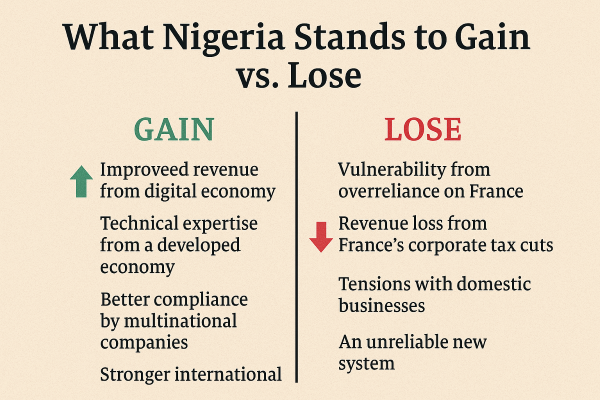
What Nigeria Stands to Gain
If implemented with nuance, Nigeria could unlock:
- Stronger digital tax compliance
- A broader tax base without new taxes
- Automated, transparent taxpayer services
- Reduced leakages and corruption
- Better tracking of multinational and digital company revenue
- Improved capacity for AI-driven tax enforcement
What Nigeria Could Lose
If poorly implemented, risks could include:
- Over-reliance on foreign systems
- Policy misalignment with Nigeria’s informal economy
- Technology that outpaces local regulatory capacity
- Increased public resistance to tax reforms
- Potential exposure or misuse of national taxpayer data
BRANDECONOMY VERDICT
In the grand scheme, the Nigeria-France tax partnership is a double-edged sword. It’s a strategic leap towards a more efficient, tech-forward tax regime but also a reminder that the success of such reforms will hinge on how well they’re localized. Nigerians will be watching closely to see if this partnership truly delivers on its promises without unintended consequences.
Nigeria desperately needs a tax system that is modern, fair and digitally intelligent. The partnership with France could be transformational—but only if Nigeria insists on leading the agenda, shaping the framework and protecting national interest every step of the way.
Revenue reform cannot become revenue surrender.
Digital innovation cannot become digital dependence.
And tax modernization must always be citizen-centred—not punitive.