FG Partners RSE Energy to Power Industrial Clusters With Off-Grid Solutions

Nigeria’s industrialisation drive received a strategic energy boost as the Federal Government sealed a landmark Memorandum of Understanding (MoU) with RSE Energy Nigeria to deploy off-grid and embedded power systems across key industrial clusters nationwide.
The partnership signals a decisive shift away from grid dependency toward decentralised, reliable energy infrastructure—a move widely regarded by development economists as critical to restoring industrial competitiveness, lowering production costs, and unlocking value across manufacturing and agro-processing corridors.




Energy at the Centre of Industrial Policy
Speaking at the signing ceremony in Abuja, the Minister of State for Industry, John Enoh, described the MoU as the culmination of months of engagement and policy alignment—one that directly addresses the most binding constraint facing Nigerian industry.
“Energy remains the biggest challenge of industry in our country,” Enoh said, noting that the agreement dovetails with recent ministerial roundtables convened to tackle structural bottlenecks to industrial growth.
The MoU outlines reciprocal commitments between the government—through the Ministry of Industry, Trade and Investment—and RSE Energy, providing a framework for rapid deployment of biomass- and gas-based embedded power systems tailored to industrial clusters, special economic zones, and agro-processing hubs.
From Grid Risk to Energy Certainty
At its core, the partnership is about energy certainty. Nigeria’s manufacturers have long battled erratic grid supply, self-generation costs, and fuel price volatility—factors that erode margins and undermine export competitiveness.
By prioritising off-grid and embedded solutions, the MoU aims to:
- Deliver predictable, 24/7 power to clustered industries
- Reduce reliance on diesel generation
- Improve environmental performance through cleaner fuels
- Enable scalable energy systems aligned with industrial demand
The Idu Industrial Cluster in Abuja has been identified as a pilot site—an intentional testbed to demonstrate technical viability, cost efficiency, and replicability across other industrial zones.
Policy Alignment With National Energy Vision
The Permanent Secretary of the Ministry, Nura Rimi, underscored that the agreement aligns squarely with the administration’s broader reform agenda, particularly the Renewed Hope Agenda of President Bola Tinubu.
From a development standpoint, decentralised energy is increasingly recognised as the fastest pathway to industrial resilience in emerging economies—bypassing grid constraints while catalysing local production and employment.
RSE Energy’s Decentralised Playbook
For RSE Energy, the Nigerian partnership is rooted in field-tested experience rather than theoretical promise. Chief Executive Officer Olena Nedryhailo said the company’s approach is shaped by real-world deployment of decentralised co-generation systems under extreme stress conditions.
Over the past three years, RSE Energy has supported industrial communities in Ukraine, deploying more than 1,020 co-generation units during periods of severe grid disruption.
“This experience taught us how systems integrate into networks, scale, and remain reliable over time,” Nedryhailo said, adding that the company views itself as a long-term partner, not merely a supplier.
That philosophy resonates strongly with Nigeria’s need for durable energy infrastructure, not stop-gap solutions.
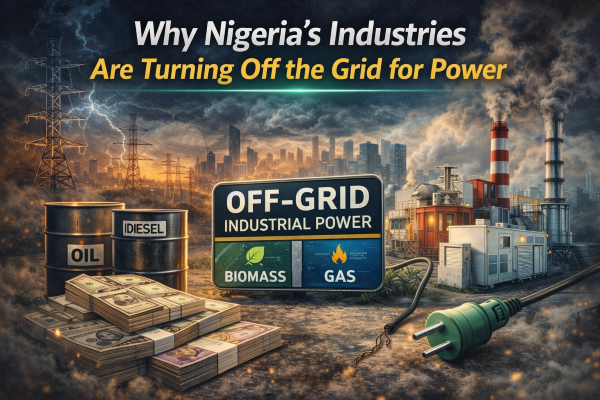
Powering Production, Not Promises: Why Nigeria’s Industries Are Turning Off the Grid
For decades, Nigeria’s biggest constraint to industrial growth has not been policy ambition, market size, or entrepreneurial energy—it has been power. Unreliable electricity has quietly imposed a “shadow tax” on businesses, eroding margins, stunting scale, and pushing manufacturers into survival mode.
Against this backdrop, the Federal Government’s newly signed off-grid and embedded power MoU with RSE Energy Nigeria is less a routine partnership and more a strategic response to a long-festering structural failure.
Nigeria’s Power Paradox
Nigeria is Africa’s largest economy and most populous market, yet its industries operate under power conditions more typical of fragile states. Installed generation capacity may exceed 13,000MW on paper, but effective, reliable power delivered to end-users remains a fraction of demand.
For businesses, the consequences are severe:
- Manufacturers self-generate power for 60–80% of operating hours
- Energy costs consume 30–40% of production expenses
- Diesel dependency exposes firms to FX volatility and fuel price shocks
- SMEs are priced out of scale before they can grow
In effect, Nigeria’s grid has functioned less as a backbone and more as a risk factor.
Why This Matters for Growth
From an energy-development lens, the MoU reflects a maturing policy logic: industrial growth follows energy reliability. Embedded power in clusters:
- Lowers unit energy costs through shared infrastructure
- Attracts private capital into manufacturing zones
- Improves productivity and export readiness
- Strengthens food security via powered agro-processing
If scaled successfully, the model could redefine Nigeria’s industrial geography, enabling clusters outside traditional grid-favoured corridors to compete nationally and regionally.
BRANDECONOMY Insight
This agreement marks a quiet but consequential pivot in Nigeria’s industrial strategy—from grid-centric dependence to cluster-centric energy resilience. The real test will be execution: speed of rollout, tariff competitiveness, and replication beyond the pilot phase.
If delivered as designed, the FG–RSE Energy partnership could become a template for industrial energy reform, anchoring productivity, reducing emissions, and restoring confidence in Nigeria as a viable manufacturing base.