Headline: FCCPC Seals Ikeja Electric After Court-Backed Order to Protect Consumer Rights

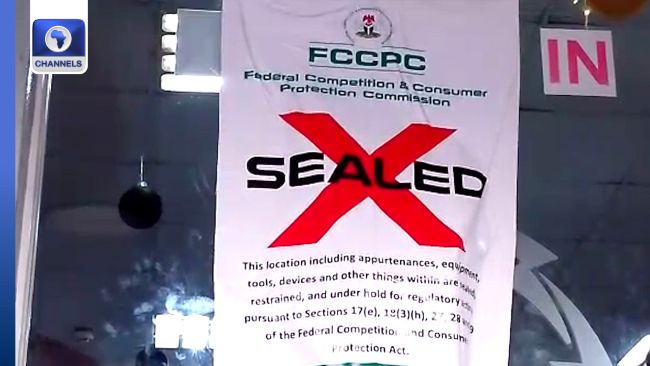
In a decisive move underscoring Nigeria’s intensifying battle against energy-sector abuses, the Federal Competition and Consumer Protection Commission (FCCPC) has enforced a court-backed sealing of Ikeja Electric’s corporate premises after the power utility repeatedly failed to comply with regulatory directives protecting consumer rights.
The enforcement—executed on Thursday at the company’s Alausa, Lagos headquarters—marks one of the Commission’s strongest interventions yet under the Federal Competition and Consumer Protection Act (FCCPA) 2018. FCCPC officials say the action was taken only after months of unheeded warnings, documented infractions, and a binding ruling that Ikeja Electric allegedly ignored.




According to FCCPC’s Director of Surveillance and Investigation, Bola Adeyinka, the Commission acted strictly within the powers affirmed by the court to ensure that electricity consumers are not subjected to unlawful disconnections, inflated billing, meter manipulation, or systemic denial of service.
“The seal will remain until Ikeja Electric complies fully with directives issued by both NERC and the FCCPC—and provides written evidence of that compliance. This is a measured enforcement action supported by law and triggered only after the company failed to honour several opportunities for voluntary compliance,” Adeyinka stated.
The Complaint That Triggered the Crackdown
At the heart of the case is a long-standing dispute involving a Maximum Demand account that NERC ordered Ikeja Electric to unbundle into 20 distinct non-MD accounts for 19 residential units and one service point. The Commission ruled that the complainant had met every financial and procedural obligation—yet the homes remained without power for over two years.
Despite multiple directives—beginning in April 2025 and reaffirmed in an FCCPC Compliance Notice on October 2—the company allegedly failed to implement the ruling.
The sealing therefore represents not merely administrative action but enforcement of a legal and regulatory mandate designed to protect citizens from protracted energy injustice.
A Pattern of Alleged Abuse
The FCCPC’s Lagos operations have recently been inundated with complaints revealing deeper structural issues at Ikeja Electric:
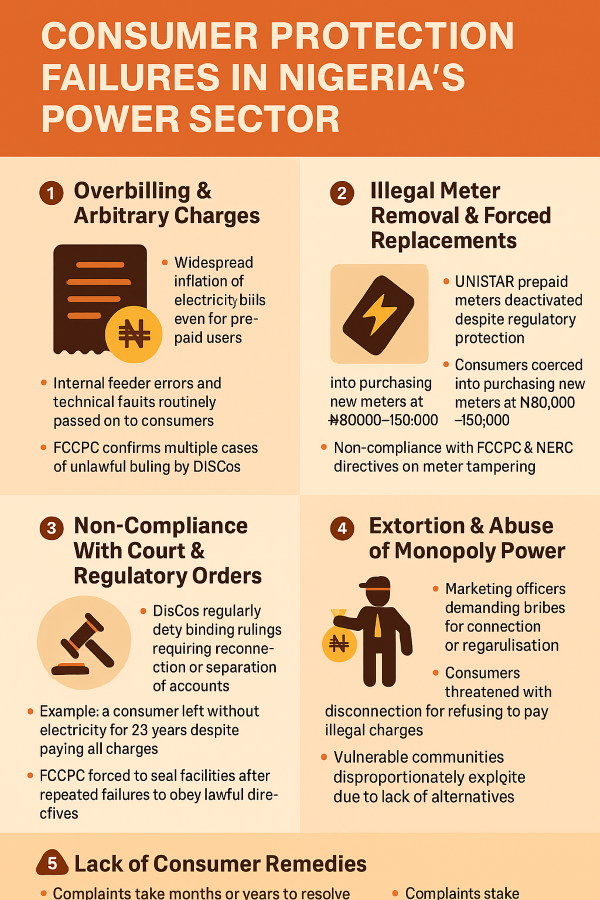
• Inflated billing and feeder misclassification
Residents of an Abesan Estate apartment block successfully proved before FCCPC panels that their prepaid meters had not been tampered with. The Commission found that an internal feeder error originating from IKEDC had triggered massive overbilling.
FCCPC ordered the cancellation of arbitrary debts amounting to:
- ₦463,845
- ₦244,362
- ₦218,030
• Alleged bribery and extortion by field officers
Residents testified that a marketing officer demanded illegal payments and, upon refusal, accused them of meter tampering before imposing exorbitant charges.
• Forced removal of UNISTAR prepaid meters
According to multiple complaints—including that of LASU scholar Dr. Tunde Akanni—the company allegedly deactivated functioning meters once credit ran out, refused to allow reloading, and then coerced customers into paying ₦120,000 for new meters.
Despite FCCPC directives prohibiting these unlawful replacements, complainants say the practice has persisted—even in quarters belonging to the Lagos State Government.
Why FCCPC Enforcement Matters
Thursday’s sealing shows regulators no longer view the electricity sector’s anti-consumer practices as isolated misconduct—they are now matters of consumer rights, economic justice and public interest.
The court-affirmed FCCPC action signals that utilities must:
- Comply with lawful regulatory decisions
- Respect consumer rights under the FCCPA
- Stop arbitrary billing and extortion
- Provide metering and connection as mandated
- Desist from punitive disconnections
- Address internal operational flaws rather than transferring costs to customers
Electricity is a national economic lifeline. Without strict enforcement, consumers remain vulnerable to predatory practices that undermine productivity, household stability, and public confidence.
BRANDECONOMY Insight
The FCCPC’s sealing of Ikeja Electric is more than a regulatory showdown—it reveals the fragile architecture of Nigeria’s electricity governance.
Three deeper currents stand out:
1. Accountability in the Power Sector Is Becoming Non-Negotiable
For decades, distribution companies have operated with weak consequences for abuses. This action sets a precedent: non-compliance now carries institutional, reputational and economic penalties.
2. Consumer Rights Are Entering a New Era
The FCCPA is no longer theoretical. Its enforcement machinery is clearly functional—and courts are actively backing regulators when consumers are wronged.
3. Electricity Reform Must Include Behavioural Reform
Tariff adjustments, metering initiatives and infrastructure upgrades are meaningless if distribution companies do not overhaul their customer-facing culture.
The sealing of IKEDC is a turning point—one that signals a stronger, more assertive consumer protection regime emerging at the heart of Nigeria’s energy transition.