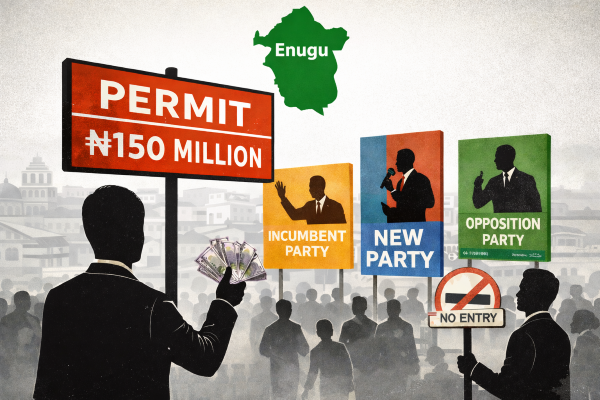
 The Enugu State Government has introduced a ₦150 million mandatory advertising permit for political parties and candidates participating in the 2026 and 2027 local, state and federal elections.
The directive was announced by Mr. Francis Aninwike, General Manager of the Enugu State Structures for Signage and Advertisement Agency (ENSSAA), following a management meeting at the agency’s headquarters in Enugu.




Under the guidelines titled “Outdoor Promotion and Visual Campaign Guidelines for 2026 and 2027 General Elections,” all political parties and candidates must secure a campaign permit before deploying any visual promotional materials across the state’s 17 local government areas.
According to Aninwike, the permit grants authorised rights to engage in outdoor political advertising, including rallies, billboards, banners, branded vehicles, T-shirts, caps, handbills, buntings and street campaigns in both urban and rural areas.
He stated that the policy aligns with ENSSAA’s statutory responsibility to regulate outdoor advertising, maintain environmental aesthetics, prevent visual pollution and safeguard public infrastructure.
The agency warned that failure to comply would result in the removal of unauthorised materials and possible legal sanctions.
Aninwike further clarified that only practitioners registered and licensed by the Advertising Regulatory Council of Nigeria (ARCON) are permitted to erect or manage billboards and campaign structures in the state.
“No individual, political party or support group is allowed to erect advertising structures without going through licensed ARCON practitioners as required by ENSSAA,” he said.
The agency also cautioned against defacing opponents’ campaign materials, describing such acts as unlawful and undemocratic.
Responding to concerns about potential selective enforcement, Aninwike insisted that the guidelines would apply uniformly to all candidates and political parties, including incumbents.
BRANDECONOMY Insight
The ₦150 million political advertising permit represents more than an electoral regulation — it introduces a significant cost barrier into campaign economics ahead of the 2027 electoral cycle.
Three strategic implications emerge:
- Rising Cost of Political Market Entry
For smaller parties and independent candidates, a ₦150 million permit may substantially limit visibility. Campaign finance structures will increasingly determine competitiveness, potentially reinforcing incumbency advantages. - Revenue and Regulatory Discipline
From a fiscal standpoint, the policy could generate substantial non-tax revenue for the state if strictly enforced. It also formalises campaign advertising within structured regulatory frameworks, potentially reducing indiscriminate poster proliferation and environmental degradation. - Political Advertising Industry Consolidation
By restricting billboard erection to ARCON-licensed practitioners, the policy may professionalise campaign advertising while consolidating opportunities within registered agencies and structured outdoor media firms.
However, enforcement credibility will determine whether the policy strengthens governance standards or becomes politically contentious. Transparency in implementation will be critical to maintaining public trust.
As Nigeria approaches the 2027 elections, campaign regulation is increasingly intersecting with fiscal policy, environmental governance and democratic access.
The broader question remains: can regulatory discipline coexist with political inclusivity?