Emefiele Trial: Coercion Claims, Voluntariness Tests and the Rule-of-Law Moment for EFCC, Nigeria

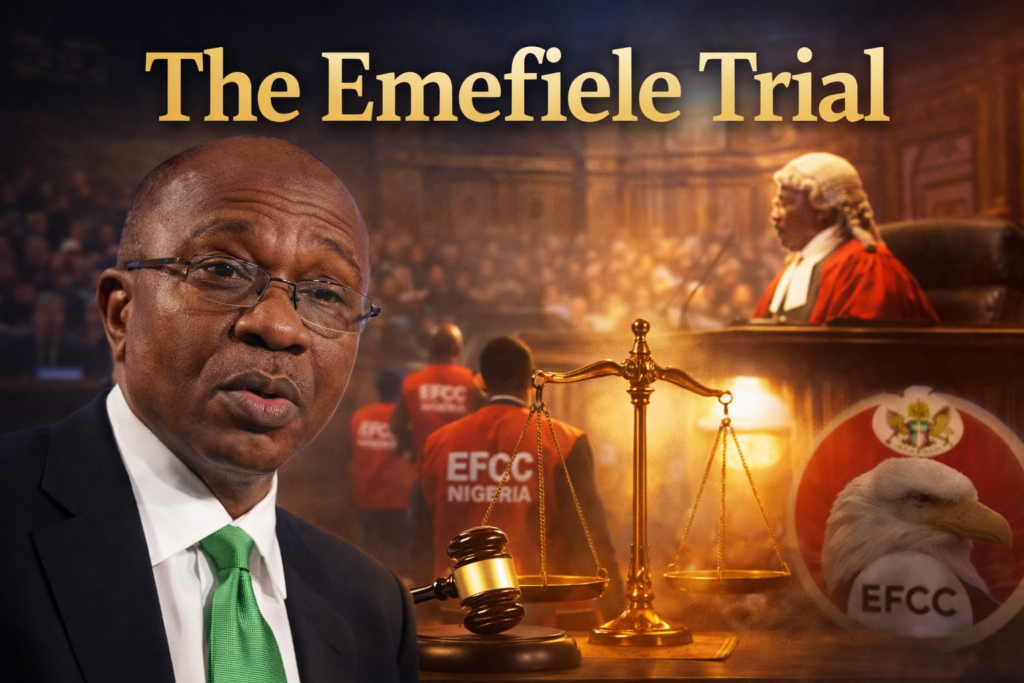
Nigeria’s anti-corruption drive has entered a legally sensitive phase as allegations of coercion, prosecutorial overreach and constitutional safeguards collide in the high-profile criminal trial involving a former central bank chief Godwin Emefiele. At the heart of the controversy is a trial-within-trial ordered by the Lagos State High Court, convened to determine whether statements obtained by the Economic and Financial Crimes Commission were made voluntarily or under improper pressure.
The proceedings form part of the ongoing prosecution of Godwin Emefiele, former Governor of the Central Bank of Nigeria, and his co-defendant, Henry Omoile, over allegations bordering on gratification, corruption and fraudulent receipt of property under Nigeria’s anti-corruption statutes.




Why the Trial-Within-Trial Matters
In Nigerian criminal jurisprudence, a trial-within-trial is not a procedural footnote. It is a constitutional firewall designed to protect the integrity of evidence and the accused person’s right to a fair hearing. Justice Rahman Oshodi, who ordered the mini-trial, is tasked solely with answering one question: Was the statement allegedly made by the second defendant voluntary?
The outcome will determine whether the statement can be admitted as evidence—or struck out entirely.
Defence Allegations: Pressure and Promises
Testifying during the trial-within-trial, Nnamdi Offial, counsel to the second defendant, alleged that EFCC investigators attempted to pressure his client into implicating the former CBN Governor.
According to Offial, his client reported that investigators made promises of bail and even the possibility of not being charged, contingent on providing incriminating information against the first defendant.
“On several occasions, questions were put to the second defendant and he answered, but he was not allowed to write them down because the answers did not conform to what the interrogators wanted him to say. I objected to this many times,” said Nnamdi Offial, Counsel to Henry Omoile.
He further told the court that the interrogation sessions were conducted in a rigid question-and-answer format, with written statements permitted only after investigators deemed oral responses “satisfactory.” Offial added that after a session on February 26, 2024, investigators informed him that his client would be detained because they were “not done” with him.
Detention, Access to Counsel and Rights Claims
Offial recounted that on February 27, 2024, he confronted investigators over questioning conducted in his absence, an encounter that allegedly resulted in his being ordered out of the premises by an officer identified as David. He stated that he was denied access to his client until late evening, when Omoile was returned to detention.
According to the defence, Omoile was subsequently detained for 21 days, prompting the filing of a fundamental rights enforcement action at the Federal High Court. Justice Muslim Hassan granted bail but ordered that the defendant be remanded at the Ikoyi Correctional Centre pending perfection of bail conditions.
From a rights-based perspective, the defence narrative raises classic concerns: prolonged detention, access to counsel, and inducement during interrogation—issues that have repeatedly tested Nigeria’s criminal justice system.
Cross-Examination: Admissions That Complicate the Claim
Under cross-examination by Rotimi Oyedepo, SAN, counsel for the prosecution, the defence account encountered significant legal headwinds.
Offial admitted that:
- His client was cautioned in his presence and signed the cautionary statement.
- He participated in the statement-taking process and knew the statement could be used in court.
- He did not file any petition or formal complaint against the EFCC regarding the alleged conduct.
- The Federal High Court, in the fundamental rights suit, did not find the EFCC guilty of any misconduct.
- His client was not harassed in his presence during interrogation.
These admissions introduce a critical evidentiary tension: allegations of coercion juxtaposed against contemporaneous procedural compliance.
The Broader Legal and Institutional Stakes
For the EFCC, the case underscores the perennial challenge of balancing aggressive investigation with strict adherence to due process. For the judiciary, it is a test of institutional independence—demonstrating that anti-corruption prosecutions must pass constitutional scrutiny, regardless of the profile of the accused.
For Nigeria’s financial and business community, the implications are wider still. The trial of a former central bank governor reverberates across investor confidence, institutional credibility and perceptions of regulatory governance.
BRANDECONOMY Insight
The Emefiele case is no longer merely about alleged financial misconduct. It has become a referendum on investigative ethics, prosecutorial restraint and the judiciary’s role as guardian of rights. Whether the contested statements survive the trial-within-trial will shape not only the trajectory of the Emefiele prosecution, but also the standards by which Nigeria’s anti-graft institutions are judged in future high-stakes cases.
Justice Oshodi adjourned proceedings for continuation—setting the stage for a ruling that could recalibrate the balance between enforcement power and constitutional protection.