The Crux of the Matter
 The Crux of the Matter
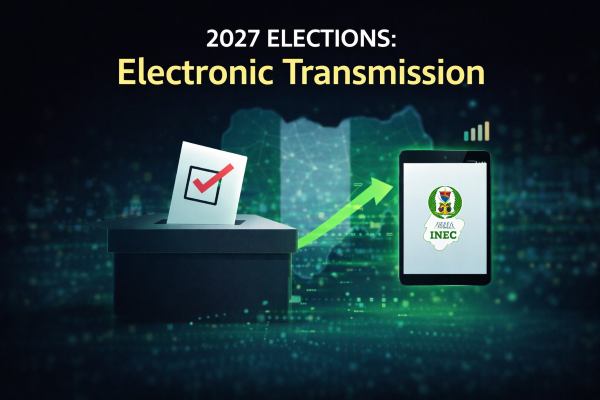
Nigeria’s democracy is confronting a defining institutional test—not at the ballot box, but on the floor of the National Assembly. The controversy surrounding the proposed amendment of the Electoral Act, particularly the refusal to make mandatory electronic transmission of election results explicit in law, has escalated into a broad-based national reckoning over trust, transparency, and democratic credibility.
What is at stake is not merely a technical clause. It is the architecture of electoral legitimacy ahead of the 2027 general elections—and, by extension, the confidence of citizens, investors, and institutions in Nigeria’s governance trajectory.




Context: How a Technical Clause Became a Democratic Flashpoint
At the heart of the dispute lies Section 60(3) of the Electoral Act. While Nigeria’s electoral framework already allows electronic transmission of results, the Senate’s decision to retain discretionary language—rather than impose a clear, mandatory requirement—has triggered widespread alarm.
Labour unions, civil society groups, legal professionals, and democracy advocates argue that ambiguity in result transmission is not neutral. In a polity with a history of disputed outcomes, discretion equals vulnerability.
The pushback reflects deep institutional memory from the 2023 elections, where result collation and transmission failures fuelled litigation, protests, and public disillusionment.
Core Analysis: The Fault Lines Exposed
1. Transparency vs Discretion
The Nigeria Labour Congress (NLC) has been unequivocal. Its president, Joe Ajaero, warned that any ambiguity around electronic transmission undermines the principle that votes must not only be counted, but seen to be counted.
From a governance perspective, this is critical. Electoral credibility relies less on intent and more on verifiability. Systems designed with discretion at critical junctures invite contestation, especially in high-stakes elections.
2. Legislative Ambiguity as Institutional Risk
The Senate’s handling of the amendment—marked by contradictory explanations and unclear records—has compounded public mistrust. The decision to reconvene an emergency plenary session underscores the depth of the backlash and the recognition that process opacity has consequences.
For institutions, ambiguity is not a compromise; it is a risk multiplier.
3. Senate’s Defence: Stability Over Speed
Defending the Senate’s position, Godswill Akpabio argued that mandating “real-time” electronic transmission could expose elections to legal challenges arising from network failures.
He framed the Senate’s intervention as a safeguard against instability, citing international precedents and warning against technology-triggered unrest in a fragile environment.
From a policy lens, this reflects a classic trade-off: technological certainty versus systemic resilience. However, critics argue that this logic confuses implementation challenges with legislative clarity.
4. Legal Community Pushes Back
The Nigerian Bar Association (NBA) has joined calls for a statutory mandate, warning that discretionary language weakens the legal foundation of elections.
NBA President Afam Osigwe, SAN, emphasised that technology-backed transparency is no longer optional in a modern democracy. In the NBA’s view, enforceable electronic transmission is essential to reduce post-election litigation and restore public confidence.
Implications: Beyond Elections
For Democracy
Mandatory electronic transmission is not about perfection; it is about reducing discretion where trust is weakest. Ambiguity risks institutionalising doubt—an outcome far more destabilising than temporary technical glitches.
For Governance
Electoral credibility underpins political legitimacy. Weak legitimacy increases governance costs, policy resistance, and social tension.
For the Economy
Investors watch elections closely. Perceived electoral opacity raises country risk premiums, affects capital inflows, and undermines long-term planning.
Forward Outlook: What Happens Next
Three paths are emerging:
- Legislative Clarification
The Senate harmonises the bill with explicit, enforceable electronic transmission provisions—restoring trust ahead of 2027. - Managed Ambiguity
Discretionary language remains, leaving implementation to Independent National Electoral Commission (INEC), but sustaining public suspicion. - Escalating Civic Pressure
Civil society mobilisation, protests, and legal challenges intensify, further politicising the electoral framework.
The choice will define whether Nigeria moves forward with institutional confidence or procedural doubt.
BRANDECONOMY Insight
This controversy reveals a deeper truth: democracy fails not only through fraud, but through ambiguity.
In societies with fragile trust, clarity is not a luxury—it is a stabiliser. Mandatory electronic transmission is less about technology than about removing human discretion at the most contested point of the electoral process.
Nigeria’s lawmakers face a strategic decision. They can either future-proof the electoral system with clarity and enforceability—or leave the nation navigating elections through interpretation, suspicion, and after-the-fact litigation, deepening the huge trust deficit of Nigerians for the electoral process. This week will give a clear sense of where the legislators opt for.
History suggests only one of these paths strengthens democracy. However, nothing short of a transparent process will give Nigerians the confidence to trust the system…and their government.