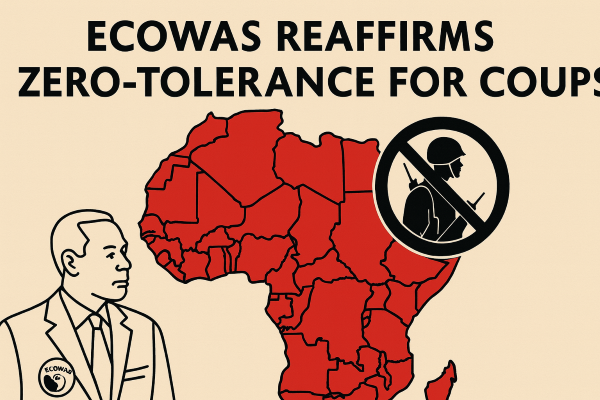
West Africa’s foremost political bloc, ECOWAS, has again drawn a hard red line: no military takeovers, no democratic reversals, no constitutional manipulations.
At the opening of the 95th Ordinary Session of the ECOWAS Council of Ministers in Abuja, Sierra Leone’s Minister of Foreign Affairs and Chair of the Council, Timothy Kabba, delivered one of the bloc’s strongest condemnations yet of unconstitutional change of government.
His message was unmistakable:
ECOWAS must remain united, vigilant, and uncompromising in defending constitutional order across the region.


A Region Under Pressure — and a Bloc Under Scrutiny
West Africa is navigating its most volatile political moment in decades. A string of coups, attempted coups, and suspended constitutions—from Mali to Burkina Faso, Niger, Guinea, and most recently Benin—have jolted confidence in the region’s democratic outlook.
Humanitarian crises, internal displacement, and economic shocks have compounded the instability.
Kabba warned that such developments demand collective resolve and decisive preventive action, not passive observation.
“We must uphold a zero-threat stance against unconstitutional changes of government,” he declared. “Our commitment must translate into timely reactions, measured responses, and strengthened preventive mechanisms.”
He reiterated that the bloc’s goal is not to isolate member states in transition, but to guide them toward credible, inclusive, and time-bound returns to democratic governance—in line with the ECOWAS Protocol on Democracy and Good Governance.
Democracy, Security, and Stability — The Trilateral Mandate
Underlying Kabba’s charge is a broader concern: political instability threatens not just governments but the region’s economic ambitions, trade corridors, energy cooperation, and integration agenda.
Nigeria’s Minister of State for Foreign Affairs, Amb. Bianca Odumegwu-Ojukwu, captured this urgency succinctly:
“Our region’s future depends on deepening intra-regional trade, strengthening value chains, and creating opportunities for our 400 million people—65% of whom are under 25.”
Political instability remains the greatest threat to ECOWAS’ long-term strategy for development, job creation, and cross-border investment.
Institutional Accountability and Economic Integration on the Agenda
ECOWAS Commission President, Dr. Omar Touray, urged ministers to review key memoranda shaping the bloc’s operations:
- Annual Work Programme
- Community Budget
- Implementation status of Community Levy Protocol
- Audit Committee reports
- Updates on the ECOWAS Trade Liberalisation Scheme (ETLS)
- Single Currency Programme
- West African Power Pool financial challenges
Touray also announced the appointment of Aliko Dangote as the inaugural Chair of the ECOWAS Business Council—a move expected to galvanize intra-African trade and regional private-sector cooperation.
The Road Ahead: Stability as the Foundation for Growth
The 95th Ordinary Session signals that ECOWAS recognises the severity of the challenge before it. The region cannot pursue economic integration or exploit the opportunities of the African Continental Free Trade Area (AfCFTA) without political stability.
In the months ahead, ECOWAS is expected to intensify diplomatic engagements, strengthen early-warning systems, and improve its crisis-response framework.
The message from Abuja is unequivocal:
Democracy is non-negotiable. Stability is indispensable. And ECOWAS will not sit idle as constitutional order comes under attack.
BRANDECONOMY INSIGHT
West Africa today sits at a geopolitical crossroads. The resurgence of coups is not merely a political crisis—it is an economic emergency. Investors flee uncertainty. Value chains fracture. Regional trade contracts. The cost of capital rises.
For a region where over 65% of the population is under 25, political instability directly translates into lost jobs, reduced capital flows, and weakened prospects for long-term development.
ECOWAS’ renewed firmness is not only about defending democracy: it is about defending the region’s economic future.
The appointment of Dangote to the ECOWAS Business Council reinforces the bloc’s understanding that business and political stability are inseparable.
To attract investment, deepen integration, and build prosperity, West Africa must close the door—decisively—on unconstitutional governance.