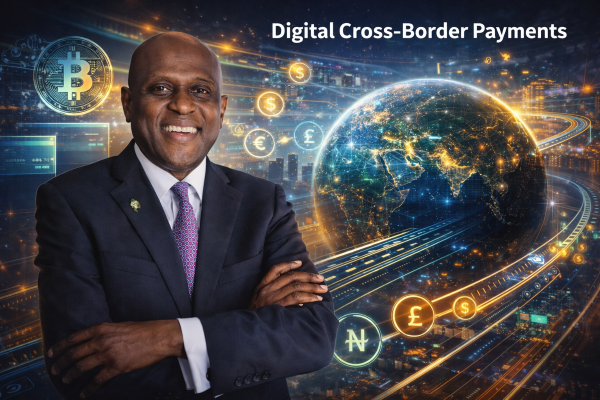
 The architecture of global finance is being quietly rewritten — not in treaty rooms, but in payment rails, digital wallets, stablecoins and real-time settlement systems.
At the 2026 Technical Group Meeting of the Intergovernmental Group of Twenty-Four (G-24) in Abuja, Olayemi Cardoso, Governor of the Central Bank of Nigeria (CBN), framed cross-border payments as the emerging backbone of the international monetary and financial system.




But he also delivered a strategic warning: if digital cross-border systems and stablecoins expand without coordinated regulation, emerging markets risk losing monetary sovereignty, exchange-rate stability and policy control.
This is no longer a technical payments debate. It is a structural question about who controls the pipes of global finance.
The Structural Frictions in Global Payments
For developing economies, cross-border payment inefficiencies are not abstract inconveniences — they are macroeconomic constraints.
Cardoso noted that global remittance corridors still cost more than six percent on average, settlement delays stretch over days, and compliance burdens exclude micro, small and medium enterprises (MSMEs) from global trade.
For G-24 economies, this translates into:
- Higher remittance costs for diaspora communities
- Expensive foreign exchange transactions
- Fragmented settlement processes
- Barriers to MSME participation in international trade
In a world where capital mobility defines competitiveness, payment friction becomes a development tax.
“An economy cannot be more inclusive than its payment system,” Cardoso argued, underscoring that financial inclusion begins with the ability to move money efficiently and safely across borders.
Digital Innovation: Opportunity and Systemic Risk
Digital infrastructure now offers a historic opportunity to correct these distortions.
Interoperable platforms, instant payment systems, distributed ledger technology and digital identity frameworks can:
- Reduce remittance costs
- Shorten settlement cycles
- Improve transparency and auditability
- Expand formal financial participation
Examples globally include India’s UPI integration with Singapore and the UAE, and Brazil’s PIX, which rapidly achieved mass adoption.
However, Cardoso cautioned that rapid expansion of private digital platforms and stablecoins raises serious concerns:
- Currency substitution
- Weakened monetary transmission
- Increased FX volatility
- Capital flow pressures
Without coordination, digital cross-border payments systems could entrench dominant currencies and platforms, undermining emerging economies’ ability to safeguard monetary sovereignty.
In essence, payment innovation without governance can amplify financial fragility.
Nigeria’s Strategic Response
Nigeria has moved deliberately to modernise its payment ecosystem.
In June 2025, the CBN launched the National Payment Stack, built on ISO 20022 messaging standards, designed for multi-currency and cross-border functionality.
The apex bank has also strengthened AML/CFT controls in line with FATF standards, including dual screening of cross-border transactions.
Diaspora-facing reforms — including the Non-Resident Nigerian Ordinary Account (NRNOA), Non-Resident Nigerian Investment Account (NRNIA) and a non-resident BVN platform — have expanded access for Nigerians abroad.
Remittance inflows now average approximately $600 million monthly, with a near-term target of $1 billion per month.
Cardoso further highlighted regional initiatives such as the Pan-African Payment and Settlement System (PAPSS), which reduces reliance on correspondent banking networks while supporting intra-African trade under the AfCFTA framework.
Multi-central bank digital currency experiments such as mBridge and Dunbar also signal an emerging shift toward local-currency settlement models.
The Geopolitical Dimension
Speaking at the same forum, Wale Edun, Nigeria’s Minister of Finance, emphasised the rising fragility in global growth, warning that economic fragmentation could reduce global output by up to two percentage points and shrink global trade by more than two percent.
Africa accounts for roughly 17 percent of global population but only about three percent of global trade — a structural imbalance that digital payments reform could either help correct or deepen.
Meanwhile, Iyabo Masha, Director of the G-24 Secretariat, cautioned that Emerging Markets and Developing Economies (EMDEs) face tightening policy space amid rising volatility, elevated debt burdens and fragile capital conditions.
Against this backdrop, payment reform is not peripheral — it is foundational to development financing and macro stability.
Implications for Markets and Policy
For central banks, the digital transition demands proactive leadership.
If cross-border systems are shaped by private platforms alone, the risks include:
- Entrenched dollarisation
- Regulatory arbitrage
- Volatile capital flows
- Reduced policy autonomy
If, however, central banks design interoperable, resilient and rule-based frameworks, digital payments can become a public good.
For investors, the signals are clear:
- Countries modernising payments infrastructure will attract capital more efficiently.
- Those failing to protect monetary sovereignty risk volatility premiums.
For MSMEs and households, efficient payments infrastructure directly translates into lower costs, faster trade cycles and expanded opportunity.
BRANDECONOMY Insight
The future of monetary power will be determined less by interest rates and more by payment rails.
Control over cross-border settlement infrastructure is emerging as the new frontier of financial sovereignty.
Cardoso’s intervention signals that Nigeria intends to shape — not merely adopt — the next architecture of global finance.
If digital cross-border payments are embedded within cooperative Bretton Woods reform discussions, developing economies can rebalance their role in global monetary governance.
If not, fragmentation could harden around dominant currencies and private digital platforms.
The stakes are existential:
Payment infrastructure is becoming geopolitics by other means.
Forward Outlook
Three scenarios define the road ahead:
- Coordinated Reform
Central banks collaborate on interoperable frameworks, strengthening sovereignty and lowering costs. - Platform Dominance
Private stablecoin ecosystems scale rapidly, eroding monetary control in emerging markets. - Fragmented Architecture
Jurisdictional silos raise compliance costs and reinforce global financial asymmetry.
Nigeria’s Payment System Vision 2028 suggests a proactive stance — modernisation anchored in regulation, resilience and inclusion.
The question now is whether G-24 economies can collectively shape the architecture of digital cross-border finance before it shapes them.