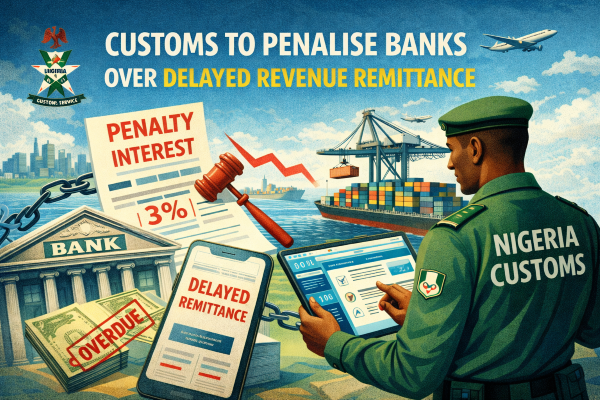
Nigeria’s port revenue architecture is entering a stricter compliance era as the Nigeria Customs Service (NCS) signals its readiness to penalise designated banks that delay the remittance of customs collections, reinforcing accountability across the maritime revenue value chain.
The warning, issued by the Comptroller-General of Customs, Bashir Adewale Adeniyi, marks a decisive escalation in enforcement under the Service Level Agreement (SLA) governing the relationship between Customs and its collecting banks.




Why Customs Is Tightening the Screws
Following reconciliations carried out on B’odogwu, the NCS’s digital revenue platform, Customs identified instances where some designated banks failed to remit collected revenues within prescribed timelines.
According to the Service, such delays constitute a direct breach of contractual obligations, with wider implications for the efficiency, transparency and credibility of government revenue administration, particularly at a time when port reforms and automation are central to Nigeria’s Blue Economy ambitions.
Under the SLA, timely remittance is not optional—it is a core obligation.
Penalty Framework: What Defaulting Banks Face
Customs has outlined a clear financial deterrent for non-compliance. Any designated bank that delays remittance will now attract penalty interest calculated at three per cent above the prevailing Nigerian Interbank Offered Rate (NIBOR) for the duration of the delay.
Affected banks will receive formal notifications detailing the delayed sums, applicable penalties and timelines for settlement.
More critically, the NCS warned that persistent or repeated breaches could trigger additional regulatory and administrative sanctions, as provided under the SLA and applicable laws governing customs revenue collection.
Zero Tolerance for Unauthorised Accounts
Beyond delays, Customs drew a red line on revenue diversion. Any payment of collected customs revenue into unauthorised accounts—whether by error or intent—will be treated as a serious violation, attracting sanctions under both contractual and legal frameworks.
Designated banks have therefore been advised to strengthen internal controls, tighten reconciliation processes and ensure strict adherence to remittance timelines.
What This Means for Ports, Trade and the Blue Economy
Customs revenue sits at the heart of Nigeria’s maritime economy—funding infrastructure, border security and trade facilitation. Delays in remittance disrupt cash flow predictability, weaken fiscal planning and undermine confidence in port reforms.
By enforcing SLA provisions, the NCS is effectively extending automation discipline beyond terminals and Customs commands into the banking system, ensuring that digitisation gains are not lost to legacy practices.
This move also aligns with broader efforts to standardise port processes, reduce leakages and improve Nigeria’s trade competitiveness.
BRANDECONOMY Insight
This is not merely a banking compliance issue—it is a system integrity play. As Customs modernises through platforms like B’odogwu, weak links are no longer tolerated. Banks have long operated as silent intermediaries in port revenue flows; Customs is now making it clear that intermediation comes with enforceable accountability. In a reformed port ecosystem, delays equal distortions—and distortions now come at a cost.