Apapa Port Goes Digital as Customs Nears End of Physical Cargo Checks

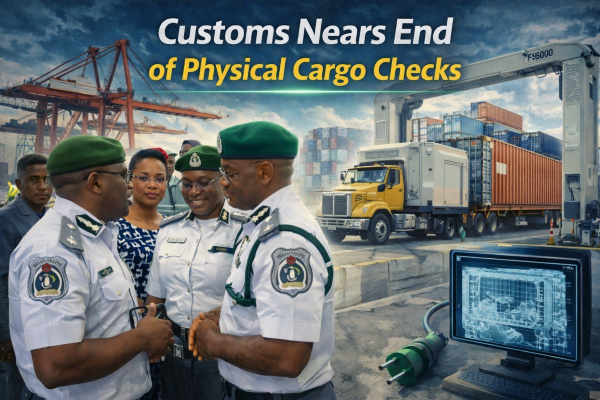
Nigeria’s busiest port is on the brink of a long-awaited operational breakthrough as the Nigeria Customs Service (NCS) moves decisively to phase out physical cargo examination at Apapa Port, replacing it with a fully scanner-driven, non-intrusive inspection regime.
At the centre of this transition is the deployment of the FS6000 high-capacity cargo scanner at APM Terminals Apapa, a move widely seen as a structural reset for trade facilitation, port efficiency, and Nigeria’s blue economy ambitions.




From Manual Bottlenecks to Digital Throughput
The momentum follows a technical inspection visit by the Deputy Comptroller-General in charge of ICT, Oluyomi Adebakin, who assessed the scanner’s operational readiness after a series of final test runs and simulation exercises.
According to Customs, the FS6000 scanner has now completed its pre-deployment validation phase, signalling readiness for full-scale operations at Apapa—Africa’s most congested container gateway.
The goal, Customs officials say, is a paperless, non-intrusive clearance system aligned with international best practice.
Why This Matters for Nigeria’s Ports
Physical cargo checks have long been one of Apapa’s most persistent pain points—slowing clearance, increasing dwell time, driving up demurrage costs, and exposing cargo to damage and discretionary abuse.
From a maritime economics perspective, manual examination is no longer compatible with high-volume ports competing in a global logistics environment defined by speed, predictability, and data.
The FS6000 scanner changes the equation.
With a throughput capacity of about 200 containers per hour, the scanner is designed for high-density port operations, enabling Customs to:
- Inspect cargo without opening containers
- Reduce human contact and discretion
- Shorten clearance timelines
- Protect cargo integrity
- Improve revenue assurance through better risk profiling
Readiness at 80%, Full Take-Off Imminent
Adebakin disclosed that overall preparedness for scanner-based operations stands at about 80 per cent, with outstanding components already being addressed.
She emphasised that scanner deployment is a shared responsibility, involving Customs, terminal operators, and the Trade Modernisation Project—underscoring the multi-stakeholder nature of port reform.
“This is a critical step in modernising customs operations at the nation’s busiest port,” she said, assuring port users of faster clearance, lower demurrage, and improved compliance.
Apapa as the Blue Economy Test Case
For the Apapa Port, this transition is more than an operational upgrade—it is a reputational reset.
As Nigeria pushes to unlock value from its blue economy, ports like Apapa must evolve from congestion hotspots into efficient trade gateways capable of supporting:
- Export-led growth
- Manufacturing supply chains
- Regional transit trade
- AfCFTA competitiveness
Non-intrusive inspection is a baseline requirement in modern ports from Rotterdam to Singapore. Its absence at Apapa has long been a drag on Nigeria’s logistics credibility.
Customs Signals Reform Continuity
The Customs Area Controller at Apapa, Emmanuel Oshoba, reaffirmed the command’s commitment to ICT-driven reforms and close collaboration with stakeholders.
He described the scanner deployment as proof of Customs’ resolve to modernise port operations, strengthen transparency, and deepen trade facilitation—a signal to importers, exporters, and shipping lines that reform momentum is real.
BRANDECONOMY Insight
Ending routine physical cargo checks at Apapa is not just about speed—it is about changing the logic of port control from muscle to metadata.
Scanner-led inspection represents a shift toward risk-based enforcement, where intelligence and technology—not congestion and delay—become the primary tools of revenue protection and border security.
If fully implemented and sustained, Apapa’s scanner transition could mark the beginning of a broader port renaissance—one where Nigeria’s gateways finally start working at the speed of global trade, not against it.