CPPE Rejects Sugar Tax Proposal, Warns of Economic Risks to Nigeria’s Beverage Industry
A Firm Rejection Amid Policy Crosscurrents

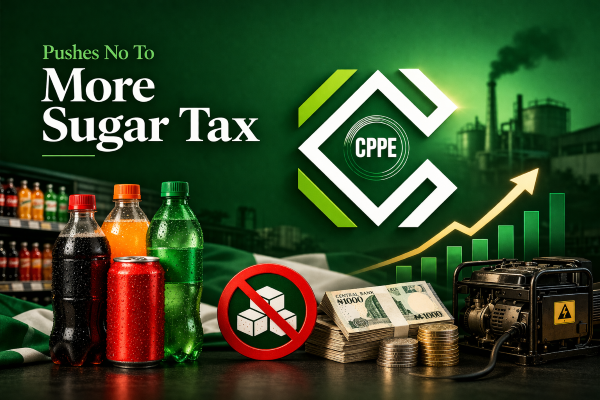 Nigeria’s fragile economic recovery has collided with a contentious fiscal proposal—one that could reshape the country’s consumer goods landscape – an upward review of the sugar tax.
The Centre for the Promotion of Private Enterprise (CPPE) has categorically rejected calls for an additional sugar tax on beverages, warning that the move risks destabilising one of Nigeria’s most critical manufacturing segments at a time when the economy is only just regaining its footing.




At issue is not merely taxation, but policy coherence, investor confidence, and the delicate balance between public health advocacy and economic sustainability.
Contextual Background: Reform Agenda Meets Sectoral Pressure
The Federal Government’s ongoing tax reform agenda is designed to:
- Reduce inefficiencies
- Improve compliance
- Stimulate private investment
Against this backdrop, CPPE argues that introducing new taxes—particularly on an already pressured sector—would contradict the very spirit of reform.
Dr. Muda Yusuf (Founder, CPPE) frames the concern bluntly:
“At a time when the Nigerian economy is still navigating a fragile recovery, imposing new taxes on an energy-intensive segment such as the sugar-sweetened beverage industry would be counterproductive to growth, employment and investment.”
Core Analysis: Why CPPE is Pushing Back
1. A Sector Already Under Strain
Nigeria’s beverage industry operates within a high-cost production environment, where energy remains the single biggest constraint.
From pasteurisation to carbonation and packaging, production cycles depend heavily on diesel-powered generation, exposing manufacturers to volatile energy costs.
Layered onto this are:
- Exchange rate pressures
- Rising logistics costs
- Weak consumer purchasing power
The result has been stark:
- Over 50% increase in beverage prices in two years
- Declining sales volumes across key categories
Adding another tax, CPPE argues, would amplify cost pressures and accelerate demand contraction.
2. Jobs, Supply Chains, and Industrial Spillovers
The beverage sector is not a narrow vertical—it is a strategic economic ecosystem.
It supports:
- Agricultural inputs (sugar, fruits)
- Manufacturing and processing
- Transport and logistics networks
- Retail distribution and hospitality
A tax-induced contraction could trigger:
- Production cuts
- Closure of SMEs within the value chain
- Widespread job losses
“At a time of high unemployment and underemployment, such policy measures could worsen socio-economic conditions,” Yusuf warned.
3. Policy Consistency and Investor Signals
Beyond immediate economics lies a more strategic risk: policy credibility.
Nigeria is actively courting capital—both domestic and foreign. However, frequent or contradictory fiscal interventions could:
- Undermine investor confidence
- Signal regulatory unpredictability
- Slow capital inflows into manufacturing
For long-term investors, consistency is as critical as reform itself.
4. The Public Health Argument—And Its Limits
Proponents of sugar taxation argue it can curb rising cases of diabetes and other non-communicable diseases.
CPPE does not dismiss these concerns—but challenges the effectiveness of taxation as a standalone solution.
Yusuf notes that:
- Health outcomes are shaped by diet, lifestyle, and physical activity
- Global evidence on sugar taxes remains inconclusive
Instead, CPPE advocates:
- Public health education campaigns
- Preventive healthcare access
- Industry collaboration on healthier alternatives
Implications: A High-Stakes Policy Decision
For Government
The rejection highlights a fundamental tension:
- Revenue generation and health policy goals
- Versus industrial growth and employment preservation
Navigating this requires sequenced, evidence-based policymaking.
For Industry
The message is clear:
➡️ Businesses must brace for policy volatility even amid reform cycles.
For Consumers
In practical terms:
➡️ Additional taxes would likely translate to higher retail prices, further eroding already strained household budgets.
Forward Outlook: Reform Requires Precision, Not Pressure
Nigeria’s economic transition demands more than bold policies—it requires timing, alignment, and strategic restraint.
The CPPE’s rejection of the sugar tax proposal is, in essence, a call for:
- Policy coherence
- Industrial sensitivity
- Balanced reform execution
The broader question now is whether Nigeria can design fiscal interventions that protect both public health and economic momentum—without sacrificing either.
BRANDECONOMY Insight
The sugar tax debate is not just about beverages—it is a stress test of Nigeria’s reform philosophy.
➡️ Will policy prioritise short-term fiscal gains, or
➡️ Safeguard long-term industrial competitiveness?
Emerging economies that succeed in this balancing act adopt:
- Predictable tax regimes
- Collaborative policymaking with industry
- Integrated health and economic strategies
Nigeria stands at that crossroads.
Handled well, this moment could define a more mature, investment-friendly policy environment.
Handled poorly, it risks reinforcing the very uncertainty reforms are meant to eliminate. Besides, are Nigerians not unwittingly being made to pay too much on indirect taxation already?