Court Voids CBN’s Union Bank Takeover, Triggers Governance Reset and Market Uncertainty
A Legal Shock with Systemic Implications

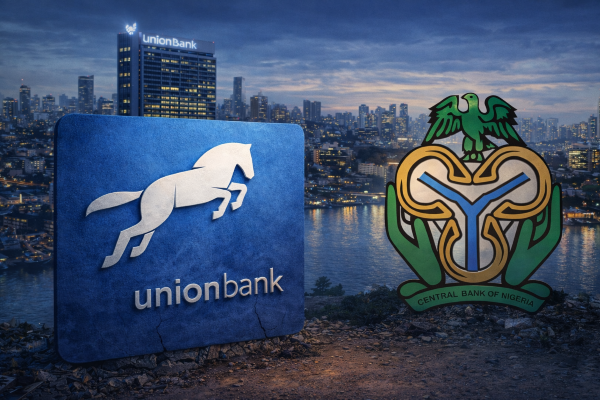 Nigeria’s financial system has been handed a rare and consequential judicial jolt. A Federal High Court ruling nullifying the Central Bank of Nigeria’s (CBN) intervention in Union Bank is not merely a corporate governance reversal—it is a defining moment in the evolving balance between regulatory authority, investor rights, and the rule of law.
At stake is more than the fate of a single bank. The judgment introduces fresh uncertainty into Nigeria’s ongoing banking sector recapitalisation drive, tests the limits of regulatory power, and forces investors to reassess governance risk across the financial system.




Context: Intervention, Ownership Disputes, and Regulatory Assertiveness
In January 2024, the CBN dissolved the board and management of Union Bank, citing supervisory concerns, and installed an interim leadership structure. The move reflected a broader regulatory posture aimed at safeguarding systemic stability amid sector reforms.
However, core shareholders—including Titan Trust Bank, Luxis International, and Magna International—challenged the intervention, arguing that it breached provisions of the Banks and Other Financial Institutions Act (BOFIA) 2020 and diluted shareholder rights without due process.
Their central contention: regulatory authority must operate within clearly defined legal boundaries, even in moments of systemic concern.
The Court’s Verdict: A Reversal of Regulatory Power
Justice Chukwujekwu Aneke’s ruling decisively sided with the shareholders, declaring the CBN’s actions ultra vires—beyond its statutory powers.
The court:
- Nullified the dissolution of Union Bank’s board and management
- Voided all decisions taken by the CBN-appointed leadership
- Ordered immediate reinstatement of the former board led by Farouk Mohammed Gumel
- Restrained the CBN from further actions, including recapitalisation and governance restructuring
In effect, the judgment rewinds nearly two years of regulatory intervention—creating a rare institutional reset in Nigeria’s banking sector.
Core Analysis: Power, Precedent, and Market Tensions
1. Regulatory Authority vs. Legal Boundaries
The ruling underscores a critical tension: while central banks must act swiftly to preserve financial stability, such actions must remain anchored in statutory legitimacy.
For Nigeria, this case establishes a precedent that regulatory discretion is not absolute—a signal likely to reverberate across future interventions.
2. Investor Confidence: Boost or Breach?
Paradoxically, the judgment cuts both ways for investor sentiment:
- Positive signal: Reinforces rule of law and protection of shareholder rights
- Negative signal: Introduces uncertainty about regulatory consistency and crisis-response capability
For foreign investors, the key question becomes:
Can Nigeria guarantee both regulatory stability and legal predictability simultaneously?
3. Recapitalisation Disruption
The timing is particularly sensitive. Nigeria’s banking sector is entering a recapitalisation cycle, with institutions expected to raise significant capital to support economic expansion.
The court’s restraining order halts:
- Ongoing investor selection processes
- Capital raising initiatives
- Advisory and underwriting engagements
This creates a potential pipeline disruption in capital markets, with ripple effects for investment banks, institutional investors, and deal timelines.
4. Governance Vacuum Risk
An immediate concern is operational continuity:
- Which board holds legitimate authority?
- Can the reinstated board seamlessly resume control?
- What happens to decisions already taken under the interim structure?
This creates a short-term governance ambiguity risk, particularly for:
- Credit approvals
- Regulatory filings
- Strategic transactions
Implications: Business, Markets, and Policy
For the Banking Sector
- Heightened legal scrutiny of regulatory interventions
- Increased caution in board restructuring and supervisory actions
- Potential delays in capital raising across the industry
For Capital Markets
- Temporary slowdown in banking-related deal flow
- Elevated legal risk premiums
- Greater emphasis on governance due diligence
For Policymakers
- Urgent need to clarify CBN’s intervention powers under BOFIA
- Possible legislative refinement to prevent future ambiguity
- Pressure to align regulatory agility with legal robustness
For Investors
- Repricing of Nigerian banking assets based on governance risk
- Increased focus on minority shareholder protections
- Strategic pause on capital commitments pending clarity
Forward Outlook: Three Scenarios to Watch
1. Legal Escalation
The CBN is likely to appeal the ruling. A higher court decision could either:
- Reinforce regulatory authority
- Or further constrain intervention powers
2. Policy Reset
Expect potential regulatory and legislative clarifications, especially around:
- Bank resolution frameworks
- Emergency intervention thresholds
3. Market Stabilisation vs. Volatility
In the near term:
- Short-term volatility in sentiment and deal-making
- Medium-term stabilisation if clarity emerges
BRANDECONOMY Insight
This ruling is less about Union Bank and more about Nigeria’s institutional maturity.
For years, Nigeria’s financial system has been defined by strong regulatory intervention but weaker legal contestation. This judgment signals a shift toward a more balanced ecosystem—where law, not discretion, is the final arbiter.
However, markets thrive on certainty. The immediate effect is not stability—but ambiguity.
The real test lies ahead:
- Can Nigeria design a framework where regulators act decisively and legally?
- Can investors trust both the system and its safeguards?
If resolved correctly, this episode could strengthen Nigeria’s investment case.
If mishandled, it risks reinforcing perceptions of institutional fragility.