Industrial Courage, Reform by Confrontation, and Nigeria’s Long Road to Energy Sovereignty
Organisation: Dangote Group
Sector: Manufacturing, Energy, Infrastructure
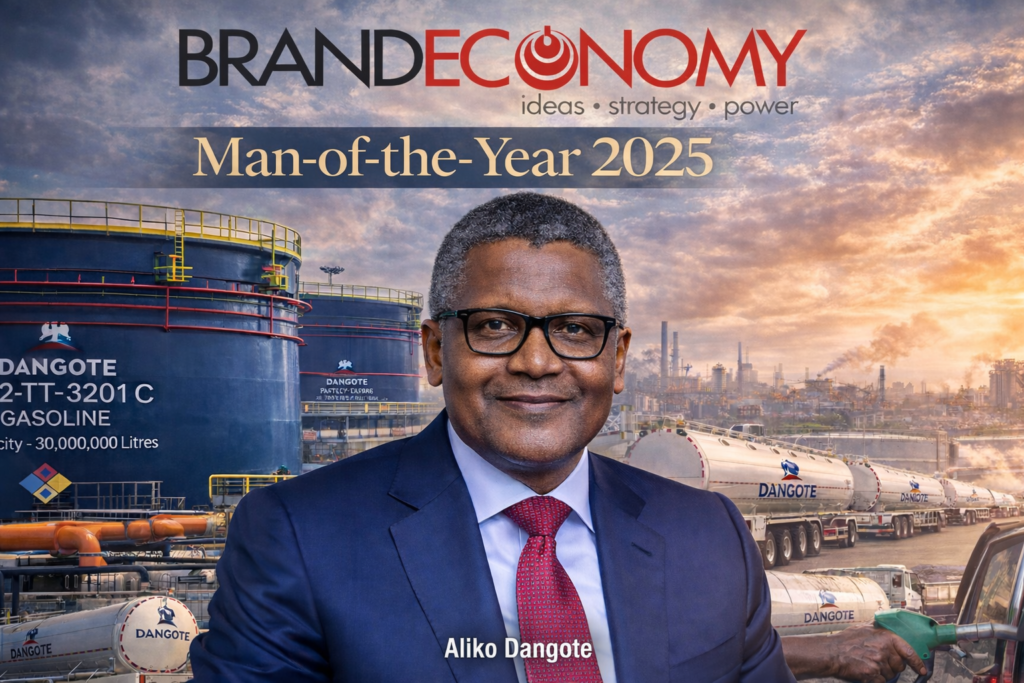
BRANDECONOMY Honour: Man of the Year 2025
Overall Ranking: #1
BRANDECONOMY Icon Score: 95 / 100

Introduction
Aliko Dangote embodies the epitome of the resilient and unrelenting spirit of the True Nigerian. Dangote has, for years stressed that Nigerian investors must take the lead and spearhead the charge to develop Nigeria to greatness, because as he puts it: “nobody will industrialise our country for us”. He argues that no foreign investor will come running to Nigeria with genuine investments if local investors do not believe in Nigeria and are not seen to be flourishing and thriving. He puts it aptly when he says importation is akin to “importing poverty and exporting jobs.”
Dangote has consistently put his money, time, assets and faith where his mouth is…the icing on the cake being the eye-popping $20 billion Dangote Refinery in Lagos that has not only positively disrupted the downstream sector in Nigeria but also reshaped the geo-political economies of West and sub-Saharan Africa.
Beyond the money, Aliko Dangote is the undisputable Man-of-the-Year for the spirited battle he had to execute even against those who should be supporting him, and how he has shown a new generation of Nigerians that they must believe in the power of their dreams for a greater Nigeria and must be ready to confront and conquer every obstacle and road-block thrust on their way to envisioned greatness. In fighting for the survival and success of Dangote Refinery, Aliko Dangote is winning the battle for Nigerian greatness through Energy sovereignty and huge forex savings despite the machinations of the infamous oil cabal.
The Aliko Dangote Story
The Measure of a Man in a Difficult Year
History is often kinder to outcomes than to the courage that precedes them. In 2025, Aliko Dangote earned BRANDECONOMY’s Man of the Year distinction not because his journey was smooth, but precisely because it was punishing, prolonged, and politically uncomfortable.
At a moment when Nigeria’s economy stood exposed—buffeted by foreign exchange volatility, fiscal realignment, subsidy removal aftershocks, and long-standing structural distortions—Dangote represented something increasingly rare in Nigerian capitalism: industrial resolve anchored in national consequence.
This was not a year for applause. It was a year for endurance.
The Refinery That Refused to Be a Metaphor
For decades, Nigeria’s refining deficit was discussed like a curse—an unfortunate but immutable reality of postcolonial mismanagement. Billions of dollars flowed out annually to import what the country already produced in abundance. Entire ecosystems of middlemen, traders, and rent-seekers flourished around this dysfunction. Reform was talked about, promised, postponed—and quietly abandoned.
Dangote chose confrontation.
The Dangote Refinery was never merely an industrial project; it was a direct challenge to a deeply entrenched political economy. By insisting on local refining at a scale never attempted on the African continent, Dangote questioned assumptions that many had learned to live with: that Nigeria could not execute complex industrial projects; that private capital should avoid long-horizon infrastructure; that reform must always wait for policy certainty.
In 2025, as the refinery edged closer to sustained operations, the debate shifted from if to how. That shift alone marks a historic turning point.
Capital at Risk, Not Capital at Ease
The defining feature of Dangote’s year was not market share or revenue figures—it was risk absorption.
In an environment where many Nigerian conglomerates prefer asset-light strategies, Dangote doubled down on capital-heavy, long-cycle infrastructure. The refinery consumed billions of dollars in financing, years of execution pain, and relentless scrutiny from regulators, critics, and competitors alike. Delays were amplified. Challenges were politicised. Motives were questioned.
Yet the project moved forward.
This willingness to place private capital in direct confrontation with structural inefficiency stands in sharp contrast to Nigeria’s prevailing business culture, where arbitrage often outperforms production. Dangote’s approach forced a national reckoning: if this fails, it fails loudly—but if it succeeds, it changes everything.
Why 2025 Belongs to Dangote
Some years reward applause. Others reward endurance. 2025 belongs to endurance—and to the rare industrialist willing to collide, repeatedly, with a system structured to resist change. In that year, Aliko Dangote emerged not merely as a successful businessman but as a consequential reformer by force of capital, scale, and persistence.
This is not a hagiography. It is a record of industrial courage—tested over two decades—finally yielding a structural shift in Nigeria’s energy economy. The Dangote Refinery’s steady march toward full operations in 2025 did more than add capacity; it reframed the nation’s relationship with petroleum, from importer dependence to domestic production and export of refined products.
The Long Arc: From Reversed Reforms to Relentless Return
To understand 2025, one must revisit an earlier inflection point. In the mid-2000s, Dangote—alongside other private investors—acquired stakes in Nigeria’s moribund refineries under a privatisation programme. That reform was reversed by the administration of Umaru Musa Yar’Adua, returning assets to state control. The reversal froze a rare opening for private-sector efficiency in downstream operations and re-entrenched a system already plagued by opacity and underinvestment.
For many, that episode would have closed the chapter. For Dangote, it reopened the argument—this time with a bolder premise: if the state could not reform refineries, private capital would build one from scratch, at scale.
Thus began a project that would take years, billions of dollars, and an unusual tolerance for pain: Africa’s largest single-train refinery, designed not only to meet domestic demand but to export refined petroleum products across West and Central Africa.
Risk Absorption as Reform Strategy
What distinguished Dangote’s 2025 was not revenue headlines but risk absorption. While many firms pursued asset-light strategies, Dangote doubled down on capital-heavy, long-cycle infrastructure—absorbing execution delays, regulatory friction, and reputational crossfire.
This posture exposed a deeper truth about Nigeria’s political economy: arbitrage often outperforms production. Import dependence created rents; rents created defenders. Dangote’s strategy—produce locally, at scale—threatened those rents.
Rather than seek applause, he relied on inevitability: scale, economics, and time.
The Cabal Question—and the Cost of Confrontation
No honest assessment of Dangote’s 2025 impact can ignore the resistance he faced. The fuel import ecosystem—long entrenched, deeply networked, and extraordinarily profitable—did not dissolve quietly. Regulatory delays, pricing debates, supply chain pushback, and narrative campaigns formed a persistent undertow against the refinery’s progress. Dangote faced intense resistance from a deeply entrenched (and corrupt) import ecosystem. That resistance manifested in pricing disputes, regulatory delays, supply-chain friction, and sustained narrative pressure.
What distinguished Dangote’s response was restraint.
Rather than wage public battles, he relied on scale, inevitability, and economics. By focusing on operational readiness and long-term pricing logic, he allowed reality to do the arguing. This strategic patience revealed a sophisticated understanding and effectictive counter-strategy under the circumstance.
Dangote’s response was notable for its restraint. He avoided populism and allowed operations to do the arguing. Yet he also did something unusual in Nigerian corporate life: he spoke plainly about structural corruption.
He alleged that dirty fuel imports—off-spec products—had long entered the country, imposing hidden costs on consumers and infrastructure, and that regulatory capture sustained the practice. These were allegations, but they resonated because they matched lived experience.
Regulatory Turbulence and a National Reset
The downstream debate intensified in 2025 amid controversies surrounding leadership at Nigeria’s petroleum regulators. Public discourse included allegations of misconduct and governance failures involving senior officials—claims that were contested but politically consequential. In this climate, President Bola Ahmed Tinubu accepted the departures of the chief executives of the two key regulators—Nigerian Midstream and Downstream Petroleum Regulatory Authority and Nigerian Upstream Petroleum Regulatory Commission—and forwarded nominees for Senate confirmation to lead a reset: Saidu Aliyu Mohammed (NMDPRA) and Oritsemeyiwa Eyesan (NUPRC).
These developments did not validate any single allegation; they signalled a policy intention—to restore confidence, credibility, and operational alignment across Nigeria’s petroleum architecture. Crucially, the reset occurred as domestic refining capacity came onstream, altering the incentives that had long shaped downstream regulation.
Dirty Fuel, Clean Breaks, and the Power of Production
Dangote’s critique of “dirty fuel” imports struck a nerve because it framed corruption not as abstract morality but as measurable harm—to engines, to emissions, to costs. Whether every claim withstands forensic scrutiny is a matter for institutions; what matters historically is that domestic production changes the game.
When a nation refines locally:
- Quality control becomes enforceable at source.
- FX pressure eases structurally, not cosmetically.
- Subsidy leakage shrinks as pricing transparency improves.
- Exports of refined products become plausible, not aspirational.
By late 2025, Nigeria was no longer debating the idea of self-sufficiency; it was operationalising it.
Leadership Without Theatre
Throughout the turbulence, Dangote’s leadership remained untheatrical. He spoke sparingly, often technically—capacity utilisation, logistics, timelines. In a media environment that rewards spectacle, he chose credibility through execution.
This restraint mattered. It kept the argument anchored in systems, not personalities. And it underscored a philosophy too often absent in reform debates: proof beats persuasion.
The Cost of Being First—and Why It Matters
First movers at scale pay a premium. They absorb inefficiencies others will later avoid. Dangote paid that premium—in delays, cost overruns, and public scrutiny. But that is precisely why his role matters. Nigeria’s development constraint has never been ideas; it has been first movers willing to suffer.
Dangote accepted that burden.
Competition, Power, and the Next Questions
Celebration without scrutiny would be irresponsible. Legitimate questions remain:
- How will competition policy evolve in a liberalised downstream market?
- How should pricing power be balanced with consumer protection?
- What regulatory frameworks best align national interest with private scale?
These questions arise after capability exists. One cannot debate dominance without production. In that sense, Dangote’s refinery creates the conditions for better policy, not worse.
From Importer to Exporter: The Strategic Payoff
The clearest measure of 2025’s significance is Nigeria’s pivot from net importer of refined products to a credible exporter of petroleum spin-offs. That shift carries second-order benefits:
- Regional energy leadership
- Industrial clustering around petrochemicals
- Logistics, shipping, and port throughput gains
- A sturdier balance of payments
This is industrial sovereignty by accumulation, not decree.
What History May Say
If Nigeria consolidates this shift—sustaining domestic refining, enforcing standards, and exporting value-added products—history will trace a straight line to Dangote’s persistence. If challenges arise, the attempt itself will stand as the moment private capital refused complacency.
Either way, 2025 is the year industrial nationalism stopped being rhetorical.
BRANDECONOMY SCORECARD
| Pillar | Score |
| Economic Impact | 20 / 20 |
| Industry Influence | 20 / 20 |
| Leadership & Governance | 14 / 15 |
| Innovation & Future-Readiness | 14 / 15 |
| Brand & Cultural Power | 14 / 15 |
| Resilience & Risk Management | 13 / 15 |
| TOTAL | 95 / 100 |
BRANDECONOMY Editorial Verdict
Aliko Dangote did not wait for perfect conditions. He forced conditions to change. By confronting import dependence, exposing systemic weaknesses, and building capacity at scale, he helped Nigeria cross from dependency toward self-sufficiency—and into export relevance. Sovereignty, in the end, is built asset by asset.
BRANDECONOMY Man of the Year, 2025.