Abia’s Sports Economic Zone: Turning Talent into Industry
From Informal Craft to Formal Industry

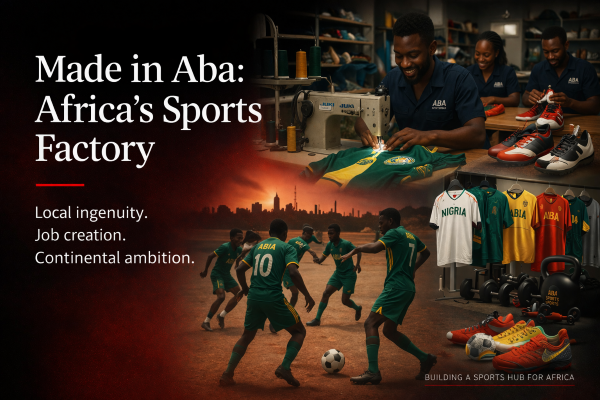 In a move that blends athletic ambition with industrial strategy, Abia State is positioning sport not merely as recreation—but as a viable economic frontier. The proposed Special Abia Sports Economic Zone, now at an advanced planning stage, signals a deliberate attempt to convert grassroots talent and artisanal heritage into structured value chains capable of generating jobs, exports and sustainable revenue.
Announced in Umuahia by the state’s Information Commissioner, Okey Kanu, the initiative is designed to industrialise a long-underestimated segment of Nigeria’s informal economy: sports merchandising. At its core lies a simple but potent thesis—that the craftsmanship of Aba’s famed leatherworkers, textile designers and footwear artisans can be repurposed into a continental hub for sportswear production.



From Informal Craft to Formal Industry
For decades, Aba has been synonymous with ingenuity—its artisans producing everything from shoes to garments that quietly supply markets across West Africa. Yet much of this activity has remained informal, fragmented and undercapitalised.
The proposed Abia sports economic zone seeks to change that. By clustering production, standardising quality, and linking artisans to broader supply chains, Abia aims to transform cottage industries into scalable enterprises. Football boots, gym equipment, jerseys and training kits—products typically imported at scale—could increasingly bear a “Made in Aba” imprint.
The ambition is not just substitution, but expansion: to serve Nigeria’s vast domestic market and tap into Africa’s fast-growing sports economy.
Sport as an Economic Asset
Globally, sport is big business—spanning broadcasting rights, merchandising, infrastructure and talent management. Abia’s model focuses on a less glamorous but highly lucrative segment: manufacturing and merchandising.
This approach reflects a deeper understanding of development economics. While elite sports often attract headlines, it is the surrounding ecosystem—kits, equipment, branding, licensing—that sustains long-term value creation.
By formalising this ecosystem, Abia is effectively building a sports-industrial cluster—one that could:
- Create employment across production, logistics and retail
- Expand internally generated revenue through taxation and licensing
- Stimulate SME growth in fashion, leather and creative industries
Youth Employment at the Centre
The state’s strategy is also a response to one of Nigeria’s most pressing challenges: youth unemployment. By aligning sports with enterprise, the initiative provides alternative career pathways beyond professional athletics.
Complementing the zone is a forward-looking partnership with Ogbonnaya Onu Polytechnic, which now offers a National Diploma in Sports Management. The programme reflects a shift from viewing sport as a short-lived career to treating it as a lifelong industry.
Graduates are expected to populate emerging roles in:
- Sports management and administration
- Physiotherapy and sports science
- Sports psychology and performance analytics
This integration of education and industry could prove critical in sustaining the ecosystem beyond its initial phase.
Early Signals from the Field
Abia’s recent performances in regional sporting events—ranging from dance competitions to emerging sports like Teqball—offer symbolic validation of its renewed focus on youth and sports development.
Yet the real test will lie not in medals, but in markets: whether the state can convert competitive energy into commercial output.
The Bigger Play: Africa’s Untapped Sports Economy
Africa’s sports economy remains largely underdeveloped relative to its demographic strength. With a youthful population and growing urban middle class, demand for sportswear, fitness products and recreational infrastructure is rising rapidly.
If executed effectively, Abia’s Special Sports Economic Zone could serve as a prototype for subnational industrialisation—leveraging local strengths to compete in continental value chains.
The challenge, as always, will be execution: infrastructure, financing, quality control, and access to regional markets.
BRANDECONOMY Insight
- Aba’s Industrial Reawakening
This initiative could mark a turning point in Aba’s evolution—from an informal manufacturing hub to a structured industrial cluster. Formalisation will unlock credit access, improve standards, and attract investment. - Import Substitution Meets Export Ambition
Nigeria imports billions of naira worth of sportswear annually. Local production offers immediate substitution benefits, while positioning Abia to compete in the African Continental Free Trade Area (AfCFTA). - Youth Employment Through Value Chains—not Tokenism
Unlike short-term empowerment schemes, this model embeds youth within a functioning economic ecosystem—production, distribution, and services—ensuring sustainability. - Sports as a Development Lever
Abia’s strategy reframes sports from entertainment to economic infrastructure—aligning with global trends where merchandising and licensing drive the bulk of industry revenues. - Replicability Across Nigeria
If successful, the model could be replicated in other states—Kano (textiles), Ogun (manufacturing), Lagos (creative industries)—creating decentralised industrial growth.