7.5% VAT on E-Banking: Why Customers Want CBN to Rein in Bank Charges

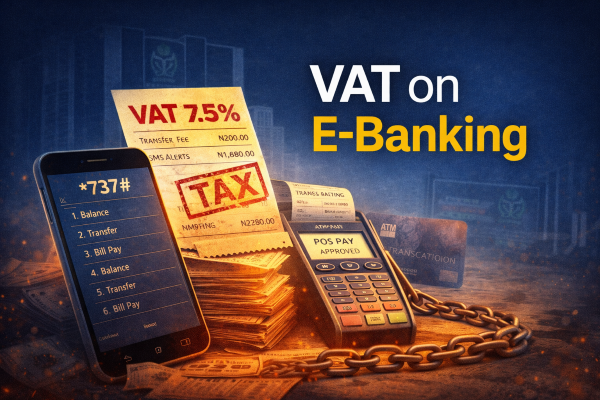
Nigeria’s push to widen its tax net has collided with everyday banking realities, as customers push back against the 7.5% Value Added Tax (VAT) applied to selected electronic banking services. While the tax is legally chargeable on service fees—not transferred amounts—users say the stacking of levies is eroding trust, discouraging formal banking usage, and worsening cost-of-living pressures.
Across Abuja and other cities, customers are now urging the Central Bank of Nigeria to step in—not to repeal the tax, but to ensure banks do not exploit VAT remittance as cover for excessive or opaque charges.




What the VAT Covers—and Why It Hurts
The directive—issued by the Nigerian Revenue Service—requires financial institutions to collect and remit VAT on banking service fees tied to digital transactions. These include mobile transfers, USSD transactions, card issuance and activation, POS fees, and loan processing/documentation charges. The VAT applies only to the service fee, not the principal amount.
In theory, the framework is standard. In practice, customers say the cumulative effect—VAT layered atop stamp duties, electronic money transfer levies, card maintenance fees, SMS alerts and NIP charges—has become punitive.
Customers Speak: “We’re Paying Too Much for Too Little”
Evelyn Oputa, a bank customer in Abuja, says the charges are outpacing household incomes.
“In December alone, I was charged ₦1,680 for SMS alerts. This month, stamp duty also increased,” said Evelyn Oputa, Bank Customer.
“I bought something and still paid stamp duty, NIP transfer, electronic money transfer levy, card maintenance fee—and now VAT. We, the customers, are always at the receiving end.”
Another customer, Akolam Nzeh, questions the balance between revenue collection and citizen welfare.
“It feels like everything is tax now. Salaries haven’t increased, but bank charges keep rising,” said Akolam Nzeh, Bank Customer.
“If these taxes must be collected, they should translate into better infrastructure.”
Segun Agboola, also a customer, called on the CBN to actively monitor bank billing practices to prevent overcharging.
The Banking View: VAT Is Not a Windfall
A senior banker, speaking anonymously, insisted banks have no incentive to exploit customers under the VAT regime, noting that the tax is a pass-through obligation.
That may be true—but customers argue that clarity and restraint are essential when multiple charges converge on small transactions, especially for low-income users who rely heavily on USSD and mobile banking.
The Regulatory Imperative: Transparency Over Tension
For regulators, the issue is not whether VAT is lawful—it is. The issue is how it is implemented. Best practice demands:
- Clear, itemised billing that separates VAT from bank charges
- Uniform fee caps to prevent arbitrage and “charge creep”
- Consumer education on what VAT applies to—and what it does not
- CBN oversight to ensure compliance without exploitation
Without these, there is a real risk of financial exclusion, as users revert to cash to avoid fees—undermining Nigeria’s digital payments strategy.
BRANDECONOMY Insight
VAT on banking services is defensible in a revenue-constrained economy. What is indefensible is opacity. As taxes and fees accumulate, trust becomes the scarce currency. The CBN’s role is pivotal: enforce transparency, cap excesses, and protect consumers—so taxation strengthens the system rather than driving users away from it.